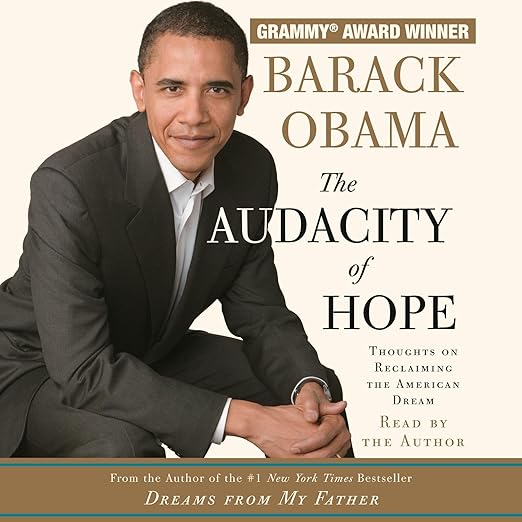
I listened to The Audacity of Hope in two sessions, one long evening and one Sunday morning, which gave the book a kind of compressed intensity it might not have if I had stretched it over weeks. Published in 2006, when Obama was a senator from Illinois and not yet a declared presidential candidate, it reads now as a document of a specific political moment and a specific version of its author: the Obama before the weight of the office, before the compromises and frustrations and erosions of two terms had done their work on whatever he believed when he wrote this.
Obama narrates his own audiobook, as he did with Dreams from My Father, and the narration is essential rather than supplementary. His voice is inseparable from the text's argument. He is making a case for a particular kind of politics, rooted in faith, in the capacity for connection across difference, in what he calls the "audacity" of believing that democratic self-governance can still work, and that case is more persuasive in his voice than it would be in anyone else's, not because of charm or celebrity but because of the specificity of his own position within the American story he is trying to tell.
What We Made of It
The book is primarily a policy book, as one careful reviewer noted, organized around the major policy domains of his senatorial work: constitutional values, faith and politics, foreign policy, race, the role of government. But the policy sections are framed by what makes the book unusual for its genre: Obama's genuine candor about his own ambivalence, his recognition that many of the questions he is addressing do not have clean answers, his willingness to credit the coherence of positions he does not hold.
This is a book that takes political difference seriously rather than treating it as error or bad faith. That quality has not aged well in one sense, the political conditions he was describing in 2006 have shifted so significantly that some of his optimism reads as period-specific rather than principled, but it makes the book more interesting as a document, not less. The contrast between his 2006 account of what American politics could be and what it subsequently became is itself a kind of historical record.
The Best Parts of The Audacity of Hope
At six hours and ten minutes, this is one of the most compact serious political audiobooks available, which makes it appropriate for a single focused listen or a short week of commuting. Obama's pacing as a narrator is deliberate, he does not rush, and there are moments where his delivery of his own prose sounds like someone discovering the sentences slightly ahead of the listener, which gives even familiar passages a quality of genuine consideration.
The personal sections, his account of meeting Michelle, his reflections on fatherhood and the demands of public life, his description of settling into the Senate, are where the book breathes most freely. These sections are where the policy voice recedes and something more like a self-portrait emerges, and they are some of the most revealing minutes of the audiobook.
What Might Not Land
Pay attention to the chapter on faith, which is the most personally revealing section of the book and the one where Obama is most candid about the complexity of his religious life. He describes himself as a Christian who arrived at faith through intellectual conviction rather than inherited tradition, and his account of what faith means in political life, how it provides a moral vocabulary without justifying theocratic policy, is thoughtful enough to reward careful listening.
The foreign policy chapter, written before the full weight of what the Iraq War would mean had settled, reads differently now than it did in 2006. That temporal distance is worth noting rather than dismissing, it is part of what makes the book a historical document as well as a policy argument.
Who Should Listen to The Audacity of Hope
Listeners interested in Obama as a thinker rather than as a historical figure will find this the most direct access to that dimension of him, more direct, arguably, than either memoir because the policy context requires him to reason in public about things that are genuinely hard. Those curious about the pre-presidential Obama, the senator and former constitutional law professor who had not yet become the figure the presidency would make him, should start here rather than with the memoirs. Listeners seeking memoir narrative rather than policy argument will find Dreams from My Father a more comfortable entry point.