Quick Take
- Narration: Tom Pile reads B. Alan Wallace’s technical meditation guide with measured pacing that suits the instructional nature of the material.
- Themes: Shamatha meditation, stages of attention training, the intersection of Buddhist practice and Western science
- Mood: Methodical and absorbing, occasionally austere, but rewarding for the patient listener
- Verdict: The most serious and systematically organized introduction to shamatha practice available in audio form.
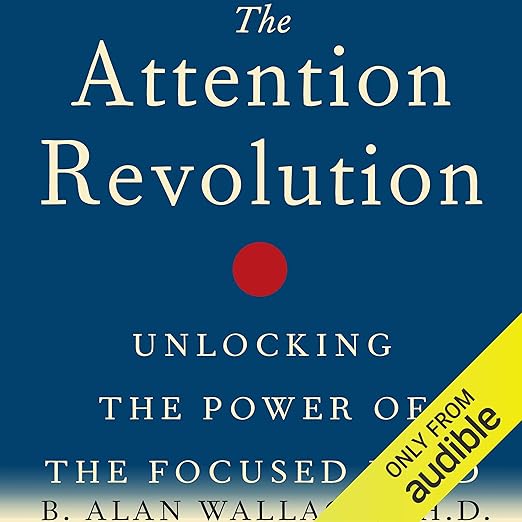
I came to The Attention Revolution at a moment when I had been meditating intermittently for about two years and had reached the point where I knew just enough to know how little I actually understood. I had done the apps, the guided sessions, the various accessible introductions that make up the popular market for mindfulness content. What I had not found was something that treated meditation as a genuine discipline with a mapped progression rather than a daily reset button. B. Alan Wallace’s book was described to me by someone with a serious practice as the real thing, and they were not wrong.
Wallace brings nearly thirty years of practice to this text, including retreat work under the Dalai Lama’s guidance, and he is positioned unusually well to speak to both the traditional Buddhist lineage from which shamatha comes and the Western scientific community that has been studying attention and consciousness for decades. That dual fluency is what makes The Attention Revolution different from the many books on meditation that occupy either the popular-wellness space or the academic-Buddhist studies space without connecting them.
The Nine Stages as a Genuine Roadmap
The core organizing structure of the book is the nine-stage model of shamatha practice drawn from traditional Tibetan Buddhist teaching. Wallace walks through each stage methodically, describing both the practical instruction for meditation at that stage and the phenomenological landscape that opens up as concentration deepens. The progression is ambitious: early stages involve simply learning to place and sustain attention without gross distraction. Later stages describe meditative states that require sustained retreat-level practice over years to access.
One reviewer noted a rather dry point of self-assessment after reaching stage two and finding no desire to commit to the twelve-hour daily practice that stage six apparently requires. Wallace is honest about what serious shamatha demands, and that honesty is both the book’s most valuable quality and the feature most likely to create some distance between the text and the average listener. He is not writing a book about feeling calmer. He is writing a book about a rigorous discipline with a defined pathway to what he describes as extraordinary clarity and power. The distinction matters.
The reviewer who noted that this is not a beginner’s book was making an accurate observation. Wallace himself is clear that new meditators might find the post-stage-two instruction mysterious or discouraging. The book is most productive for listeners who have some established practice and want to understand what they are working toward and where they currently sit on the progression. For that reader, it is genuinely illuminating.
Wallace’s Cross-Disciplinary Position
A reviewer who identified themselves as a physician wrote about Wallace’s ability to bridge Buddhist practice and scientific inquiry, which has been central to his academic career and public work including the widely discussed dialogues between Buddhist scholars and cognitive scientists. The Attention Revolution predates some of the more recent neuroscience research on meditation and attention, but its core arguments hold up: attention is a trainable faculty, the training has measurable effects, and the traditional Buddhist system for developing it is more systematic than anything Western psychology had developed independently at the time of writing.
Wallace addresses what one reviewer called continuous partial attention, the modern condition of perpetually diverted focus across multiple inputs, with more rigor and less sympathy than the popular attention-management genre tends to offer. He is not primarily interested in helping listeners manage their email more effectively. He is interested in a fundamentally different relationship with the workings of the mind, one that requires extended practice rather than technique adoption. Whether that is what you are looking for will shape your response to the book considerably.
Tom Pile and the Challenges of Instructional Audio
Tom Pile’s narration serves Wallace’s instructional prose with appropriate precision. The text is not driven by narrative momentum or emotional arc in the way that memoir or fiction is, and Pile’s measured delivery honors that. He does not inject energy the material is not asking for, which is the right call: the instruction-heavy sections require clarity over expressiveness, and the more philosophical passages benefit from a reader who treats them as serious ideas rather than interesting asides.
At just under seven hours, the audiobook is a manageable length for the depth of material it covers. Listeners who want to use it alongside an actual meditation practice will likely want to return to specific chapters rather than listening straight through, and the chapter structure accommodates that approach well.
Who Sits With This Book
The Attention Revolution is for listeners who take meditation seriously as a practice discipline rather than a stress management tool. Readers who have found most popular mindfulness books too shallow will find Wallace’s systematic treatment satisfying in ways those books cannot be. Those who are brand new to meditation and looking for a gentle introduction should start elsewhere. The book cited by reviewers most readily as a companion to this one is William James’s foundational work on attention and consciousness, which gives some indication of the intellectual register Wallace is operating in. This is not light listening, but for the right listener it is exactly what they have been looking for.
Frequently Asked Questions
Is The Attention Revolution appropriate for someone who has never meditated before?
Wallace himself cautions that beginners may find the post-introductory chapters disorienting. The book works best for listeners with at least several months of regular meditation practice who want a systematic framework for understanding where they are and where the practice can go.
What is shamatha, and how does it differ from mindfulness meditation?
Shamatha is a Tibetan Buddhist concentration practice aimed at developing stable, sustained attention. Wallace distinguishes it from mindfulness-based stress reduction and popular mindfulness practice, which he treats as related but less systematic. Shamatha in its full form is a rigorous discipline oriented toward deep meditative states.
Does the book address the practical challenges of building a serious meditation practice in daily life?
To some extent, but Wallace is candid that the highest stages of shamatha require intensive retreat practice that most Western practitioners cannot sustain. He addresses the early and middle stages in ways applicable to practitioners with limited daily practice time, while being honest about the demands of advanced development.
How does B. Alan Wallace’s perspective differ from other Buddhism-informed meditation teachers?
Wallace has participated in formal academic dialogues between Buddhist scholars and cognitive scientists, including extended collaborations with the Dalai Lama. He bridges traditional Tibetan Buddhist teaching and Western scientific frameworks more systematically than most popular teachers, making the book valuable for listeners interested in both the philosophical foundations and the empirical research.