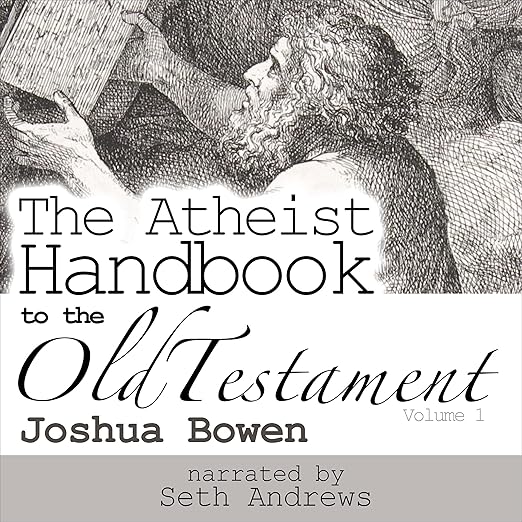
Quick Take
- Narration: Seth Andrews brings a broadcaster’s clarity and genuine intellectual enthusiasm to dense scholarly material, making the eleven-plus hours consistently accessible
- Themes: biblical scholarship vs. apologetics, textual authorship debates, moral critique of ancient religious law
- Mood: Rigorous and combative in the best sense
- Verdict: A rare nonfiction audiobook that succeeds as both a reference resource and a genuinely engaging listen, provided you come to it ready to engage with the arguments rather than simply absorb them.
I finished this one on a Tuesday evening after spending an afternoon trying to write about something completely different and failing. I had picked it up weeks earlier out of professional curiosity: as someone who reads widely across religion and its discontents, I wanted to see how a scholar with a declared agenda handles the tension between intellectual honesty and advocacy. By the time Seth Andrews finished reading the final chapter, I had filled half a notepad and turned down at least a dozen passages to revisit.
This is not a casual listen. It is also not a difficult one. That combination is rarer than it should be.
Scholarship First, Then the Argument
The reviewer Mark Lamourine makes a point worth foregrounding: Joshua Bowen has an agenda, it is in the title, and the book does not pretend otherwise. This is The Atheist Handbook, not The Neutral Scholar’s Survey. What Bowen does with that position is the interesting part. The reviewer C.C. Jones notes that most resource books written specifically for atheists are produced by well-read laypeople rather than field specialists, and that the rare scholarly voices tend to be writing for other scholars rather than for general audiences. Bowen closes that gap. He has the credentials and the accessible prose, and he uses both.
The material he covers is genuinely contested: the authorship of disputed Old Testament books, the textual and archaeological record around events like the Exodus, the historical context for passages about slavery and genocide that apologists and critics have been arguing about for decades. Bowen does not simply assert conclusions. He builds cases, cites the underlying scholarship, and then engages with the counter-arguments that defenders of the text typically deploy. The reviewer Veda Vaughn calls the level of detail outstanding, while also noting this is not for the casual atheist who wants a quick rebuttal. That is an accurate calibration.
Seth Andrews and the Challenge of Dense Material
Seth Andrews is best known as the creator of the podcast and community The Thinking Atheist, which means he arrives at this material with both personal investment and professional audio experience. The combination serves the text well. He does not editorialize beyond what the text demands. He does not perform the argument. He reads it with the kind of sustained attention that dense argumentative nonfiction requires, keeping the listener oriented through chapters that move from ancient Near Eastern archaeology to specific textual criticism without losing the thread.
The chapter on Ezekiel’s prophecy regarding Tyre drew criticism from at least one reviewer for repetitiveness in the source material itself. That repetition is present in the audio as well. Bowen makes his point about the failed prophecy multiple times from slightly different angles, and Andrews dutifully renders each iteration. It is the one section where I found myself wishing for an abridged version. Everything else moves with admirable precision.
What This Book Provides That Other Critiques Do Not
The most useful thing about this handbook is its orientation toward specific arguments. Bowen does not write in generalities. He writes for a listener who expects to find themselves in an actual conversation, at a dinner table, in a comment thread, with someone who believes the Old Testament’s difficult passages are being taken out of context. His goal, stated plainly, is to prepare his audience to engage from a position of strength. He does that by teaching the context rather than bypassing it. You leave this audiobook understanding more about the ancient Near East and the history of biblical textual transmission than you probably expected to when you started.
The reviewer ejrod13 says they learned a great deal about the culture, archaeology, and historical aspects of the Hebrew Bible, which captures the book’s secondary value accurately. Even if you never use a single argument in a debate, the historical and archaeological material is substantive enough to stand on its own as education.
Who Gets the Most from This Audiobook
This is genuinely for listeners who want to understand the scholarly ground beneath the cultural arguments about the Old Testament. If you are a skeptic who wants to be equipped for serious engagement rather than armed with talking points, this volume delivers. If you are a believer who wants to understand what rigorous critical scholarship actually looks like, this is also worth your time, though you will need to be comfortable with a text that does not pretend to neutrality.
At eleven hours and thirty-nine minutes, this is a significant time investment. It repays that investment for listeners who come prepared to think rather than simply consume. Volume 2 awaits those who want to go deeper.
A final note on format: at eleven hours and thirty-nine minutes, this is a long listen, but Bowen does not pad. Every section earns its length. If you work through this alongside Volume 2, you will emerge with a more substantive understanding of the Old Testament’s textual and historical problems than most people acquire in a lifetime of casual reading on the subject.
Frequently Asked Questions
Is this audiobook accessible to someone without a background in biblical studies or ancient Near Eastern history?
Yes, accessibility for general audiences is one of Bowen’s stated goals. The reviewer ejrod13 describes it as easy to follow and clear in its presentation of key issues in the Hebrew Bible. That said, the level of detail is substantial, and listeners who want a light introduction may find the depth more than they bargained for.
Does Joshua Bowen present only one side of the arguments, or does he engage with the apologetic responses?
Bowen explicitly engages with apologetic counter-arguments throughout. His stated purpose is to prepare readers to discuss these issues with people who will push back using standard apologetic defenses, so the book is structured around both presenting the critical position and addressing the responses it typically receives.
Why is Seth Andrews the narrator for this book specifically?
Seth Andrews is the founder of The Thinking Atheist podcast and community, making him a recognizable voice in the secular and skeptic community that forms Bowen’s target audience. His background in audio production and his familiarity with the subject matter make him a natural fit for narrating material this dense.
Does this volume cover the entire Old Testament, or only specific books?
Volume 1 focuses on key contested topics including authorship of disputed books, passages related to slavery and failed prophecy, and the archaeological and historical context of the ancient Near East. It is not a comprehensive survey of every Old Testament book. A second volume continues the coverage.