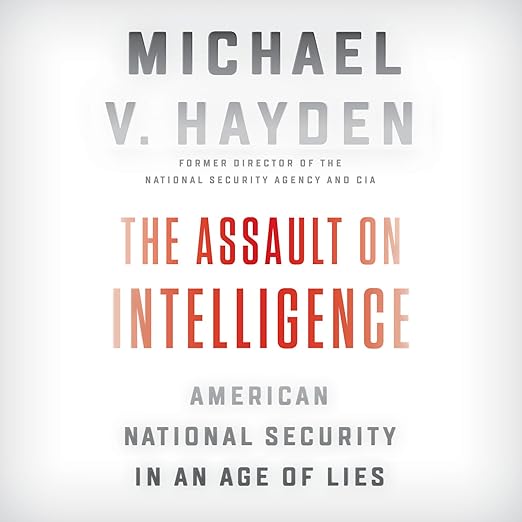
- Read by: Hayden reads his own book with the measured authority of a career intelligence officer, controlled, precise, and occasionally restrained to a fault, which actually suits the gravity of the argument.
- At its heart: Intelligence community accountability, post-truth politics, democratic erosion
- Vibe: Sobering and urgent, with the quiet anger of someone who has spent decades protecting institutions now watching them crumble
- Short version: If you want to understand what senior intelligence professionals saw happening to American democracy in real time, Hayden's insider account earns its place on any serious reading list.
General Michael V. Hayden spent decades at the highest levels of American intelligence, serving as Director of both the NSA and the CIA under multiple presidents. That career gives the audiobook version of The Assault on Intelligence, narrated by Hayden himself, a weight that few Washington critiques can match. This is not a cable-news pundit cataloguing talking points. It is a man who sat in the room, read the cables, and briefed the Commander-in-Chief on what foreign adversaries were doing to undermine the country he spent his life protecting. Listening to him describe what he witnessed in the early years of the Trump administration carries the particular chill of expertise refusing to look away. The audiobook format matters here precisely because Hayden's voice is not the voice of performance; it is the voice of institutional discipline brought to bear on a subject he finds genuinely alarming.
What We Made of It
The central argument Hayden builds is more nuanced than the blunt title suggests. He is not simply accusing a president of being unintelligent. He is diagnosing a broader epistemic collapse, what he calls the retreat from evidence, expertise, humility in the face of complexity, and a respect for ideas, and tracing how that retreat, accelerated by social media and political tribalism, made the American intelligence community both more essential and more vulnerable than it had ever been. He details the Russian information warfare campaign not as a conspiracy theory but as a documented reality that intelligence professionals had been tracking for years before it became a partisan flashpoint. His frustration that this evidence was not merely rejected but actively used to attack the messengers is palpable throughout, and the audiobook captures that frustration in the very flatness with which he delivers the most damning passages.
One reviewer noted that the book works best alongside Hayden's earlier Playing to the Edge, his history of the surveillance state under Presidents Bush and Obama. That context genuinely matters. The Assault on Intelligence assumes a reader who understands how the intelligence community is structured and what its analytic standards are. Hayden does not waste pages explaining how the CIA works. He goes straight to the deterioration he witnessed, which rewards informed listeners but can feel dense to those coming cold to the subject. The reviewer who called his writing "concise" is accurate; Hayden compresses a great deal of institutional knowledge into observations that can sound simple and are in fact precisely calibrated to say no more and no less than the evidence supports.
The Best Parts of The Assault on Intelligence
The self-narration is the right call here. Hayden's voice is not the voice of an entertainer; it is the voice of someone accustomed to briefing four-star generals and Cabinet officials, and it sounds like it. Deliberate, dry in places, occasionally understated in ways that make the content land harder than dramatic reading would. When he describes the President of the United States responding to intelligence assessments of Russian cyber operations not by ordering a response but by attacking the analysts, Hayden does not raise his voice. He does not need to. The factual accumulation does the work, and the steadiness with which he delivers it is itself a kind of argument about how intelligence professionals are trained to communicate: you do not save gravity for dramatic moments when every moment is already grave.
At 8 hours and 27 minutes, the audiobook is well-paced for its content. Hayden moves through North Korea's nuclear program, Russian active measures doctrine, and the structural vulnerabilities of American democracy without significant digression. The chapters on North Korea's weapons development are technical in places, and Hayden does not translate intelligence tradecraft into fully accessible language for the general public. But for listeners who want to understand these events from the inside rather than from partisan media coverage, that density is a feature. Reviewer Isaac's four-star assessment noted that Hayden stands out among intelligence-community critics for acknowledging legitimate concerns about government overreach, and that intellectual honesty, the willingness to indict himself and his institution alongside the political actors he is describing, keeps the book from collapsing into simple polemic.
What Might Not Land
The book is time-stamped in ways that matter. Hayden was writing as events unfolded, which means some of his concerns have since resolved in various directions and others have metastasized beyond what he anticipated. Listeners should engage with this as a primary document, a senior intelligence official's real-time assessment, rather than as finished historical account. The sections on North Korea read differently now than they did at publication, and the Russia interference chapters carry both the urgency of real-time alarm and the limitations of a writer who could not know what the subsequent years would produce.
The chapter addressing Russian information warfare is the strongest in the audiobook, both analytically and rhetorically. Hayden is specific about the techniques used, the scale of the operation, and why the American system was uniquely vulnerable to them in ways that go beyond any single political figure. He draws on his NSA background to explain signals intelligence in accessible terms without condescending to the listener. The fundamental question he keeps returning to, whether democracy can survive the systematic erosion of its epistemic foundations, is not answered, which reflects the genuine uncertainty Hayden felt and which the subsequent years have done nothing to fully resolve.
The Right Listener for The Assault on Intelligence
Listeners who follow national security policy seriously, who want primary-source testimony rather than punditry, and who can engage with dense material delivered at a measured pace will find this audiobook genuinely rewarding. Political independents who trust institutional expertise are the book's natural audience. Those looking for sharp partisan narrative will find Hayden's carefulness frustrating; he is too much the intelligence analyst to abandon complexity for a clean villain. Listeners who arrive expecting a general-audience explainer on how the intelligence community works should look elsewhere; Hayden assumes you know the architecture and is interested in what is failing within it. For those with the background to follow him, this remains one of the more precise and credible accounts of the period it covers.