Before You Press Play
- Read by: Eliza Foss brings a mature, controlled register already proven on Cameron's earlier audiobook The Listening Path, suiting this material's tone precisely.
- At its heart: creative recovery, Morning Pages and Artist Dates as daily practice, distilled self-help methodology
- Vibe: Encouraging and practical
- Short version: A well-narrated, genuinely useful companion for existing Artist's Way practitioners, though it is not a substitute for the full original program.
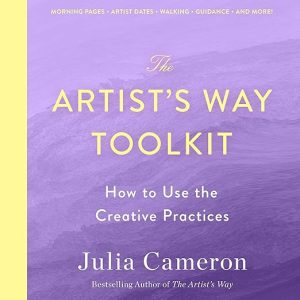
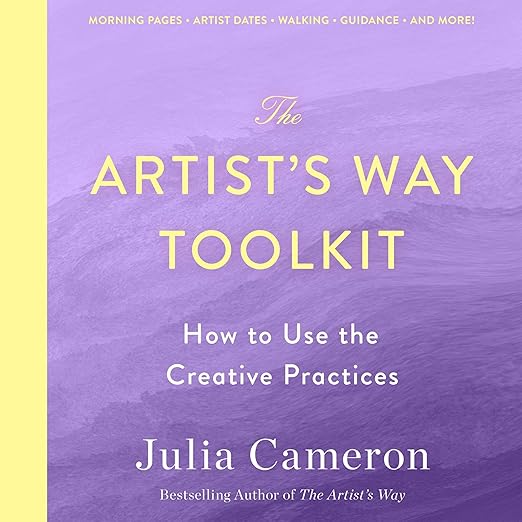
Can a four-hour audiobook actually distill a creativity method that has shaped nearly thirty years and five million readers since it first appeared? Julia Cameron built The Artist's Way around two now-famous practices, Morning Pages, three handwritten pages of unfiltered stream-of-consciousness writing every day, and Artist Dates, a weekly solo excursion meant to refill creative reserves, and The Artist's Way Toolkit repackages that foundation into a leaner companion rather than a full replacement. This audiobook adds previously unpublished Q&A material, instruction manuals, and a glossary, aimed at both newcomers wanting an entry point and longtime practitioners wanting a refresher.
Two Decades of Reader Questions, Distilled
Reviewer Christina Vourcos frames the value proposition plainly: this is for listeners who want the tools and a small journal to write in rather than the full original text, a shorter, updated version of the source material rather than a substitute for reading it. That framing matters because Cameron's original book unfolds across a structured twelve-week program with extensive personal essays and case studies; this toolkit strips that scaffolding down to the practical mechanisms themselves, prioritizing usability over the fuller narrative journey.
Tracee L. Garner's review adds useful context on where the added Q&A material comes from: responses to the many questions Cameron has fielded over more than twenty years of readers working through the Artist's Way method. That real-world, accumulated-from-practice quality gives the toolkit's supplementary content genuine value beyond a simple abridgment, since it reflects actual patterns in where practitioners get stuck rather than material generated in the abstract.
Morning Pages and Artist Dates work as deliberately complementary rather than redundant practices: the Pages are verbal and internal, three unfiltered handwritten pages meant to clear mental clutter before the analytical brain wakes up fully, while the Dates are experiential and external, a weekly solo outing meant to feed the well of raw material and wonder that the Pages alone cannot generate. Understanding why Cameron insists on both, rather than treating them as interchangeable options, is a big part of what this toolkit tries to distill for listeners in one sitting.
The included glossary is a small but telling detail: Cameron's method has accumulated its own internal vocabulary over more than three decades, Morning Pages, Artist Dates, filling the well, blocked creatives, terms that longtime practitioners use like shorthand but that can genuinely confuse a total newcomer encountering them for the first time. Building a glossary directly into this toolkit acknowledges that the philosophy has become its own dialect, and gives new listeners a way in without needing to reverse-engineer the vocabulary from context alone.
Foss Already Proved Herself on Cameron's Prior Book
Eliza Foss already has a proven track record with Cameron's material specifically: AudioFile praised her performance on The Listening Path, a prior Cameron audiobook, as powerful and skillfully modulated, and that same mature, controlled register carries over here. For a genre this reliant on tone, warm enough to feel encouraging, grounded enough to avoid sounding like a self-help infomercial, having a narrator with established, reviewed success on adjacent material from the same author is a real, verifiable asset rather than a marketing claim.
Reviewer Good Food Good Living calls the toolkit an ideal resource for both seasoned artists and total beginners, and the streamlined format genuinely earns that dual appeal in audio specifically: newcomers get a manageable four-hour introduction rather than a multi-week program to absorb all at once, while existing practitioners can use it as a quick-reference refresher without re-listening to the full original text every time their creative practice stalls.
Cameron's method sits alongside other well-known creativity nonfiction, Elizabeth Gilbert's Big Magic and Twyla Tharp's The Creative Habit among them, but where those books lean essayistic and philosophical, Cameron's approach has always been the most structured and workbook-like of the bunch. This toolkit edition leans even further into that practical, checklist-driven identity, which makes it a genuinely different listening experience from Gilbert's or Tharp's more discursive meditations on creative life.
AudioFile's specific praise for Foss's 'mature-sounding voice' on Cameron's previous audiobook is worth unpacking rather than just citing: creativity self-help aimed at adults blocked by fear or self-doubt needs a narrator who sounds like someone who has actually lived through creative frustration, not a bright, youthful cheerleader voice. That register distinction matters enormously for whether this kind of material lands as credible guidance or as generic motivational filler, and Foss's established track record on exactly this author's prior work is a real, verifiable data point in the toolkit's favor.
The never-before-published Q&A material is a genuine draw for existing fans specifically, since it represents content unavailable anywhere in the original Artist's Way text. For listeners who already know Cameron's core philosophy well, that exclusivity is arguably a stronger reason to pick this up than the toolkit framing alone.
This Toolkit Still Requires an Actual Notebook
The journaling component is worth naming directly as a format limitation: Morning Pages and other exercises referenced throughout require actual handwriting in an actual notebook, and audio alone cannot walk a listener through that hands-on practice the way a physical toolkit or workbook edition can. Treat this as a companion to an actual notebook and pen rather than something to complete passively while driving or exercising.
This is explicitly not the full Artist's Way. Listeners wanting the complete twelve-week program, with its extensive personal essays, exercises, and case studies, should seek out the original book rather than expecting this toolkit to replace it; this is a condensed, practical companion aimed at people who already know roughly what they're looking for rather than a comprehensive introduction to Cameron's full method.
Reviewer Christina Vourcos specifically mentions a small journal accompanying this toolkit edition, which points to a hybrid physical-and-audio product rather than a pure listen-only experience. That detail reinforces the broader caveat about the exercises themselves: this is designed to be used alongside physical materials, not consumed passively start to finish the way a novel or a straightforward nonfiction narrative would be.
This arrives specifically under the St. Martin's Press Essentials line via Macmillan Audio, a format built for condensed, single-sitting adaptations of larger backlist titles. Recognizing that imprint context helps set expectations correctly: this is designed from the ground up as a compact companion piece within a broader series of similarly streamlined releases, not as an isolated abridgment of one specific book.
Newcomers Get a Low-Commitment Entry Point
Existing Artist's Way practitioners wanting a compact refresher, along with newcomers who want a low-commitment entry point before deciding whether to tackle the full twelve-week program, are the clearest audience here. The short runtime suits a single weekend or a handful of commutes rather than demanding an extended reading commitment.
Skip it if you specifically want the complete original program with its full case studies and structured weekly exercises, since this toolkit assumes some familiarity with, or genuine curiosity about, that fuller framework rather than delivering it in miniature.
Does this audiobook replace The Artist's Way itself?
No, it is a condensed companion and toolkit drawn from that book's philosophy, not a substitute for the full twelve-week original program.
Can I complete the journaling exercises through this audiobook alone?
Not fully. Morning Pages and other written exercises require an actual notebook and pen; the audiobook can guide you through the concept but not the handwriting itself.
How long is this audiobook?
It runs four hours and ten minutes, short enough for a single weekend or a few commutes.