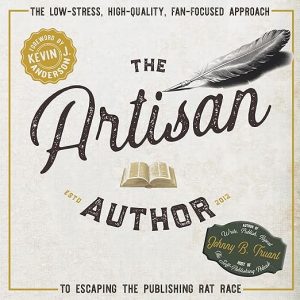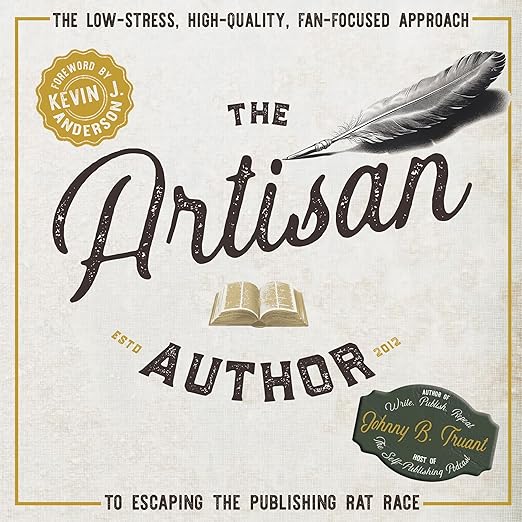
Johnny B. Truant has spent years inside the indie-publishing machine, and The Artisan Author reads like a deliberate rejection of the playbook he helped popularize. This audiobook argues that the Rapid Release model, one new book every month or faster, is not a law of nature but a choice, and a self-destructive one for a lot of working writers. Truant narrates his own material, and that turns out to matter more than usual, since the entire pitch of the book is that slower, more careful work is not only survivable but more profitable in the long run. Hearing him deliver that argument at an unhurried pace, rather than racing through it, functions as a kind of proof of concept before he's even made the case explicitly.
The alternative he's proposing borrows its foundation from Kevin Kelly's well-known '1000 True Fans' idea: that a sustainable creative career doesn't require mass-market reach, just a modest, genuinely loyal readership willing to pay more because they feel a real connection to the person making the work. Truant calls his version of this approach the Artisan path, built around writing whatever genuinely interests him rather than obeying genre formulas built for algorithmic discovery. It's a philosophy book about publishing as much as a tactics book, and that balance is unusual in a category that usually leans hard toward growth-hacking checklists.
Truant Argues Against His Own Past Incentives
What separates this from the standard indie-publishing advice audiobook is how openly Truant argues against his own past incentives. He's frank about having chased speed and volume earlier in his career and treats the burnout that followed as the central evidence for his new approach, rather than glossing over it to preserve an image of unbroken success. That kind of self-implicating honesty is rare in a genre that usually sells confidence over doubt, and it gives the book's central claim, that slower and more personal work builds a sturdier business, real weight instead of reading like an untested theory.
The chapters move between craft philosophy and concrete business mechanics, covering everything from pricing strategy to how a writer builds direct relationships with readers outside of any single retailer's algorithm. K. Mandell's review captures the throughline well, describing a 'make a friend, make a sale' ethos borrowed from decades of customer-service experience and mapped cleanly onto author-reader relationships. That's the practical spine underneath the more philosophical talk of freedom and creative fulfillment: build genuine human connection first, and the income tends to follow rather than lead.
Trading Fast Success for a Slower Path
The tension he's naming, between chasing algorithmic discoverability and writing what actually interests you, will be familiar to anyone who has watched a favorite author's backlist drift toward whatever genre is currently selling. Truant doesn't pretend the artisan path is risk-free or guarantees any particular income; he's explicit that it trades a shot at fast, large-scale success for a slower, more durable one built on relationships rather than algorithm favor. That honesty about the tradeoff, rather than overselling either path as obviously correct, is what keeps the argument credible across a full eight hours.
Truant's Narration Embodies the Patience He Preaches
Self-narration is doing real work here beyond simple authenticity. A book arguing for patience, unhurried pacing, and resistance to industry pressure is far more persuasive delivered by someone whose own vocal pacing embodies that same patience, rather than read by a professional narrator brought in after the fact. Truant's voice carries the specific weariness of someone who has actually burned out chasing a release schedule, and that lived-in quality is difficult to fake or replicate secondhand.
The reviews back up the sense that this lands especially well with writers who feel worn down by current industry pressure. Josh's five-star review calls it 'a breath of fresh air in the self publishing world,' and GL George reports getting far more value than expected, explicitly noting the book's value extends past self-publishing specifically into general writing craft. Across eight hours, the book has room to build its argument in layers rather than compressing everything into a single motivational chapter, which suits the more meditative, less list-driven approach Truant is making the case for.
A structural pleasure also comes from hearing an author narrate a book about creative sustainability at a pace that never feels rushed toward the next chapter, unusual for business nonfiction audio, which often reads like an extended sales pitch delivered as fast as the narrator can manage. Truant lets ideas breathe, repeats key points when they matter enough to repeat, and treats the listener like someone settling in for a real conversation about their career rather than someone to be sold a course.
No Spreadsheets Here, Just Mindset and Relationships
This isn't a book of hard numbers, templates, or step-by-step launch sequences, and going in expecting that kind of tactical checklist will lead to frustration. Truant is more interested in mindset and relationship-building than in giving you a spreadsheet to fill out, which means some of the most concrete advice, on pricing or reader outreach, arrives wrapped in more philosophy than a purely practical listener might want. Writers who already have a defined system and just need tactics to plug in might find themselves waiting through material aimed at people still working out their whole approach to the craft.
At eight hours and ten minutes, this sits solidly in the range of a serious business book rather than a quick primer, and the pacing assumes patience from the listener that mirrors the patience it's asking writers to bring to their own careers. Anyone hoping to finish this on one commute should adjust expectations; it rewards sitting with a chapter and letting an idea settle before moving to the next one, closer to reading a single chapter of a print book at a time than binging a full audiobook in one sitting.
Indie Authors Worn Down by Release Pressure
Working and aspiring indie authors who feel ground down by publishing-industry pressure toward speed and volume are exactly the audience Truant is writing for, and this should land as validation as much as instruction. Writers drawn to Kevin Kelly's original 1000 True Fans concept, or anyone curious what that idea actually looks like applied specifically to a modern author's business, will find a fully worked-out version of it here. It's also a reasonable pick for writers early in their careers who haven't yet locked into the Rapid Release model and want an alternative framework before default habits set in.
Anyone still chasing a monthly-release sprint calendar will find little tactical comfort in Truant's unhurried approach, and that mismatch is worth naming upfront rather than discovering three hours in. Writers looking purely for craft instruction, plotting, prose style, structure, rather than the business and mindset side of authorship should also look elsewhere; this stays focused on the publishing model and the writer's relationship to their own pace, not the writing itself.
Before You Press Play
- Voice: Johnny B. Truant narrates his own work with unhurried, measured pacing that mirrors the book's core argument.
- Big ideas: Sustainable indie publishing, resisting rapid-release pressure, building genuine reader relationships
- Atmosphere: Calm, encouraging, deliberately anti-hustle
- Worth it?: A genuinely useful reset for indie authors burned out chasing speed, light on rigid step-by-step tactics.
A Few Questions About The Artisan Author
Is this audiobook only useful for self-published authors?
No. Reviewer GL George specifically notes it's not just meant for self-publishing but valuable for any working writer thinking about pacing, career sustainability, and reader relationships.
Does the audiobook include concrete business tactics or just philosophy?
Both, though it leans more philosophical than tactical. Pricing and reader-relationship strategies are covered, but always inside a broader argument about pacing and creative sustainability rather than as a standalone checklist.
Is Johnny B. Truant a good narrator for his own audiobook?
Yes. His self-narration reinforces the book's central argument, since his own unhurried, patient delivery embodies the slower creative pace he's recommending rather than just describing it.