Bill Belichick spent five decades as one of the most private figures in professional sports, and The Art of Winning, his self-narrated audiobook, is the most extended case of evidence we have for why that privacy was a strategic choice rather than a personality limitation. The book is not a memoir in the conventional sense. It is a leadership manual assembled from lived experience, organized around principles that Belichick has been refining since his earliest years in Navy football, and delivered in the voice of someone who has never been interested in telling you what you want to hear.
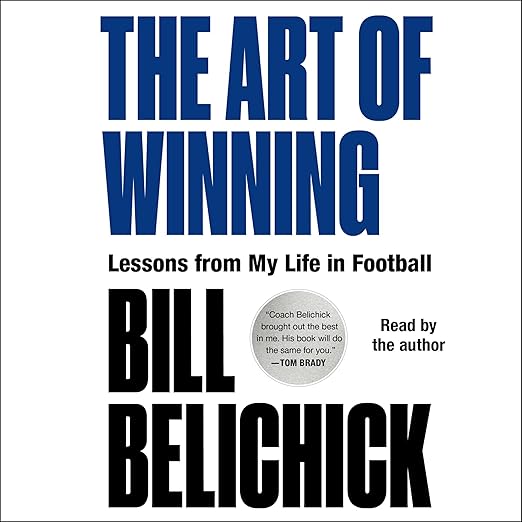
The endorsements on the cover are worth noting before the content itself: Tom Brady, Michael Jordan, Nick Saban, Ray Dalio, and Admiral William McRaven each contribute specific praise in terms that reflect genuine familiarity with the material. This is not celebrity blurb stacking. These are people who have either worked with Belichick directly or operate in the same domain of high-stakes performance, and their framing of the book, as a playbook for life, as invaluable for anyone trying to succeed, as a remarkable deep dive into the mind of a champion, reflects the content's actual range beyond football.
The 2008 Call Was a Genuine Mistake
The book's central argument is honest about its own simplicity and does not apologize for it: winning is not a science but a set of learnable practices, and Belichick's approach is to enumerate them with the specificity that comes from fifty years of testing them under the highest possible competitive pressure. His rule for how to win football games, score the most points, is presented not as a joke but as the beginning of a useful argument about what it means to subordinate every practice to a single clear objective. The willingness to be thought simple in the service of clarity is itself a leadership principle.
Belichick owns his failures here in ways that distinguished observers from his coaching career would recognize as characteristic. He discusses deciding to go for it on 4th and 13 in the 2008 Super Bowl as a genuine mistake, not as a decision that was right in context but happened to fail. The ability to distinguish between good-process-bad-outcome and genuine error, and to be specific about which category a given decision belongs to, is one of the book's most practically useful contributions. Leaders who cannot make that distinction cannot learn from experience.
No Warmth, No Effort to Be Likable
Belichick self-narrating is the correct format choice, and it shapes the entire listening experience. His voice carries the same quality as his press conference answers: no warmth in the conventional sense, no effort to be likable, absolute precision about what he is and is not saying. A reviewer captured this as the simple yet extremely effective principles and wisdom Bill utilized in achieving and sustaining success in his storied coaching life. That simplicity is not absence of depth, it is the result of removing everything that does not carry weight.
The stories from his career that appear throughout the book are the most absorbing passages. His observations about handling colorful personalities and egos, about the specific challenge of motivating players at different stages of their careers and different positions on a depth chart, and about what he learned from his early career challenges carry the texture of lived experience rather than retrospective framing. At 9 hours and 6 minutes, the runtime is enough to move through multiple seasons' worth of principle-building without exhausting the material.
A Coach Without a Team, Writing Anyway
The book positions itself as applicable beyond football, and the leadership principles it articulates genuinely are transferable. However, listeners whose primary interest is in the psychological and tactical specifics of NFL coaching and team construction will find more of that content here than the title might suggest. The football stories are not merely illustrative, they are the substance through which Belichick prefers to communicate. Readers looking for a fully abstracted leadership framework without extensive sports-specific context may find the balance occasionally tilted toward the game.
The book was written after Belichick's departure from the New England Patriots in 2024, during what he describes as a year as a coach without a team. That context gives the reflection a particular quality, there is something slightly more exposed in writing done from outside the organization than the controlled reticence of the press conference years. The personal dimension, which one reviewer noted as genuinely surprising given Belichick's public profile, appears most clearly in the sections on preparation and on what he learned from his father about football and about conducting oneself in a profession.
The New York Times bestseller status and the commercial context of the book are worth acknowledging honestly: this is a leadership book released into a crowded genre by an unusually credentialed author. The quality is real, but so is the marketing apparatus around it. Listeners should read for the principles rather than the brand.
How Belichick's Care Actually Appears
Leaders who have read the generic leadership canon and found it insufficiently grounded in real competitive pressure will find Belichick's approach a useful corrective, the specificity of his examples, the willingness to acknowledge genuine mistakes, and the absence of aspirational language distinguish this from most entries in the genre. Football fans with professional or organizational responsibilities will find the crossover material particularly satisfying. Those who want to understand what sustained organizational excellence actually looks like from the inside, at the highest level, will find the coaching career stories irreplaceable.
Listeners looking for emotional warmth, inspirational framing, or a narrative that celebrates personal connection and team culture in the conventional sense should note that Belichick's register is fundamentally analytical. The care he has for the people around him appears in how he talks about preparing them and deploying them effectively, not in the language of sentiment. That mode of care is entirely real, but it may not be what some readers are looking for in a leadership book.