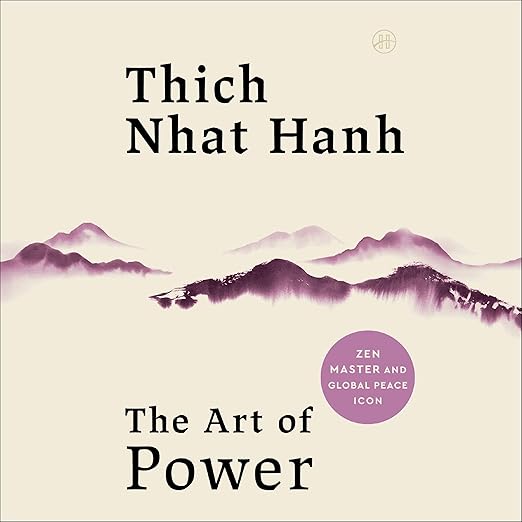
Quick Take
- Narration: David Lee Huynh brings a measured, contemplative cadence that honors Thich Nhat Hanh’s teaching voice without ever slipping into performed serenity.
- Themes: Mindful presence, redefining power and wealth, freedom from ego-driven ambition
- Mood: Quietly radical and grounding
- Verdict: A short but demanding listen that asks you to genuinely question what you think power is worth chasing.
I came to this one on a Tuesday morning when I had back-to-back meetings lined up and a to-do list that felt more like a personal indictment. I put the kettle on, opened Audible instead of my email, and let David Lee Huynh read me the first chapter of Thich Nhat Hanh’s The Art of Power. By the time the kettle clicked off, I had already missed the start of my first call. That is, I think, exactly the kind of thing this book is designed to do to you.
Thich Nhat Hanh, ranked by the New York Times as second only to the Dalai Lama among Buddhist leaders influential in the West, does not write about power in the way you might expect from a business shelf staple. There is no framework for negotiating salary or projecting authority in a boardroom. The book’s central premise is simpler and considerably more unsettling: we already possess everything we need for genuine power, and most of our ambition is a sophisticated system for avoiding that fact.
What Hanh Actually Means by Power
The book opens with a provocation. In a culture saturated with greed and egocentrism, Hanh argues, the competitive scramble for control and recognition prevents us from accessing the only kind of power worth having. He is speaking directly to CEOs, politicians, and people who occupy positions of institutional authority, and he is telling them that their wealth and influence are not the point. That is a harder sell than it sounds, and to Hanh’s credit, he does not soften it. He frames conventional power as a kind of addiction, something that offers the sensation of control while steadily eroding the capacity for genuine happiness.
What he proposes instead is the power that comes from being fully present, from releasing shame, from seeing the larger picture of one’s life rather than grinding through daily stress. One reviewer, a doctor who signed his note Gregory K. Binus MD, captured it well: Hanh has a compelling, clear communicative gift for translating the mystical aspects of Buddhism into everyday contemporary terms. That translation work is real. The book never requires you to accept Buddhist metaphysics wholesale; it simply asks you to examine your own experience and notice whether your current definition of power is actually delivering what you hoped it would.
The Problem Some Listeners Will Have
A reviewer named Mark, who gave the book four stars, flagged something I think is worth naming honestly: the advice can seem almost too simplistic for hard real-world situations. Breathe. Return to the present moment. Recognize that others are extensions of yourself. He is right that these instructions, stated plainly, sound inadequate to the scale of genuine suffering or systemic injustice. This is the inherent tension in Hanh’s work, and it runs through every book he has written. The teaching is not incomplete so much as it operates at a different register than most self-help advice. It is less a toolkit and more a sustained invitation to shift your foundational orientation toward experience. If you come to it wanting step-by-step instructions for career advancement, you will be disappointed. If you come to it after reading the instructions for career advancement and finding they have not helped, you might find it devastating in the best possible way.
David Lee Huynh and the Question of Voice
The narration matters more here than it would for a thriller or a history. Huynh’s voice carries a stillness that suits the material without becoming precious. He does not perform tranquility; he simply reads with care. There are moments in longer passages where his pacing slows almost imperceptibly, and I found that effect worked in the book’s favor. You genuinely cannot rush through this listen. The audio format actually strengthens the experience compared to reading the text on a page, because Huynh’s delivery keeps pulling you back to the present tense of listening. At just under six hours, the length is generous enough to develop Hanh’s arguments without demanding a multi-week commitment.
Who This Is For and Who Will Struggle
If you already find Hanh’s other work meaningful, this one will fit naturally into your rotation. Fans of Pema Chodron, Jon Kabat-Zinn, or Ram Dass will recognize the terrain. It also works surprisingly well for high-achieving listeners who have begun to notice a gap between what they have accomplished and how they actually feel. One listener found particular comfort in it during the COVID-19 lockdowns, noting that it applies to any time, and this time was a great time to read it. That durability is a mark in the book’s favor.
Skip it if you are looking for behavioral strategies, persuasion frameworks, or evidence-based productivity research. The book simply is not making that kind of argument. Skip it too if Hanh’s earlier titles have left you cold. His style, his framing, and his core assumptions are consistent across his catalog, and The Art of Power does not reinvent the approach.
What it does is hold a very clear mirror up to the idea that power over others and over outcomes is worth the sustained cost of pursuing it. That is an uncomfortable question to sit with. The fact that it is asked in a voice as gentle as Huynh’s makes it harder to dismiss, not easier.
Frequently Asked Questions
Is The Art of Power a business book or a spiritual one?
It sits firmly in the spiritual category. Hanh uses the language of power and success to reach readers who might not pick up a traditional meditation guide, but the core argument is about Buddhist mindfulness and presence, not professional strategy.
Do I need to have read Thich Nhat Hanh before to follow this audiobook?
No prior reading is required. Hanh writes with enough context that each book stands alone, though listeners familiar with his other titles will recognize recurring themes around interbeing, the present moment, and non-self.
Is the narration by David Lee Huynh a faithful match for the material?
Yes. Huynh’s delivery is measured and unhurried in a way that reinforces rather than decorates Hanh’s teaching. He does not perform spirituality; he simply reads with genuine attention to the text’s rhythm.
At under six hours, does The Art of Power cover enough ground to feel substantive?
It is a short book by design. Hanh’s writing is dense with implication rather than length, so the runtime feels appropriate rather than thin. Listeners who want extensive case studies or data may find it brief; those comfortable with essay-style Buddhist teaching will find it complete.