- Narrator: Marguerite Gavin reads Rand's lecture transcripts with steady, measured authority that suits the instructional register without adding dramatic color the text does not require.
- Subjects: Writing craft, Objectivist aesthetics, conscious versus subconscious creation
- Tone: Brisk and didactic, with flashes of genuine philosophical curiosity
- Bottom line: Rand's lectures on nonfiction writing reward careful listening from any serious writer, even those who actively reject her philosophy.
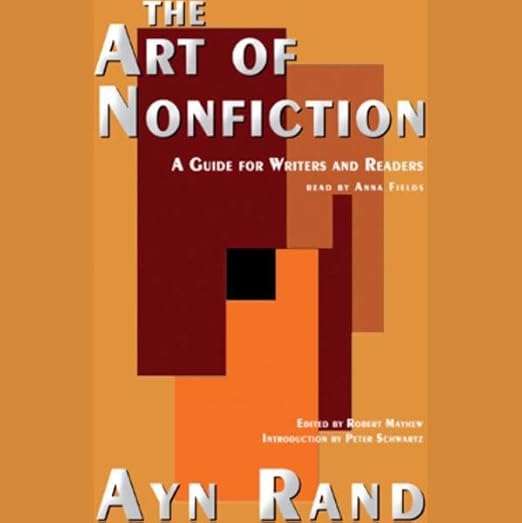
Ayn Rand delivering informal lectures on writing is a stranger and more rewarding audiobook than the title alone suggests. The Art of Nonfiction, narrated by Marguerite Gavin at just under seven hours, collects the edited transcripts of two private courses Rand gave to small groups in 1958 and again in 1969. The result sits somewhere between a craft manual and a philosophical seminar, and the unusual origin gives it a texture you rarely encounter in writing instruction books. Rand is not writing for publication here. She is talking to people she knows, working through ideas in real time, and the audio format, oddly, restores something of that intimacy.
Gavin narrates cleanly, without over-dramatizing material that is already fairly austere. The lectures were informal gatherings, and that quality survives the editing process. Gavin's even delivery suits the instructional register without adding dramatic color the text does not call for. At its best, the audiobook feels like sitting at the edge of a room where someone very confident about ideas is holding court, watching her dismantle a student's fuzzy premise with the precision of someone who regards muddled thinking as a moral failing.
Rand's Case for Clear Thought Before Prose
Rand builds her entire framework from a single premise: all writing, including nonfiction, reflects an underlying philosophical stance, whether the writer acknowledges it or not. This is the most interesting argument in the book, and three decades of composition theory would largely endorse it, even from writers with no sympathy for Objectivism. The practical implication she draws is that clarity of thought precedes clarity of prose, which is not a radical position but is stated here with unusual force and specific application to the sentence and paragraph level.
She walks through the writing process in sequence, covering how to select a subject and theme, how to identify your intended audience before putting a word on the page, and how to produce a workable first draft without letting the conscious mind strangle the subconscious creative process. That last section is particularly sharp. Rand's discussion of the relationship between deliberate planning and spontaneous execution is more nuanced than her reputation for rigid systematizing might lead you to expect. She is emphatic that the writer who outlines everything in advance and then refuses to deviate is as stuck as the writer who never outlines at all. The discipline she endorses is about identifying your thesis clearly before you write, not about controlling every move once the writing begins.
The Self-Sabotage Patterns Rand Diagnoses So Sharply
The book also contains a substantial discussion of the psychological dimension of writing, the fear of the blank page, the tendency to over-edit on the first draft, the relationship between the writer's sense of self-worth and their willingness to assert a position in print. These passages are less specifically Objectivist and more broadly useful than the philosophical framing might suggest. Rand is sharply observant about the ways writers sabotage themselves, and her diagnosis of those patterns is as applicable today as it was in 1958.
Gavin's Narration Restores the Lectures' Original Rhythm
The audio format suits this material well. Because the text originated as spoken lectures, Gavin's narration restores something of the original rhythm. The asides, the moments where Rand pauses to rephrase a point, the places where an idea is being worked out in real time rather than polished on the page: these qualities give the audiobook an intimacy that a conventional craft book rarely achieves. A reviewer who described the text as a philosophical approach to writing nonfiction is accurate, but that framing undersells how practical the advice is at the sentence level.
Rand has specific things to say about article structure, about how to anchor an abstract argument in concrete detail, and about what distinguishes a paragraph that carries the reader forward from one that fills space. One reviewer noted that, while rejecting Rand's broader philosophy as crude and sophomoric, her analysis of what constitutes solid, well-reasoned writing is nonetheless correct and useful. That separation is worth holding onto as you listen. You do not need to accept Objectivism as a system to find her instruction on subordinating decorative flourish to logical architecture valuable. The Atlas Shrugged author who believed that reason was the supreme human faculty is also, consequentially, the writing teacher who can identify with unusual precision when a paragraph is doing actual intellectual work and when it is merely pretending to.
Nonfiction Forms Rand's Framework Leaves Untouched
There are genuine weaknesses. The book does not address the full range of nonfiction forms. Rand focuses primarily on articles and books of argument or exposition. Narrative nonfiction, the kind of long-form journalism or memoir that was being written contemporaneously by writers like Joan Didion and Gay Talese, is largely absent from her frame. If you are looking for guidance on scene-setting, immersive reporting, or the use of character in nonfiction prose, this book will leave you wanting significantly more.
There is also a ceiling on the book's ambition that Rand never quite acknowledges. Her concern is always with writing that argues, explains, or persuades. The possibility that nonfiction might aim primarily to evoke, to produce a sustained aesthetic experience rather than to win an argument, does not feature in her framework. For some readers this will be a frustrating omission. For others, the narrowing of scope will feel like a feature rather than a limit. Rand is at her clearest when she has limited her territory, and nonfiction argument is the territory she knows and cares about.
Journalists and Essayists Get the Most Here
Writers working in argumentative or expository nonfiction will get the most from this audiobook. It is especially valuable for journalists, essayists, and business writers who want a framework for thinking about structure and theme rather than a list of copyediting rules. Readers curious about Rand's mind as distinct from her fiction will find this a surprisingly candid window into how she thought about communication and clarity. Skip it if you need guidance on narrative form, scene construction, memoir, or any nonfiction mode that relies on showing rather than arguing. Rand's framework simply does not reach those forms, and she would not pretend otherwise.