Key Details
- Read by: The credit reads Richard Rohr Father, a transposed honorific, and the sessions are delivered by the teacher who wrote them, which for a spoken course is the original form rather than a casting decision.
- At its heart: The life and example of St. Francis of Assisi, true self against false self, non-dual reading of Jesus, contemplation paired with action.
- Vibe: Unhurried, pastoral, quietly demanding.
- Short version: A recorded course rather than a book, and worth the six sessions if you actually intend to do the work it sets.
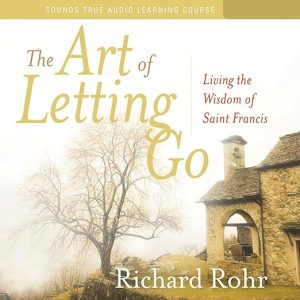
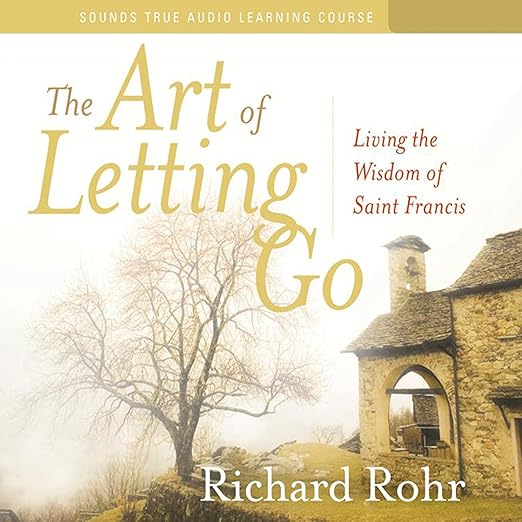
Course objectives, not chapter titles, are what the description opens with, and that single choice tells you more about this audiobook than any amount of jacket copy could. Discuss the life of St. Francis of Assisi. Identify the difference between the true self and the false self. Explain the non-dual aspects of Jesus's teaching. Practice contemplative prayer. Five hours and fifty-eight minutes of Richard Rohr, arranged as a six-session learning course rather than as a book that somebody happened to record.
What We Made of It
Francis of Assisi is the vehicle rather than the subject. The description makes the move explicitly: we tend to file saints as exceptional people whose gifts sit far beyond our own, and Rohr's argument is that this particular life offers a spirituality anyone can actually inhabit. From there the sessions work outward into the richness available through simplifying a life without taking a vow of poverty, and into liberation from what the description calls our self-limiting biases and certitudes.
Phoenix customer's five-star response puts the case for Rohr about as strongly as it can be put, calling Rohr "the premier spiritual author and teacher I have ever read or heard" and this "the most amazing series of lessons on the life and wisdom of St. Francis of Assisi". That phrase, read or heard, is worth pausing on. It is one of the few acknowledgements anywhere on the page that this material has existed in more than one medium, and it comes from someone who clearly encountered a good deal of it.
The listing shows 4.3 across 51 ratings while the five written notices score 5, 5, 5, 5 and 1. That single low score is not a verdict on the teaching at all, as the next section explains, so the readable content responses here are unanimous. What the aggregate tells you is that a fair number of the fifty-one raters were less convinced than the people who wrote, and the page gives you no way to hear from them.
What Makes The Art of Letting Go Worth Hearing
Six sessions with stated objectives is a genuinely different product from a spiritual memoir, and the fourth objective is the one that changes how you should use it. Practice contemplative prayer is not something you absorb; it is something you stop and do. The syllabus pairs contemplation with action as two steps rather than one mood, which means the recording is designed to be interrupted. A listener who runs it end to end like a novel will have received the information and skipped the course.
Seal's response is the most affecting thing on this page and also the most concretely useful. Written after losing "both my parents, eleven close friends and three dogs in the last two years", it credits the material with helping to "realign my mind and mindfulness" and with the reminder "to take action on my spiritual development". Then the practical detail: this reviewer ordered it as an audio book and has "listened to it several times". Repeat listening is exactly what a six-session course is built for.
Delivery deserves its own consideration. The description introduces Rohr as a prolific author and a renowned speaker, and what is on offer here is the speaking half of that description. A course assembled from talks does not have to be converted into audio, because it began there, and the transposed narrator credit on the listing, which reads Richard Rohr Father rather than Father Richard Rohr, is a data-entry slip rather than a sign that anyone else is reading. It is still worth a sample, because a teacher working a room and an actor reading a transcript of one produce very different results over a course this long.
What Might Not Land
One star, and it has nothing to do with Rohr. The lowest score on this page, filed in September 2023, is a complaint about manufacturing: "Quality of discs is very poor", with the first disc playing cleanly and the next three "garbled, kept stopping and clicking without playing forward". By the time the fault surfaced, the window for a return had closed. That is a verdict on a physical pressing rather than on anything you would download, and it should not move your view of the content by a single point.
Categorization on this listing is worse than careless. The tag reads Occult. What the description actually contains is a Franciscan priest teaching about a Catholic saint, the true and false self, the non-dual dimensions of Jesus's teaching, and contemplative prayer. Nothing in that belongs under an occult heading, and the misfiling will simultaneously deter the Christian listeners this course is written for and mislead anyone browsing the tag in good faith.
Expectations need setting on format as well. This edition dates from April 2010 and the written responses run from December 2013 to September 2023, so the material has been circulating a long while in more than one physical form. Anyone arriving expecting Rohr's narrative nonfiction will find instead a teacher working through a syllabus, returning to points, and addressing a room. That is a strength if you want to be taught and a frustration if you wanted to be read to.
The Right Listener for The Art of Letting Go
Non-Catholic listeners have been explicitly invited by one of the reviewers here, and the invitation is worth quoting. That notice tells prospective buyers not to "allow the fact that Fr. Rohr is a Catholic priest limit your wanting to purchase this book/CD", then adds: "I am Buddhist & found that this book teaches lessons that people of all faiths need to learn & practice". Anyone drawn to contemplative traditions from outside Christianity has a clear signal there.
Avoid this if you want scholarship on Francis of Assisi. The description is candid that the objective is embodying a spirituality rather than reconstructing a thirteenth-century life, and a listener after biography or history will get neither. Anyone who resists the true self and false self framing altogether should also pass, since it is not one idea among several here but the structure the whole course hangs from.
Faith aside, what convinced me is that this course asks something of you and says so in advance, in a numbered list, before you have spent anything. Most spiritual audio does the opposite. Come to it as a course with homework rather than as company for a commute, keep the sessions apart, and the material has a decent chance of doing what its strongest supporters here say it did for them.
Frequently Asked Questions
Is The Art of Letting Go audiobook a book or a course?
A course. The description opens with four stated objectives and describes six sessions, one of which asks you to practice contemplative prayer rather than simply hear about it. Listeners expecting narrative nonfiction will find a teacher working through a syllabus, returning to points and addressing a room.
Why does one reviewer give this a single star?
Because of physical media, not content. That notice describes discs two, three and four as garbled and stopping mid-playback while the first played cleanly, and says the return window had closed by the time the problem appeared. It is a complaint about a pressing rather than about Richard Rohr's teaching.
Do I need to be Catholic to get something from this?
No, and one reviewer makes that case directly, identifying as Buddhist and arguing that the lessons apply to people of all faiths. The material is grounded in Franciscan spirituality and the teaching of Jesus, so some Christian vocabulary is unavoidable, but the framing is contemplative rather than doctrinal.
How should I listen to this audiobook to get the most from it?
Session by session, with gaps. The fourth objective is to practice contemplative prayer, which is something you stop and do rather than absorb in passing, and the syllabus pairs contemplation with action. One reviewer reports listening several times over. Running it straight through gets you the information and skips the course.