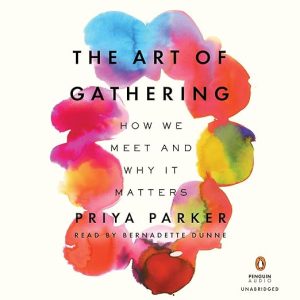
Priya Parker's The Art of Gathering audiobook opens a question that turns out to be more radical than it first sounds: why do we gather? Not how, not where, but why, and whether the gatherings we have inherited and replicate without reflection actually serve any real human purpose. Parker, a professional facilitator who has worked at the highest levels of organizational and diplomatic gatherings, makes her argument with the confidence of someone who has watched countless well-intentioned gatherings collapse under the weight of their own generic formats. Bernadette Dunne narrates with a voice that suits Parker's intellectually urgent but conversational prose precisely, and the nine-hour runtime unfolds without the pacing problems that often afflict social science audiobooks of this length.
The craft of this book lies in how Parker makes her argument experiential rather than prescriptive. She does not open with a set of rules for hosting. She opens with the observation that most gatherings are defined by category rather than purpose, that we call something a conference or a dinner party and then allow the expectations attached to those labels to do all the organizing work. The argument that follows, that this habit is the primary reason so many gatherings feel interchangeable and forgettable, is developed through an extraordinary range of examples: an Arab-Israeli summer camp, a courtroom, a flash-mob party, a high-stakes corporate facilitation. Seth Godin called this book a long overdue and urgent manifesto, and Chris Anderson of TED endorsed it as essential reading for anyone who hosts. The material earns both descriptions.
Beyond Category, Toward a Vulnerable Purpose
The central concept that Parker develops most carefully is what she calls the specific vulnerable human purpose behind any gathering. The distinction between a gathering that has a category and one that has a purpose sounds simple but has significant practical implications. A dinner party for someone's birthday is a category. A dinner party specifically designed to repair a fractured friendship, or to create a space where a person transitioning out of a career can be seen fully by people who know them, is a purpose. The first planning process involves logistics. The second involves genuine thought about what the gathered people actually need from each other.
Parker's facilitation background shapes the book's most useful chapters, specifically those dealing with how gatherings open and close. Her argument that openings set a social contract and closings provide meaning, and that both are almost universally bungled in practice, is supported by examples from her professional work that range from international peace processes to neighborhood block parties. The flash-mob party section is particularly strong, illustrating how unconventional structural choices can disrupt social convention productively rather than just chaotically. These are not abstract observations. They are case studies drawn from real interventions with real groups.
Dunne Holds Steady Across Anecdote and Analysis
Bernadette Dunne has the range to handle both Parker's anecdotal passages and her more analytical sections without a tonal drop between them. The audiobook at nine hours and twenty-one minutes does not feel like a long listen, which is partly a function of Parker's accessible prose and partly a function of Dunne's ability to maintain momentum through the theoretical passages. The book is organized with a logic that rewards linear listening, but individual chapters are coherent enough that listeners who skip around will find each section usable in isolation.
Reviewers who work as community builders and organizers have been particularly enthusiastic about this audiobook, noting that Parker's principles hold up in real-world application rather than merely sounding plausible in theory. One reviewer described it as essential for anyone who has ever hosted or wanted to host. Another noted that as someone who has started various communities, the principles ring very true in real-world settings. The audiobook format suits Parker's conversational style, making these feel less like chapters from a business book and more like extended conversations with someone who has thought seriously about a subject most people take for granted.
Benevolent Assertiveness Is a Form of Care
One substantive critique in the reviews notes that Parker's case studies tend toward higher-profile, higher-resource gatherings: international summits, well-funded organizations, people with the social capital to attempt unconventional formats. The observation is accurate, and listeners who are hosting from a position of limited institutional authority will sometimes find Parker's guidance requires adaptation. She addresses intimate gatherings throughout, but her instincts are those of a professional facilitator, and some of her suggestions for generating purpose and structure require a level of control over the event that casual hosts may not have or feel comfortable asserting.
The chapter on the role of the host as a temporary authority figure is one of the most provocative in the book. Parker argues that good hosting requires a kind of benevolent assertiveness that social politeness tends to suppress, and that the failure to exercise this authority is actually a failure of care toward guests. That argument will resonate strongly with some listeners and feel too directive for others. It is worth sitting with rather than accepting or dismissing quickly, because the reasoning behind it is more nuanced than the claim alone suggests.
Philosophy First, Then the Practical Guidance
Anyone who regularly facilitates meetings, leads community groups, hosts professional events, or wants the gatherings in their personal life to feel more purposeful will find this audiobook genuinely useful. Parker's framework applies at every scale from a two-person check-in to a multi-day organizational retreat, and the book is specific enough that listeners tend to leave it with particular changes already identified and planned.
Listeners seeking a narrowly practical hosting guide with checklist-style advice will find The Art of Gathering operating at a more philosophical register than they might expect. The book is fundamentally about why gatherings fail and how purpose can repair that failure, and the practical guidance flows from that philosophical foundation rather than being its own separate section. Readers willing to sit with the ideas before reaching for the actionable recommendations will get considerably more from it.
- Voice: Bernadette Dunne delivers Parker's conversational and intellectually urgent prose with authority, making the nine-hour runtime feel compressed rather than stretched.
- Big ideas: Intentional community, purpose-driven gatherings, facilitation and the philosophy of hosting
- Atmosphere: Curious and conversational, intellectually stimulating without being dry
- Worth it?: A rare ideas book that actually changes how you behave, making every future meeting and dinner party feel like an opportunity you previously misunderstood.
Does this audiobook cover virtual or hybrid gatherings, or is it focused on in-person events?
The original edition focuses primarily on in-person gatherings. Some listeners have noted this as a gap, though Parker's underlying principles about purpose and human connection apply across formats and can be adapted for virtual or hybrid contexts with some translation.
Is this audiobook worth listening to if I already have strong intuitions about how to host well?
Likely yes. Parker's value is not in covering obvious hosting basics but in surfacing the structural reasons why gatherings fail even when logistics are handled correctly. Experienced hosts tend to find her framework clarifies patterns they recognized intuitively but had not fully articulated.