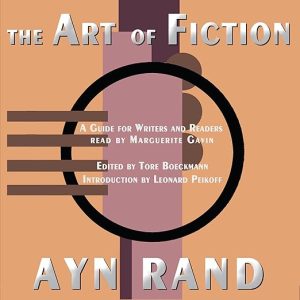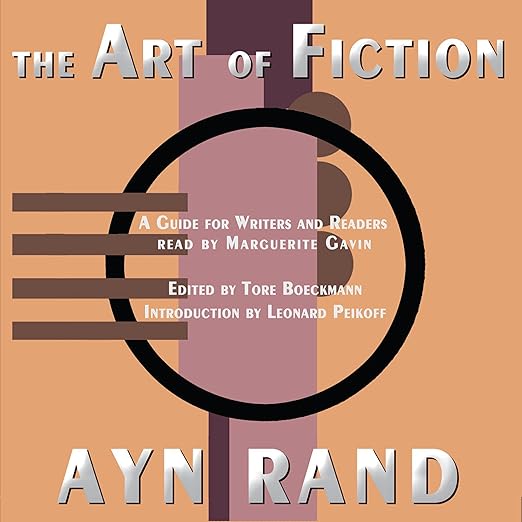
1958 and 1969 are the two years Ayn Rand gathered a small circle of friends and acquaintances into her home for an informal course on writing, never imagining the transcripts would end up as a published audiobook decades later. The Art of Fiction preserves those sessions almost exactly as delivered, unpolished seminar cadence and all, which makes it a strange, revealing document: part philosophy lecture, part craft manual, part unfiltered look at how one of the twentieth century's most argued-about novelists actually thought about the mechanics of storytelling. Rand walks through theme, plot, characterization, and style as four elements that must achieve what she calls unity, and she illustrates the argument by picking apart passages from famous writers and, more interestingly, rewriting scenes from her own novels in real time.
Marguerite Gavin narrates with the kind of calm, serious authority that serves lecture-transcript material well, treating Rand's often combative opinions with respect rather than either mockery or breathless reverence. That neutrality is the correct choice for a text this opinionated; Gavin lets Rand's own words carry the weight of persuasion or provocation, never editorializing through tone. Because this started as spoken seminar material rather than a book written for the page, the audio format arguably suits it better than print does, restoring some of the original classroom energy that a silent read of the transcript can flatten into dry lecture notes.
The four-element framework, theme, plot, characterization, and style, gives the course real structural backbone rather than letting it drift into scattered writing-advice platitudes. Rand's method of rewriting passages from her own fiction as a teaching tool is the most genuinely useful material here, since it lets a listener watch a working novelist's editorial instincts in action rather than just hearing abstract rules asserted. One reviewer, a self-described Montessori parent, frames the book as a natural companion to The Romantic Manifesto, situating it correctly within Rand's broader aesthetic theory of Romantic Realism rather than treating it as a standalone how-to guide divorced from her larger body of thought.
The gap between the two seminars, 1958 and 1969, is itself worth noting: eleven years separate the sessions that make up this single edited transcript, and Rand's core framework of theme, plot, characterization, and style stays remarkably consistent across that span rather than shifting with her evolving public profile. For listeners tracking Rand's intellectual development more broadly, that consistency suggests her views on fiction craft specifically had solidified well before either seminar took place, distinct from the more publicly contested territory of her wider philosophy.
Rand Calls a Spade a Spade Here
Aspiring novelists get genuine craft value here regardless of what they think of Rand's politics, because the analysis of unity across theme, plot, characterization, and style holds up as serious formal thinking about how fiction actually works. A reviewer who calls it one of the best books on writing they have encountered specifically praises how directly Rand names problems other craft books tiptoe around, writing that she 'calls a spade a spade,' which matches the blunt, unhedged tone that carries through the whole course. That directness is refreshing in a genre, writing advice, that often drowns useful information in reassurance and qualification.
The book also works as a window into Rand's own process at a specific moment, delivered not long after Atlas Shrugged, a novel one reviewer notes runs to roughly thirteen hundred pages and six hundred fifty thousand words, among the longest ever originally written in English. Hearing her explain, in her own recorded cadence as preserved through the transcript and Gavin's reading, how she approached scene construction on a project of that scale gives the craft advice a concrete, high-stakes anchor that a purely theoretical writing guide would lack. For listeners already fascinated by Rand as a literary figure, that biographical proximity is a real draw on its own.
Unity is the word Rand returns to again and again across the course, the idea that theme, plot, characterization, and style must all serve one coherent purpose rather than operating as separate craft skills bolted together. That single organizing concept gives listeners something concrete to test against their own writing long after the audiobook ends, a rare craft book that reduces to one memorable, applicable question rather than a checklist that fades from memory within a week.
An Audiobook That Assumes Prior Vocabulary
Rand's forceful personality is inseparable from the craft instruction, and listeners should expect philosophical certainty alongside the technical advice, not a neutral, universally applicable style guide. One reviewer acknowledges this directly, praising the material while admitting Rand's ego occasionally gets in the way of the argument, which is a fair and honest way to frame the experience. Because this is transcript material from an informal course rather than a text drafted for publication, the structure is looser than a written craft book, with digressions and audience-response energy baked into the pacing. Listeners expecting the tight organization of a modern writing manual, chapters, exercises, clean takeaways, should recalibrate expectations toward something closer to sitting in on an opinionated, occasionally meandering seminar.
The audiobook also presumes a listener already carries some working vocabulary for craft discussion, terms like theme and plot get defined on Rand's own idiosyncratic terms rather than reviewed from first principles, so complete newcomers to writing craft conversations generally may want patience for a session or two before her specific definitions click into place. The passages she analyzes from other authors, drawn mostly from mid-century literary fiction, will also read as somewhat dated reference points for listeners whose reading is concentrated in contemporary fiction, though the underlying formal analysis, how a scene builds tension or reveals character, translates across eras regardless of which specific novels get used as examples.
Devotees of Romantic Realism Get the Most
Aspiring fiction writers interested in craft mechanics over vague inspiration will get real, usable material here, particularly anyone drawn to a more architectural, theme-first approach to plotting. Rand devotees and students of Romantic Realism specifically will find this an essential piece of her nonfiction catalog, filling in process details that her novels alone do not reveal. Listeners who enjoy hearing a strong, opinionated voice defend specific formal choices, rather than hedge toward universal writing advice, will find the directness bracing rather than off-putting. Listeners who enjoy craft-focused podcasts or university-adjacent lecture content generally will recognize the format immediately and likely find the seminar pacing comfortable rather than strange, since informal spoken instruction has become a familiar audio genre well beyond writing craft specifically.
Writers seeking only contemporary craft trends, or anyone unable to separate Rand's philosophical reputation from her value as a craft teacher, should skip this one and look elsewhere.
Quick Take
- Voice: Marguerite Gavin delivers Rand's opinionated seminar transcripts with calm, respectful authority.
- Big ideas: Craft mechanics of theme, plot, characterization and style, Romantic Realism, the writing process
- Atmosphere: Analytical, opinionated, classroom-like
- Worth it?: Essential listening for craft-focused writers who can separate Rand's ego from her genuinely useful technical insight.
A Few Questions About The Art of Fiction
Does the Art of Fiction audiobook feel like a polished writing manual or something looser?
Looser, deliberately so. This preserves an informal 1958 and 1969 seminar nearly as delivered, so expect seminar energy and digressions rather than the tight chapters of a modern craft book.
What makes The Art of Fiction different from other audiobooks about writing craft?
Rand rewrites passages from her own novels as a teaching tool, letting listeners watch a working novelist's editorial instincts in action rather than just hearing rules asserted abstractly.