Quick Take
- Narration: Donal Donnelly’s rich, lilting Irish voice is inseparable from the text, this is a case where the narrator transforms the material into something closer to oral tradition.
- Themes: Cultural preservation, the artist finding his voice, the tension between modernity and ancestral life
- Mood: Slow, lyrical, and quietly haunting, the rhythm of tides more than plot
- Verdict: A rare piece of literary travel writing that rewards patience; Donnelly’s performance alone justifies the listening experience.
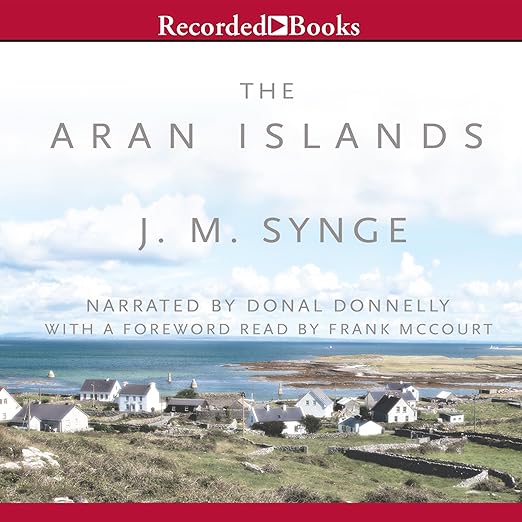
I spent a Saturday morning with The Aran Islands and came away feeling I had been somewhere I had never been and could now never entirely leave. J.M. Synge wrote this account of his four visits to the remote Irish islands at the turn of the twentieth century, on the instruction of W.B. Yeats, who told the young playwright to go live among the people themselves and express a life that had never found expression. The result is one of the strangest and most beautiful pieces of literary nonfiction in the English language, and hearing it read aloud by Donal Donnelly changes it entirely from a reading experience into something approaching immersion.
I want to say something about that instruction from Yeats, because it contains everything about what this book is and what it is not. Synge did not go to the Aran Islands as a journalist or a tourist. He went as an apprentice, learning Irish from the islanders, sleeping in their cottages, listening to their stories and their dreams. The Aran Islands is the record of that apprenticeship, and it reads accordingly, not as shaped narrative, but as accumulation. Days, conversations, observations, fragments of folklore. A man describing what he saw because the seeing mattered, not because he had a thesis to prove.
Our Take on The Aran Islands
The book’s pacing is its most discussed feature, and the reviews are accurate on this point. One reader noted that the rhythms of Synge’s narration are very much like that of the changing tide and the rolling of the waves. That is the right frame. This is not a book that drives forward. It pools and deepens. Synge is building a portrait of a way of life that was already beginning to disappear when he arrived, and he knew it. The elegiac undertone is never announced but it is everywhere.
What Synge captures that most travel writers cannot is the texture of spoken culture. The folklore stories he records, the dreams the islanders share with him, the patterns of Gaelic speech, these are not decorations. They are the subject. He is trying to preserve something that lived in the air of those islands, in the voices of the people, and the choice to encounter this text as an audiobook is therefore more than usually apt. Reading these words silently misses half of what they are.
Why Listen to The Aran Islands
Donal Donnelly is the answer to the question of why to choose audio for this particular text. Donnelly was an acclaimed Irish actor, and he brings to Synge’s prose exactly what it needs: a voice that sounds as if it knows these islands from the inside, that finds the music in sentences that can appear flat on the page and opens them into something melodic. One reviewer mentioned finishing the book six weeks after starting it because they spent that time reading everything around Synge to better understand the rich history. That kind of engaged, surrounding approach to a book is only possible when the text itself creates genuine curiosity, and Donnelly’s performance sustains that curiosity across six hours.
A caveat that reviewers have flagged: skip the preface. The preface, written in the early twentieth century, is described in multiple reviews as pompous and diminishing. Donnelly’s reading of the text proper more than compensates, but going in prepared saves the frustration of wondering whether the book is worth continuing.
What to Watch For in The Aran Islands
Synge’s influence on his own later drama is visible here in ways that reward attention. The rhythms of The Playboy of the Western World, the cadences of Riders to the Sea, these emerge from the speech patterns Synge absorbed on these islands. Listeners who know those plays will hear the seeds of them in the dialogue fragments Synge records. For those approaching Synge for the first time, The Aran Islands is a remarkable introduction to a writer who died at thirty-seven and left a body of work of disproportionate power.
The book is also worth listening to for what it reveals about the nature of artistic vocation. Synge arrives uncertain, takes instruction from a poet, and through the process of attending carefully to other people’s lives, becomes himself. That story runs quietly beneath the ethnographic surface and gives the text a personal resonance that pure reportage could never achieve.
Who Should Listen to The Aran Islands
This is a book for listeners drawn to literary nonfiction, Irish culture and history, or the relationship between landscape and language. It is not for anyone expecting conventional travel narrative momentum or plot-driven engagement. Those willing to let the tidal pacing carry them will find something genuinely rare, a text that sounds as alive as it must have felt to write.
Frequently Asked Questions
Is The Aran Islands a travel book or a work of literature?
Both simultaneously. Synge came to the islands as an aspiring writer on Yeats’s advice and produced a text that functions as ethnographic record, literary apprenticeship document, and lyrical prose work. It resists easy genre classification.
How does Donal Donnelly’s Irish accent affect the listening experience?
Significantly and positively. Donnelly’s voice carries the cadences of Irish speech that Synge was himself absorbing during his visits, which makes the narration feel authentically embedded in the material rather than imposed on it from outside.
Can a listener enjoy this without knowing Synge’s plays first?
Yes. The Aran Islands stands on its own as a portrait of a vanished way of life and as a piece of lyrical nonfiction. Knowledge of The Playboy of the Western World or Riders to the Sea adds resonance but is not required.
Why do reviewers recommend skipping the preface?
The preface was written by a contemporary of Synge’s and is widely described as dense, pompous, and not representative of the quality of Synge’s own prose. Multiple reviewers suggest jumping straight to Synge’s text to avoid a discouraging first impression.