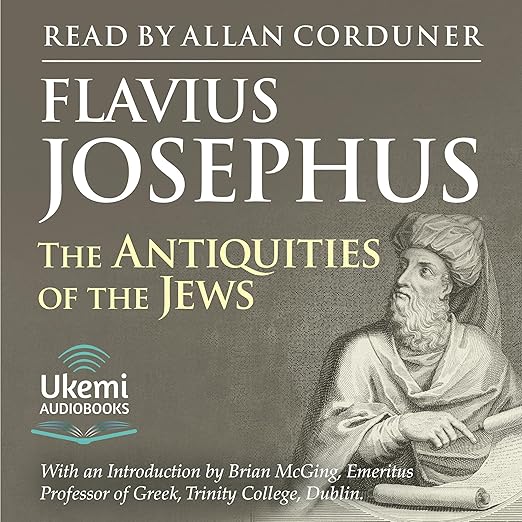
Jerusalem fell to Rome in the year 70, and the man who would spend the rest of his life writing its history had watched the destruction from the winning side, a defector, a former rebel general turned Roman citizen with an enormously complicated relationship to the story he was about to tell. That's Flavius Josephus, and The Antiquities of the Jews is his twenty-book attempt to walk a Greco-Roman audience through the entire sweep of Jewish history from Genesis's Adam and Eve up through his own turbulent century. I set aside a long stretch of commute time to work through this audiobook gradually, since fifty-one hours and forty-six minutes is not a casual undertaking, and Allan Corduner's narration turns out to be exactly steady enough to sustain that kind of extended commitment.
Corduner's reading is genuinely the reason to choose this particular edition over another. Fifty-one hours is an endurance test for any narrator, and he sustains a formal, dignified register across the entire runtime without ever tipping into archaic stiffness or academic dryness, which is a much harder balance than it sounds for a text translated in 1737. His handling of the more brutal material, Herod's domestic catastrophes among them, carries real weight without theatrical overselling, and that restraint is consistent whether he's working through genealogies, political intrigue, or outright atrocity.
The book's structure genuinely rewards patience: the first ten books retell the Hebrew Bible's narrative from Josephus's own first-century vantage point, while the remaining ten move into Greco-Roman history proper, Pompey, Crassus, Mark Antony, Julius Caesar, Augustus, and eventually Herod's entire four-book reign. Josephus himself is as interesting as his subject matter. Born Yosef ben Matityahu in Jerusalem, he led troops in the First Jewish Revolt, survived the war's aftermath as an enslaved interpreter to the Roman general Vespasian, and ultimately took Roman citizenship without ever fully abandoning his Jewish heritage, a genuinely contradictory position that gives his history its distinctive, conflicted texture.
The split between the two halves is not perfectly even in tone. The first ten books, retelling Genesis through the return from Babylonian exile and beyond, read as closer to scripture with historical annotation, while the second half shifts into something closer to conventional Greco-Roman political history, court intrigue, military campaigns, succession crises, once Rome enters the story directly. Corduner's steady register actually helps bridge that shift, since a listener moving between the two halves gets tonal continuity from the narration even as the source material itself changes character substantially.
Corduner Reads the Jesus Passages Without Bias
What makes Antiquities worth the time investment is how much of it survives nowhere else. Josephus preserves details about Pompey's and Crassus's careers, Herod's court, and the broader collision between Jewish and Greco-Roman civilization that later historians simply do not have independent access to. Reviewer Edward Hetzler calls it "a retelling of the stories in the bible by a first century Jewish / Roman aristocrat minus the religious agenda", and that outsider-insider vantage point, someone who lived through the actual Jewish Revolt and then had to make peace with Rome afterward, is precisely what gives the historical material its unusual credibility.
The book also contains two brief references to Jesus and one to John the Baptist, passages historians have long debated, since the surviving manuscript copies all date from the Christian era and may have been added to or amended by later scribes. Corduner reads these passages exactly as written, without any editorial emphasis pulling a listener toward one interpretation or another, which is the right choice for genuinely contested primary-source material. Reviewer Raphi Kutchukjan specifically sought out the passage identifying James as "the brother of Jesus who was called the Christ", and the fact that listeners still hunt for these exact lines nearly two thousand years later says something about how much interpretive weight a few disputed sentences can carry.
Josephus wrote The Jewish War roughly two decades before completing Antiquities, and the synopsis is right to flag it as his most-read work, a tighter, more focused account of the same revolt Josephus himself fought in. Antiquities is the far larger undertaking, a full history of the Jewish people rather than one war's narrative, and listeners who find fifty-one hours daunting might reasonably start with The Jewish War first to get a feel for Josephus's voice and biases before committing to the longer, more encyclopedic project.
Whiston's 1737 Translation, Precise and Opinionated
Josephus assumes a listener already has some grounding in the relevant historical figures and biblical narrative, and anyone with zero prior context may want a shorter introduction to Second Temple Judaism or Roman history first, since fifty-one hours is a difficult place to build that foundation from scratch. The 1737 William Whiston translation used for this edition is itself something of a classic, still genuinely readable for a modern audience despite its age, but it does carry period phrasing that occasionally slows comprehension compared to a contemporary academic translation.
Raphi Kutchukjan's review notes something worth flagging directly: Josephus quietly omits several "shameful" incidents that the Bible candidly reports, softening or skipping material that reflects poorly on figures he treats with more reverence than the original sources do. That selective retelling is worth knowing going in, since Antiquities functions as much as Josephus's own argument about Jewish history's dignity, aimed at a skeptical Roman audience, as it does a neutral historical record.
William Whiston, whose 1737 translation this audiobook uses, is a genuinely interesting historical figure in his own right: a mathematician and theologian who succeeded Isaac Newton in Cambridge's Lucasian Chair before losing the position over his own unorthodox religious views. That background shows in the translation's texture, precise, occasionally opinionated in its footnoting tradition, produced by someone who approached ancient religious history as a serious intellectual project rather than a devotional exercise. Nearly three centuries later, it remains the translation most English-language editions default to, Corduner's included.
Essential Listening for Second Temple Judaism Students
This is essential listening for anyone seriously interested in Second Temple Judaism, early Roman imperial history, or the historical context surrounding the New Testament, and Mark P's review is right that it pairs naturally with other ancient sources like Eusebius's history of the church for listeners building out a fuller picture of the period. Students, clergy, and general ancient history enthusiasts with the patience for a long-form primary source will find few audiobooks in the catalog offering this much original material in one place.
A brisk single-sitting overview this is not, and listeners hoping for a condensed survey of Jewish history should look toward a modern secondary source instead of a first-century primary text running past fifty-one hours. Anyone uncomfortable with historically contested material, particularly around the Jesus and John the Baptist passages, should also know going in that Corduner's neutral reading offers no interpretive guardrails either way.
Frequently Asked Questions
How long is The Antiquities of the Jews audiobook?
Fifty-one hours and forty-six minutes, covering all twenty books of Josephus's original text in the 1737 William Whiston translation.
Does this audiobook take a position on the contested references to Jesus and John the Baptist?
No. Allan Corduner reads the disputed passages exactly as written, without any added emphasis, leaving the long-standing scholarly debate over their authenticity entirely open.
Do I need background in ancient history before starting this audiobook?
Some grounding helps considerably. Josephus assumes familiarity with key biblical and Greco-Roman figures, so listeners with zero background may want a shorter introductory history first.