
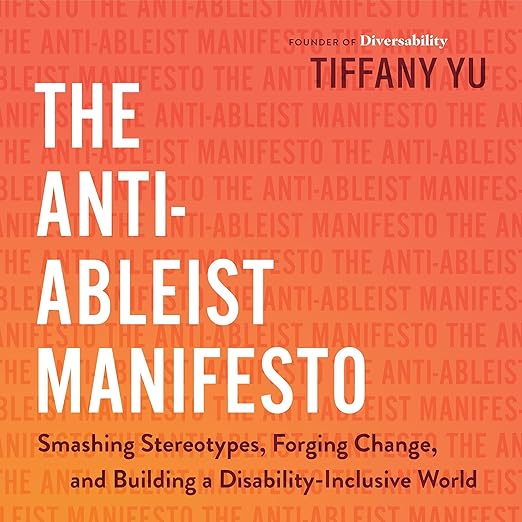
Tiffany Yu reading The Anti-Ableist Manifesto herself anchors this audiobook in something that companion disability texts rarely achieve: the voice of direct experience combined with genuine institutional knowledge. Yu founded Diversability, built an award-winning organization run by disabled people, worked as an investment banker at Goldman Sachs before that, and navigated the intersection of being an Asian American daughter of immigrants with a permanent arm injury sustained in childhood. By the time she speaks the first chapter, the credentials are not decorative. This is an audiobook about disability from someone whose life has been shaped by disability in ways both visible and invisible.
The Anti-Ableist Manifesto is organized from the personal outward: Me, then We, then Us. That structural choice reflects the book's argument. Yu is not asking the listener to engage with ableism as an abstract systemic problem before they have sat with what ableism looks and sounds like in a single human life. The early chapters are memoir-adjacent: Yu's childhood injury, the social messaging she absorbed about her arm, the professional environments she navigated where disability was either invisible or inconvenient. Only after that personal foundation does the book expand to its broader analytical work.
What to Say Instead, and Why It Matters
The book's most practically useful sections deal with language. Yu breaks down ableist vocabulary with the precision you would expect from someone who has spent years analyzing microaggressions in disability contexts: not cataloging offensive terms for their own sake, but tracing the assumptions embedded in everyday phrases and showing what those assumptions communicate to disabled people who hear them constantly. The difference between this analysis and similar exercises in other advocacy texts is that Yu pairs each example with the proximate alternative. Not just what not to say, but what to say instead and why the distinction matters at the level of relationship rather than just policy.
The chapters on inclusion in professional and institutional settings are specific enough to be immediately applicable. Yu addresses hiring practices, event design, and the market opportunity that organizations routinely miss by not considering disabled consumers and employees as a serious constituency. The economic case is made alongside the moral one, and Yu is deliberate about this. She understands that some audiences will be moved by principle and others by market logic, and the manifesto is designed to reach both. The HR and corporate book-club response documented in the reviews speaks to that dual register working as intended.
Yu's Narration Pairs Warmth With Authority
Yu's narration across 8 hours and 30 minutes is consistent and clear. The personal sections carry warmth; the analytical sections maintain authority without becoming lecturing. The book includes contributions from disability advocates, activists, entrepreneurs, and scholars, and the way Yu integrates those voices into her own argument creates a genuine sense of community around the text rather than a string of guest appearances. Hearing Yu deliver those contributions, alongside her own reflection on what they mean, makes the audio format preferable to print for this particular book.
The TikTok Anti-Ableism Series that preceded the book built an audience already familiar with Yu's approach, and the manifesto expands on that framework at book length. For listeners encountering these ideas for the first time, the ramp-up is accessible: Yu defines terms as she introduces them and does not assume prior knowledge of disability studies. For listeners already engaged with disability justice conversations, the book offers both new frameworks and a compelling synthesis of existing ones drawn from across advocacy, scholarship, and lived experience.
An HR Leader's Three Brothers, Blind Since Birth
The manifesto format means Yu is arguing a position rather than presenting a survey. The book does not offer a balanced academic account of competing frameworks in disability studies; it takes a stance, the anti-ableist stance, and builds the argument for it. Listeners looking for a neutral introduction to disability studies theory will find a more persuasive and personal text than they may have anticipated. That is a feature rather than a flaw, but it is worth knowing going in, particularly for listeners who prefer their nonfiction to be more equivocal.
The intersectional framing is consistent throughout. Yu does not treat disability as separable from race, gender, class, and immigration status in her own experience or in the broader structural analysis. For some listeners this integration will be precisely what they needed. For others it may feel like more context than they expected in a book whose title focuses on disability specifically. The book is honest about the complexity, and Yu's own life story illustrates why the separation is artificial. An HR leader reviewed the book while thinking about her three brothers who have been blind since birth: the intersection is not theoretical for most people who live with disability in their own families and organizations.
Self-Narration Makes the Investment Audible
HR professionals, organizational leaders, and diversity practitioners looking for a substantive disability-focused resource will find this audiobook immediately useful, particularly the chapters on workplace inclusion and consumer market opportunity. Corporate book clubs, as documented in the listener reviews, will find it generates real conversation rather than comfortable agreement. Individuals who want to understand ableism at a personal, daily-life level, not just a policy level, will find the memoir sections equally valuable.
Listeners who want a purely academic or clinical treatment of disability should look elsewhere. The Anti-Ableist Manifesto is written from inside the experience, and Yu's personal investment in its argument is not a bias to overcome but the entire point. The self-narration is what makes that investment audible.
Does Tiffany Yu narrate The Anti-Ableist Manifesto audiobook herself?
Yes. Yu narrates the entire 8-hour-and-30-minute audiobook herself. Her narration combines the personal warmth of the memoir sections with the analytical precision of the advocacy and professional chapters. Reviewer accounts of the audio version specifically praise the author's own voice as a meaningful asset to the listening experience.
How is The Anti-Ableist Manifesto structured as an audiobook?
The book moves from the personal (Me) to the communal (We) to the broader societal (Us). Early chapters are memoir-based, covering Yu's own experience as an Asian American woman with a disability. Later chapters address professional environments, language, event design, and institutional accessibility, with contributions from disability advocates and scholars integrated throughout.
Is this audiobook useful for corporate or organizational book clubs focused on diversity and inclusion?
Reviewers specifically document using it for exactly this purpose. Yu addresses hiring practices, consumer market opportunity, and workplace inclusion in concrete terms, making the content applicable to organizational decision-making. The dual register of moral and economic argument means the book reaches both value-driven and ROI-focused audiences in the same session.







