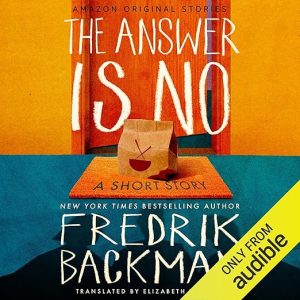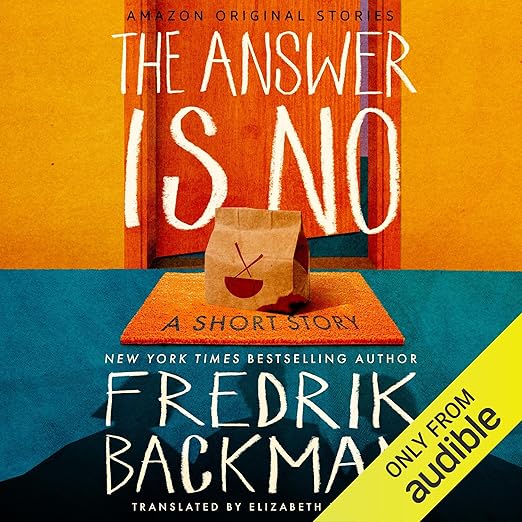
Fredrik Backman's short fiction tends to operate on the same fundamental principle as his novels: place a principled, slightly curmudgeonly loner into the path of other people's chaos, then watch the sparks. The Answer Is No audiobook, narrated by Stacy Gonzalez and clocking in at just one hour and forty-nine minutes, is as compact an expression of that principle as Backman has produced. Lucas, the story's protagonist, has constructed his ideal life around three elements: video games, wine, and pad thai with peanuts. Other people do not appear on the list. He is not unhappy. He is, in fact, the rare fictional character who has genuinely solved the problem of modern existence by opting out of most of it.
What sets this novella apart from generic comfort fiction is how precisely calibrated its absurdism is. The inciting incident, a frying pan left near the recycling room, should not be funny. It is mundane, trivial, the sort of micro-grievance that apartment buildings have been generating since apartment buildings existed. But Backman understands that bureaucracy is a comedy machine, and the building board that descends on Lucas's peace, demanding accountability for the errant pan, becomes a perfectly realized trio of petty authority. Their refusal to simply remove the pan and move on is both completely believable and completely ridiculous, and that overlap is exactly where Backman lives as a writer.
Reviewer D. W. Peach notes that Lucas is a figure of genuine satire and insight, not just slapstick, and that reading hits on something real. The story's comedic momentum depends on Lucas's logic being internally consistent, even when it collides with the logic of everyone around him. He is not wrong to prefer solitude. He is not wrong to suggest that removing the frying pan would solve the problem. The comedy comes from the gap between his reasonable position and the world's determined refusal to accept it.
There is also something worth noting about the title itself. The answer is no to what, exactly, becomes the story's running joke: it is never stated directly, and the phrasing covers Lucas's answer to the apartment board, his answer to social obligation in general, and his answer to the premise that other people's problems should become his. Backman has used this structure before, particularly in A Man Called Ove, where the protagonist's external gruffness functions as a cover for genuine moral seriousness. Here the same architecture appears in miniature, stripped of the larger novel's emotional arc but retaining its core observation: that people who seem antisocial often simply have a cleaner set of priorities than those around them.
The Strengths
Stacy Gonzalez handles the narration with the kind of restraint this material demands. Backman's humor often suffers when performers oversell it, leaning into the comedy rather than letting it land on its own. Gonzalez resists that temptation. Her delivery of Lucas's internal observations has a dry, almost reluctant quality, as though she too finds the apartment board's behavior self-evidently absurd and sees no need to underline it. The result is a listening experience that matches the writing's register rather than amplifying or undercutting it.
The short runtime deserves direct attention. One hour and forty-nine minutes is not a book that will fill a commute week or anchor a month of reading. But it is a genuine short story, not a padded summary or a teaser chapter. Backman is working within a form he understands, and the story is as long as it needs to be. Reviewer Karissa Eckert found it adorable, which sounds diminishing but is not applied here. There is skill in making a story feel exactly the right size.
Weak Spots in The Answer Is No
Pay attention to how Backman manages sympathy. Lucas is presented as a deliberate outsider, someone who has made a clear choice about how to live, and the story never punishes him for it or frames his preference as a problem to be fixed. The frying pan incident does not end with Lucas learning to love community or opening his door to connection. The comedy is sharper and more honest than that resolution would be. Readers who have encountered Backman's novels, particularly A Man Called Ove, will recognize the template, but this story applies it with a lighter touch and considerably more economy.
Also worth noting: reviewer Damita Perez, who gave it three stars, read the story as a tender, introspective piece about the quiet beauty of ordinary life rather than as satire. That reading is not wrong, exactly. Backman does embed a genuine fondness for solitude beneath the comedy. But listeners looking for Backman at his most pointed and funny will find that dimension more central here than the contemplative one. The two registers coexist, and how much you value each will shape your experience of the story considerably.
Recommended For
Backman readers who want a quick, satisfying dose of his sensibility without committing to a full novel will get exactly what they are looking for. This also works as an introduction to his fiction for people curious about his style but uncertain about the length of his novels. Listeners who expect dramatic stakes or a complicated plot will find this slim. And anyone who found A Man Called Ove too slow or too quiet will likely have the same reaction here. But for listeners who value precise comic writing, a narrator who trusts the material, and a story that knows when to stop, The Answer Is No is a confident, well-made piece of short fiction.
For listeners who appreciate Backman's longer novels and want to understand how he handles smaller-scale work, this audiobook provides a useful comparison point. The novelette form demands compression, and Backman applies it without sacrificing his characteristic voice. The result is a piece that stands on its own merits rather than feeling like an excerpt or an extended short story padded to publication length.
Does the audiobook of The Answer Is No work as a standalone listen without reading other Fredrik Backman books?
Completely. The story has no connections to Backman's novels and stands on its own. No prior familiarity with his work is needed, and it actually functions well as a first introduction to his style.
How does Stacy Gonzalez handle the comedy in The Answer Is No audiobook?
She plays it straight rather than leaning into the jokes, which suits Backman's deadpan style well. The humor lands because she delivers it with the same matter-of-fact tone that makes the prose work on the page.
Is the runtime of under two hours enough to make this audiobook feel complete?
Yes. The story is structured as a novella, and Backman does not pad it. The short runtime reflects the form, not a lack of content. It is a fully realized story that simply does not overstay its welcome.
What kind of humor does The Answer Is No use, and is it accessible to listeners who do not usually read comedy?
The humor is situational and dry rather than broad or joke-driven. It builds from an escalating absurd scenario and relies on the gap between Lucas's reasonable logic and the world's irrational response. Listeners who enjoy sardonic, understated comedy will find it accessible without any genre-specific background.