Quick Take
- Narration: Jonathan Keeble matches Thubron’s elegiac register without imposing on it, which is the right relationship between narrator and this particular prose.
- Themes: imperial memory and its living aftermath, contested border histories, the people who remain when empires recede
- Mood: Contemplative and geopolitically urgent, with lyrical stretches that earn their length
- Verdict: Thubron at eighty is still the most serious practitioner of literary travel writing working today, and this journey rewards the full ten hours.
I listened to The Amur River over the course of a wet November week, which turned out to be the right atmospheric pairing. Thubron’s journeys have a quality of weather to them, not picturesque weather but working weather, the kind that makes the ground uncertain and the distances feel longer than the map suggests. The Amur is not a cheerful river and this is not a cheerful book, which I say as someone who found it one of the most genuinely illuminating audiobooks I spent time with all year.
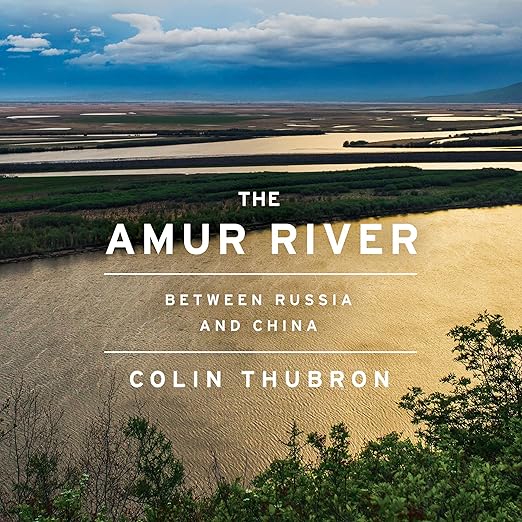
Colin Thubron at eighty years old travels nearly 3,000 miles from the Amur River’s source in the Mongolian mountains to its mouth on the Pacific, following a watercourse that for 1,100 miles forms the contested border between Russia and China. He does this by Mongolian horse, by hitchhiking, on poacher’s sloops, and via the Trans-Siberian Express. He is harassed by injury. He is detained by local police. He has revived his Russian and Mandarin for the journey, which gives him access to conversations that most travel writers working this territory couldn’t approach, and those conversations are what make the book literature rather than journalism.
What the Border Itself Means and Why Thubron Understands It
The Amur River forms one of the most heavily fortified frontiers on earth, simmering with the memory of land-grabs and unequal treaties, territorial anxieties that go back centuries and are very much alive in the present. Thubron has written about Russia and about China separately across a career of four decades; this journey is the first time he has written about the place where they press against each other. The geopolitical timing is acute: the border between these two powers sits at a point of rapid and tense reconfiguration of global politics, as the Washington Post review accurately identifies. The book was published in 2021 and reads as more urgent now than it did then.
The historical depth Thubron brings is not decorative. One reviewer described him weaving historical events with ancient and modern trade, including a seventeenth-century treaty between China and Russia that was negotiated in Latin, which is exactly the kind of detail that distinguishes this author from most travel writers. The past is not background here. It is the context within which the present is legible, and Thubron is one of the few writers working in this genre who can make that relationship feel lived rather than academic, who can hold five centuries of history and a single afternoon’s conversation in the same sentence without either one diminishing the other.
The People Along the River and What They Reveal
Thubron talks to everyone he meets: Chinese traders, Russian fishermen, monks, indigenous peoples. One reviewer described his ability to connect with the people he encounters as uncanny, noting that in revealing their hopes, motivations, concerns, loves and prejudices he brings them to life in ways that connect history, geography and humanity simultaneously. That is both the hardest thing to do in travel writing and the thing that separates the literature from the journalism. The human encounters accumulate into a portrait of a whole, pivotal world whose existence most of his readers will never directly access.
One reviewer who gave three stars noted that the dullness of certain sections was less the author’s fault than the challenging quality of some terrain and some of the people encountered along the Russian shore, and that the journey came fully alive when approaching the wild Pacific Coast. That caveat is fair and worth naming. This is a journey through some genuinely difficult landscape and the book doesn’t smooth over that difficulty. Readers looking for an easy aesthetic experience will find stretches of genuine work. Readers willing to do that work will find the Pacific Coast sections, and the accumulated weight of everything that preceded them, proportionally rewarding.
Jonathan Keeble and the Register of Thubron’s Prose
Thubron’s prose is among the most carefully constructed in the travel writing tradition. It is not showy but it is precise, and precision in audio requires a narrator who doesn’t rush toward the surface meaning at the expense of what is embedded in the sentence structure. Jonathan Keeble’s approach is measured and appropriately elegiac. The lyrical passages land without becoming overwrought. The political and historical sections maintain enough urgency that the book doesn’t tip into museum-piece detachment.
At ten hours and twelve minutes, Keeble sustains the register consistently across material that tests different emotional registers, from the bleakness of certain Russian villages to the historical grandeur of the river’s geopolitical significance. The 4.4 rating across 730 reviews reflects a readership that knows travel writing and brings serious expectations to it. The three-star reviews tend to reflect specific pacing preferences rather than objections to quality, which is the kind of distribution that indicates a book doing something genuinely its own thing rather than trying to please every possible taste.
There’s a particular section of the journey, Thubron’s encounters with the indigenous peoples along the Amur’s banks, that I found among the most affecting. These are communities caught between two empires, belonging fully to neither, and their presence in the narrative functions as a reminder that the geopolitical contest being narrated across the book’s ten hours is not abstract. People live in this contested space, have always lived in it, and will continue living in it regardless of how the larger powers rearrange their border agreements. Thubron understands that and gives those lives their proper weight.
Who Should Listen and Who Should Skip
Listen if you read travel writing as literature rather than as itinerary, if the Russia-China border is a geopolitical story you want to understand from the ground level, or if you’ve been reading Thubron for years and want to hear what he found at the place where his two great subjects meet. Skip if you need narrative momentum above all else, or if long meditative passages in difficult landscape aren’t a form you want to spend ten hours with.
Frequently Asked Questions
Do I need prior knowledge of Russian and Chinese history to follow The Amur River?
Thubron provides enough historical context within the book to orient general readers, but familiarity with the broad outlines of Sino-Russian relations enriches the experience considerably. The book works without it but rewards background knowledge.
Is this book more about Russia or about China, or does it treat both sides of the border equally?
Thubron travels both shores and gives meaningful time to both sides, though the character of the two banks is very different and the book reflects that asymmetry honestly. The Russian chapters have a different texture from the Chinese chapters.
How does The Amur River compare to Thubron’s earlier books on Russia and China?
This is widely considered among his best, with the added dimension that it synthesizes two bodies of work developed separately over decades. Readers who know Shadow of the Silk Road or his Russia books will find this a culminating perspective.
Is the geopolitical content dated given how quickly the Russia-China relationship has shifted since 2021?
The underlying structural tensions Thubron describes remain analytically current even as specific political events have shifted. The book reads as more relevant now in some ways than at its 2021 publication date.