Key Details
- Narrator: Joe Barrett gives McManus's densely researched text a steady authority, keeping the individual soldier accounts from blurring together across a 13-hour production that demands clear differentiation between hundreds of named participants.
- Subjects: American military experience, individual courage under catastrophic conditions, the human cost of strategic decision-making
- Tone: Solemn and deeply researched, with the pace of serious military history that never loses sight of the people inside it
- Bottom line: McManus's first volume on American forces at Normandy is the most thorough personal-account-based history of D-Day available in audio, and Barrett's narration gives the archival voices a dignity that suits the material.
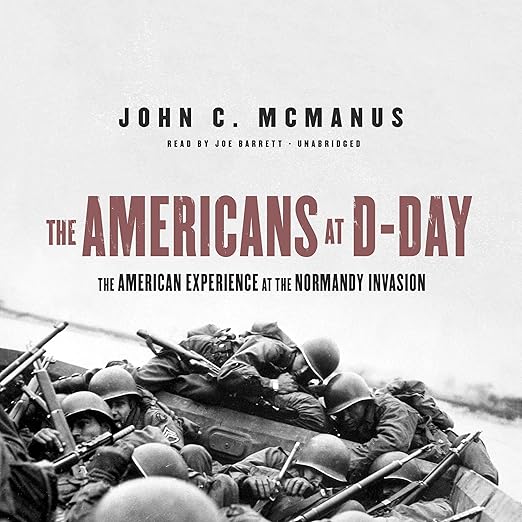
McManus begins his account of June 6, 1944 not with the strategic map or the political context but with the people who were there. That choice - to build the history from hundreds of firsthand accounts gathered from archives and survivors rather than from the commanding officers' memoirs that dominate the popular D-Day shelf - defines what this audiobook is and what it is not. It is not a tactical overview of Overlord. It is, as the subtitle implies, the story of the American experience at D-Day, conducted at the level of the precisely named and ranked individual soldier rather than the division or the army group. For listeners who want to understand what it felt like to land on Omaha Beach or drop behind German lines in the dark hours before dawn, this audiobook is the right resource. At 13 hours and 9 minutes, narrated by Joe Barrett, it has the depth to honor that ambition.
One reviewer uses the phrase "D-Day on a first name basis" to describe what McManus achieves, and that is accurate. The tapestry McManus weaves consists of singular events by singular men - their fear, their improvisation, their moments of extraordinary and often lethal courage, the specific conditions on specific sectors of the beach at specific moments in the assault. Eisenhower and Bradley and Collins appear, but they are not the center of gravity. The center of gravity is the private who found himself separated from his unit and had to decide in seconds what to do next, with evidence of that decision preserved in an archive that McManus tracked down and incorporated into this account.
The Review
Barrett's narration is steady and clear, the voice of a reader who understands that his function with this kind of material is to stay out of the way of the content rather than to perform it. Military history of this scope - encompassing the airborne drops, the naval bombardment, the landings at Utah and Omaha, the chaos of the opening hours, and the consolidation that followed - requires a narrator who can maintain the listener's orientation across an enormous cast and a complex sequence of events happening simultaneously in different locations. Barrett does this effectively, keeping the individual accounts distinct without slipping into character voices that would feel inappropriate given the gravity of the subject matter.
McManus is explicit that this is the first of two volumes on the American contribution to the Allied victory at Normandy, and that framing matters for listener expectations. This audiobook covers the preparation in England, the night drops, and D-Day itself through the end of June 6 - it does not extend into the Battle of Normandy that followed. Listeners who want the full campaign arc will need the second volume. For others, what McManus delivers within the scope of this first volume is the most thoroughly sourced personal account of D-Day that is available in audio form.
What Makes The Americans at D-Day Worth Hearing
The archival depth is the primary argument for the audio format. McManus draws on hundreds of firsthand accounts, and Barrett's reading of those accounts gives them a presence that skimming citations in footnotes cannot replicate. When a soldier's own words appear in the narrative, Barrett's voice does not shift register dramatically, but there is an attentiveness in how he reads those passages that signals their status as direct testimony. The effect, across 13 hours, is cumulative - listeners emerge from the audiobook with a population of real people in their minds, not a statistical mass of casualties and strategic outcomes.
The audiobook also works particularly well for listeners who consume military history in fragments - on commutes, in intervals, during routines that allow for sustained audio but not sustained reading. McManus structures his chapters around coherent sequences of events, so pausing between chapters doesn't break the experience the way pausing mid-chapter might. Each section is organized around a specific element of the operation, which gives the audiobook a navigable quality even across its substantial runtime.
The Caveats
One reviewer notes explicitly that this is a book about Americans at Omaha and Utah and that listeners seeking British and Canadian perspectives should look to other sources. McManus is scrupulous about his scope and does not pretend to cover the Allied operation as a whole - but listeners who are not aware of that editorial decision going in might feel the British and Canadian experience is underserved. The title makes the scope clear, but it bears emphasizing in the context of audio discovery where jacket copy is often not read carefully.
The density of named individuals is also worth acknowledging. McManus introduces an extremely large number of soldiers by name, rank, and unit across 13 hours. In print, a reader can flip back to check who someone is. In audio, that quick reference is not available, and some listeners will find the sheer population of names difficult to keep sorted without the textual scaffolding that a printed page provides. This is not a failure of the audiobook - it reflects the ambition and scope of the research - but it is a genuine audio-format consideration that listeners should factor into how they engage.
Who John C. McManus Is Writing For
Serious students of World War II and military history who want the most thoroughly sourced personal-account treatment of June 6, 1944 available in audio will find this their best option. Listeners who have read the prominent popular D-Day histories and want something that goes deeper into the individual experience, particularly the airborne operations and the specific beach sectors, will find McManus offers perspective that broader histories cannot accommodate. Veterans and families of veterans who were present at Normandy will find their people honored in the specificity of this account.
Casual military history listeners who want a single-volume overview of D-Day rather than a sustained deep study of the American contribution specifically should look at shorter, broader treatments. Those who want the full Allied perspective, including British and Canadian operations, will need to supplement this with other sources. The second volume is a natural continuation for anyone who finishes this one and wants to follow the story through the Battle of Normandy.
Questions Listeners Ask
Is this the complete story of D-Day or does it require the second volume to be fully satisfying?
McManus covers the preparation in England, the night airborne drops, and D-Day itself through June 6 in this first volume. It is complete in terms of what it sets out to cover. The second volume follows the subsequent Battle of Normandy. Listeners who specifically want D-Day rather than the full Normandy campaign will find this audiobook does not leave them stranded mid-story, though the broader arc continues in the follow-up.
How does Joe Barrett's narration manage the enormous number of named soldiers in this audiobook?
Steadily and clearly, which is the correct approach for material of this gravity. Barrett doesn't attempt to differentiate hundreds of soldiers through character voices but maintains a consistent, respectful tone that keeps the individual accounts from blurring together. For an audiobook with as many specific named participants as this one, clarity and consistency are more valuable than theatrical differentiation.
Does this audiobook cover the British and Canadian D-Day operations as well as the American landings?
No. McManus is explicit that this is a study of the American experience specifically, focusing on Utah and Omaha beaches and the American airborne operations. British and Canadian operations at Gold, Juno, and Sword beaches are mentioned where they bear on the American sectors but are not the subject of sustained coverage. Listeners wanting the full Allied perspective should supplement with British- or Canadian-focused D-Day histories.
Is The Americans at D-Day audiobook suitable for listeners who already know the D-Day story from other sources?
Particularly well-suited. The value of this audiobook is not in the basic sequence of events - which is covered in many places - but in the extraordinary depth of firsthand accounts McManus has assembled from archives. Readers who know Ambrose or Beevor on D-Day will find that McManus is operating at a different level of personal specificity that those broader histories cannot accommodate.