Quick Take
- Narration: Robert Petkoff brings measured authority to a sprawling, multi-voiced history without ever crowding out the source material, his pacing matches the weight of the subject.
- Themes: Colonial rebellion, identity and belonging, democratic ideals vs. lived exclusion
- Mood: Sweeping and intimate in equal measure, like watching a great documentary with your eyes closed
- Verdict: An essential companion to Ken Burns’s PBS series that stands on its own as a serious, carefully humanized account of America’s founding contradiction.
I started this one on a long Sunday afternoon when I had nothing pressing to do except launder some clothes and think about things. I expected the familiar frame, Washington, Jefferson, Bunker Hill, Yorktown. What I did not expect was to be nearly two hours in before a single conventional hero’s name appeared, because Ward spends that early stretch with the people who typically exist only in footnotes: the Loyalists who believed they were the real patriots, the Black soldiers who fought on both sides for reasons that had everything to do with their own freedom and almost nothing to do with the colonists’ ideological arguments, the Indigenous nations watching a power struggle that would, regardless of outcome, mean the erosion of everything they had.
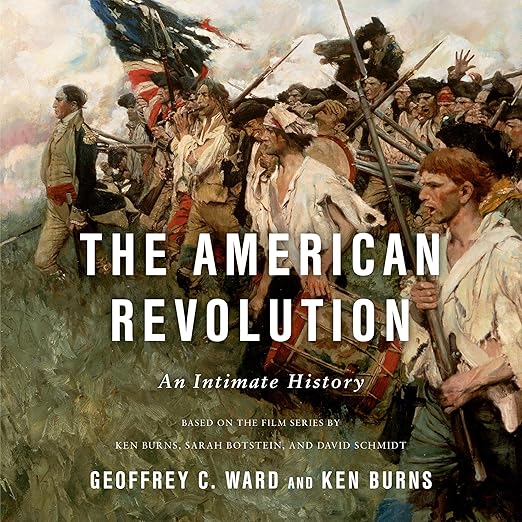
The audiobook runs just under 23 hours, which is long, but the length is earned. This is Geoffrey C. Ward working at the peak of his documentary collaboration with Ken Burns, and the material is organized to mirror the six-part PBS series that aired in late 2025. But the book is not a transcript. Ward gives you context the screen cannot, and Robert Petkoff’s narration never feels like a reader racing to cover territory. He sounds like a man who has thought carefully about each sentence.
Where the Guest Historians Change Everything
The structural decision to weave in guest essays from historians like Maya Jasanoff, Vincent Brown, Jane Kamensky, and Alan Taylor is what separates this from a solid survey textbook. Jasanoff has spent her career looking at the American Revolution from the perspective of the people who lost it, the Loyalists who were expelled, the freed slaves who ended up in Sierra Leone, the Indigenous leaders who understood with terrible clarity what a British defeat would mean. Her presence in this audiobook is not decorative. Her arguments actively complicate Ward’s central narrative in productive ways, and Petkoff handles the tonal shift between Ward’s prose and the more academic register of the essayists with genuine skill. He does not perform the difference; he simply lets it land.
Brown’s contribution on African American resistance and the radical reimagining of liberty is particularly striking in audio form, where you cannot skim. You have to sit with the argument that the Revolution was simultaneously a founding document of freedom and a legal fortification of slavery, and you have to follow that argument from beginning to end before the chapter moves on. That linear discipline is one of audio’s genuine gifts to serious history.
The Bottom-Up Architecture That Holds
Ward frames this explicitly as a history told not from the top down but from the bottom up. The Founding Fathers are here, you get Washington’s tactical limitations as much as his moral authority, and Adams’s irritability alongside his intellectual rigor, but they are not the gravity around which everything orbits. That reorientation is harder to sustain over 23 hours than over a 90-minute film, and there are moments, particularly in the military chapters around the middle of the audiobook, where the bottom-up ambition recedes and we are back in conventional battlefield history. Petkoff reads those sections with the same care he brings to everything else, but they are the sections where the book feels most like its peers and least like itself.
The Thomas Paine thread, the book opens with the line “From a small spark kindled in America, a flame has arisen not to be extinguished” and returns to his words throughout, functions as a kind of spine for the whole enterprise. Paine is used to ask the question the book never lets drop: who exactly was entitled to life, liberty, and the pursuit of happiness? It is not a rhetorical question here. Ward and his historian collaborators mean it literally, and the audiobook’s final hours feel like the accumulated weight of that question pressing down.
The Visual Apparatus You Are Missing
One reviewer noted this is a companion volume with rich illustration, and that deserves acknowledgment. Maps, paintings, engravings, and primary documents reproduced in the print edition are simply absent in audio. For the military campaign sequences in particular, where geographic context matters, listeners may want to have a map open on a second screen. The audiobook does not collapse without it, but a few of the campaign descriptions, particularly around the southern theater in the later years of the war, assume a spatial orientation that audio cannot provide. Ward’s prose compensates by being unusually precise about cardinal directions, but it only goes so far.
Who Should Listen, Who Should Skip
This is for listeners who watched the PBS series and want to go deeper, and also for listeners who have not seen it and want a serious, humanized account of the Revolution that does not treat the founding mythology as settled fact. It is not for someone looking for a quick orientation, at nearly 23 hours, this is a genuine commitment. It rewards patience, and Petkoff’s narration makes that patience easy to maintain. Skip it if you want pure military history or a straight biographical portrait of one founder; this book’s interest is structural, not heroic.
Frequently Asked Questions
Do I need to watch the Ken Burns PBS series before listening to this audiobook?
No. The book is designed as a companion but functions independently. The PBS series aired in late 2025, and the audiobook expands on it with additional context, guest historian essays, and material the documentary format could not accommodate. Either order works.
How does Robert Petkoff handle the shift between Ward’s main text and the guest historian essays?
Petkoff maintains a consistent, measured tone throughout but modulates register subtly when moving between Ward’s narrative prose and the more analytical passages from historians like Maya Jasanoff and Vincent Brown. He does not over-dramatize the transitions, which suits the material.
Are the maps and illustrations from the print edition available in the audiobook version?
No. The print edition is described as visually rich with maps and primary source images, none of which are accessible in the audio format. For the military campaign sequences, having a separate map resource open helps with geographic orientation.
How does this compare to other survey histories of the American Revolution, like Joseph Ellis’s work?
Ward’s approach is more deliberately inclusive of marginalized perspectives, Loyalists, Indigenous nations, enslaved people, women, than most single-author survey histories. The guest essay format also gives the book a multi-voice quality that single-author surveys cannot replicate. Ellis tends toward the biographical and the psychological; Ward tends toward the structural and the human.