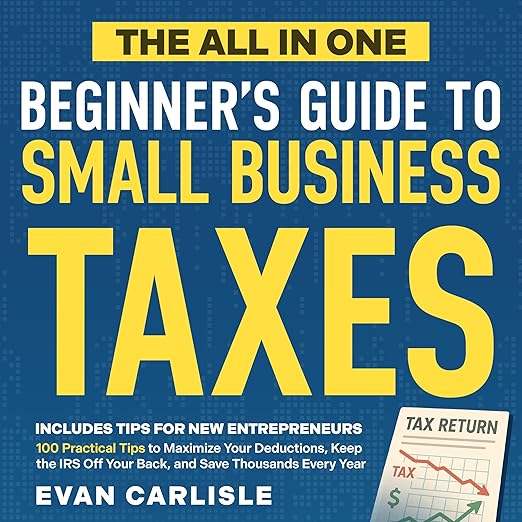
Tax season dread is a specific kind of anxiety: not fear exactly, but the persistent worry that you are doing something wrong without knowing quite what or how to fix it. Evan Carlisle identifies that feeling in the opening pages of this audiobook and builds the entire structure of The All in One Beginner's Guide to Small Business Taxes around dismantling it. That focus on the emotional experience of being a confused small business owner, as much as on the technical content, is what distinguishes this title from more purely instructional competitors.
Third Entry Speaks Directly to Etsy Sellers
The book is the third entry in Carlisle's All-in-One Beginners Guide series, and it shows the confidence of a writer who has learned how to calibrate information density for a specific audience. The target listener is named directly in the synopsis: freelancers, coaches, Etsy sellers, and small business owners who have worried about audits, questioned whether they are tracking deductions correctly, and found the quarterly tax system baffling. That specificity of audience is one of the book's genuine strengths, because it means the examples and framing consistently match the situations listeners are actually in rather than defaulting to abstract scenarios.
One Hundred Tips Spread Across the Whole Book
The content covers the territory its title promises: deductions, receipt and income tracking systems, quarterly tax calculations, and common beginner mistakes. The promise to do this without spreadsheets is not empty; the book consistently translates financial concepts into language that does not require a background in accounting to follow. Reviewer David Klick described it as confidence-building without ever feeling overwhelming, which captures the tone accurately. Carlisle explains tax concepts clearly and connects them to the kinds of business arrangements his target readers actually have.
The one hundred practical tips mentioned in reviewer aker's response are spread throughout the text rather than listed as a standalone section, which means the book functions better as a complete listen than as a reference document to return to for specific items. For listeners who want to bookmark particular deduction categories or quarterly calculation methods, the PDF companion is the more appropriate tool. The audiobook delivers its value in the progressive clarity it builds across the full runtime.
Rodis's Warmth Turns Tax Talk Into Conversation
Cory Rodis handles the narration with the kind of measured warmth that instructional audiobooks in the personal finance space require. Tax content in audio format can easily tip into the monotonous, particularly when covering material that is inherently procedural. Rodis maintains engagement through a conversational register that matches Carlisle's writing style and keeps the listener oriented as the subject matter shifts between deduction categories, system-building, and quarterly planning.
The audiobook format has a specific advantage for this material: it reduces the intimidation factor that the same content encounters on the page. Reviewer YF noted that taxes had always felt overwhelming and stressful before this book and that the plain, straightforward language, delivered without talking down or overcomplicating, genuinely changed that. That response recurs across positive reviews: the audio experience of having someone calmly explain something that has previously felt threatening is itself a significant part of what the format delivers.
At 3 hours and 41 minutes, the production is compact. A first-time self-employed person could complete it in an afternoon and emerge with a working understanding of quarterly taxes, the landscape of common deductions, and a basic framework for organizing records. That is a meaningful return on under four hours, and the PDF companion extends the value by providing the working documents that put the concepts into practice.
Structural Knowledge Outlasts This Year's Specific Rates
Tax law changes. The specific rates, thresholds, and rules described in this audiobook reflect a particular point in time, and some details will inevitably become outdated as tax legislation evolves. The structural knowledge, which covers the approach to tracking, deduction categories, quarterly estimation logic, and audit preparation, remains useful regardless of year, but listeners should verify current-year specifics against IRS guidance or a qualified professional before filing. The book is best treated as a system for thinking rather than a definitive reference for any particular tax year.
The book explicitly notes that a PDF companion is available. The downloadable materials, which include deduction planners, quarterly estimators, and audit-proof templates, are directly relevant to the book's core promises and are worth accessing alongside the audio. Listeners who want to use the systems the book recommends should plan to engage with the PDF as a working document rather than treating it as optional supplementary material. The audiobook describes the systems; the PDF is where you actually use them.
The geographic scope is US-focused. The book addresses IRS requirements, Schedule C, and federal quarterly tax obligations. Listeners outside the United States will find the structural framework for thinking about self-employment taxes useful, but the specific regulatory content applies to US law. International listeners should confirm whether the book's tax-specific guidance applies to their jurisdiction before treating any particular recommendation as actionable in their context.
Right for Side-Hustlers Without a Reliable Tax System
The clearest audience is someone who has recently moved from employment to self-employment or who is running a side hustle alongside a day job and has not yet established a reliable tax system. The specific examples in the book, Etsy sellers, coaches, freelancers, reflect a real understanding of the kinds of business arrangements that create the most tax confusion for first-time self-employed people, and the content addresses those situations directly rather than defaulting to generic small business scenarios.
Established business owners with an accountant already in place and existing systems for tracking deductions will find the book redundant. Those who are somewhere in the middle, running a business but still uncertain about whether they are handling taxes correctly and not yet ready to hand everything off to a professional, are the listeners this audiobook was built for. At its runtime and level of specificity, it delivers clearly on that promise without the anxiety that tax content often generates in the people who need it most.
Questions Listeners Ask
Is this audiobook useful for someone who already uses an accountant?
Probably less so. The book is aimed at self-employed individuals and small business owners who are managing their own taxes without professional help, or who want to understand enough to work more effectively with a professional. If you already have an established system and a regular accountant, the foundational content may cover ground you have already internalized.
How current is the tax information in this audiobook?
The structural framework around deductions, quarterly taxes, and record-keeping is durable, but specific rates and thresholds change with legislation. Treat the book's specific numbers as starting points to verify against current IRS guidance or a qualified tax professional before filing. The foundational concepts are what deliver long-term value from this audiobook.