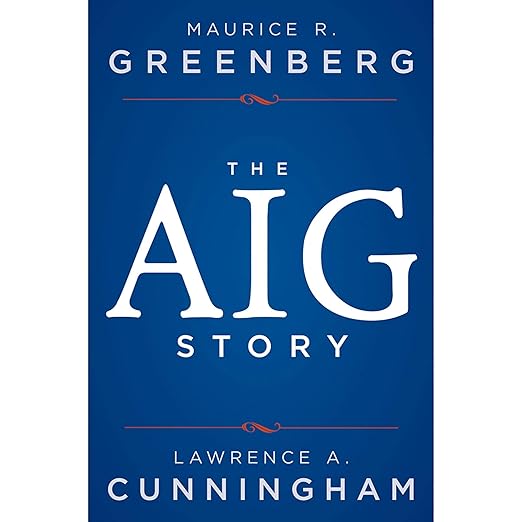
Quick Take
- Narration: Andy Caploe maintains a businesslike tone suited to the corporate history format, clear and professional across nearly twelve hours of dense financial and political narrative.
- Themes: Entrepreneurial vision and institutional culture, the politicization of financial regulation, legacy and accountability
- Mood: Authoritative and somewhat partisan, this is a defense as much as a history, and it reads that way
- Verdict: An indispensable inside account of AIG’s rise and the circumstances of Greenberg’s removal, essential for finance and business history listeners, though its advocacy posture should be taken with clear eyes.
I came to The AIG Story looking for the inside account of one of the twentieth century’s most remarkable corporate builds and one of the most contested corporate collapses. What I found was both of those things, plus something I had not quite prepared for: a defense brief, written with full conviction, by the man who built the institution and who watched what he considered its destruction from the outside. That is a different kind of business book than the neutral analytical histories that populate this genre, and understanding what it is going in makes the experience considerably more productive.
Maurice Greenberg took control of a small, failing insurance company in 1962. By 2004, American International Group had become the eighteenth largest company in the world, a genuinely astonishing forty-two-year build that involved opening markets in countries where no Western insurer had operated, developing global relationships with heads of state, and building an internal culture that multiple former employees have described in unusually loyal terms. That is the first half of this book, and it is the more compelling half: the mechanics of building something that had not existed before, at a scale that was not obvious to anyone in 1962.
Our Take on The AIG Story
The second half is where the book becomes explicitly argumentative. Greenberg was forced out of AIG in 2005, before the financial crisis, after the New York State Attorney General Eliot Spitzer began an investigation into accounting practices. The 2008 crisis then nearly destroyed the company he had built, requiring a massive government bailout. Greenberg’s position is clear and sustained throughout: the culture and risk management structures he had built would not have produced the 2008 catastrophe, and the circumstances of his removal were driven by Spitzer’s political ambition rather than genuine wrongdoing. A reviewer described Spitzer’s investigation as “wholly unwarranted, unsustainable, and frankly spiteful”, a characterization Greenberg would recognize as consistent with his own account.
A more measured reviewer acknowledged that this is “a vigorous and impressive defense” while noting that the absence of the opposing voice means the simplistic negative view of Greenberg gets corrected without being fully complicated. That is the right reading: this is not a neutral text. It is a first-person history by someone with strong grievances and a compelling case to make, and it is more useful when read with an awareness of that posture than when read as if it were disinterested biography.
Why Listen to The AIG Story
Andy Caploe narrates with the steadiness that nearly twelve hours of corporate history and regulatory argument requires. The material is dense, insurance arcana, geopolitical market-opening, complex financial instruments, regulatory procedure, and a narrator who loses the thread loses the listener for extended stretches. Caploe does not lose the thread. His delivery suits the authority of Greenberg’s voice without impersonating it, which is the right call for material this specific.
The book is co-written with Lawrence Cunningham, a corporate governance expert, and the collaboration shows in the structural organization of the historical chapters. Cunningham’s interviews with other players add credibility to sections that could otherwise feel entirely one-sided.
What to Watch For in The AIG Story
The advocacy posture is not a flaw in the book but a feature of its genre, insider memoir is inherently partial, and financial memoir is especially so. But this book is more explicitly a legal and reputational defense than most, and the passages dealing with Spitzer, with the government seizure of 2008, and with Greenberg’s battles in the aftermath of his removal are written with a heat that the earlier historical chapters do not share. A reviewer specifically recommended reading Fallen Giant alongside this book for a more balanced perspective, and that is sound advice for anyone trying to understand the AIG story in full rather than Greenberg’s version of it.
The book is also genuinely dense. The early chapters on building AIG’s international operations contain detailed accounts of market-by-market expansion across decades, which rewards listeners with existing interest in global insurance and financial history but can feel granular to those without that background.
Who Should Listen to The AIG Story
Essential for listeners with serious interest in twentieth-century business history, global insurance, or the financial crisis of 2008 from a perspective that is rarely given this much space. Also valuable for anyone studying the relationship between regulatory enforcement and corporate governance, or the role of state attorneys general in financial markets. Former AIG employees who experienced Greenberg’s tenure will find the internal culture sections particularly resonant. Skip it if you require neutral analysis, the book’s advocacy posture is not a flaw but it is a defining characteristic, and listeners who come expecting dispassionate history will find the second half actively uncomfortable.
Frequently Asked Questions
Is The AIG Story a neutral history of the company, or is it written from Greenberg’s perspective?
It is explicitly written from Greenberg’s perspective and functions in part as a defense of his record and reputation. Co-author Lawrence Cunningham adds structural rigor and interview material from other players, but the primary voice and argumentative posture is Greenberg’s. Several reviewers recommend reading it alongside more neutral accounts, such as Fallen Giant, for a complete picture.
How much background knowledge of insurance and financial markets does this book require?
More than most business audiobooks assume of their audience. The sections on AIG’s global market expansion and the financial instruments at the center of the 2008 crisis use terminology that rewards some prior familiarity. General business history listeners can follow the broad narrative, but some of the technical detail in the middle chapters will be more accessible with existing knowledge of insurance and finance.
Does The AIG Story cover the 2008 financial crisis and government bailout in detail, or does it focus primarily on Greenberg’s era?
It covers both. The book tracks Greenberg’s building of AIG from 1962 through his removal in 2005, then addresses the 2008 crisis and government seizure through the lens of what he believes would have been different had he remained in control. His argument about the connection between the post-2005 leadership culture and the 2008 collapse is one of the book’s central claims.
How does Andy Caploe’s narration handle the difference between the historical sections and the more contentious regulatory and legal passages?
Caploe maintains a consistent, measured tone throughout both the historical chapters and the more heated regulatory sections. He does not editorialize through vocal inflection, which serves the book’s credibility by not amplifying the advocacy posture, the arguments are left to carry themselves rather than being pushed by performance choices.