- Narration: Virtual Voice AI narration handles terminology clearly but strips the professional urgency from Bohnke's practitioner-driven prose; the irony of AI-generated audio for a human-AI partnership guide is real and worth acknowledging.
- Themes: AI integration in sales workflows, objection prevention versus objection response, human judgment in AI-augmented selling
- Mood: Practical and forward-facing, occasionally evangelical
- Verdict: A practitioner-grounded AI sales framework that works better as a print reference than as an AI-narrated audiobook, though the content is strong enough to justify either format for the right reader.
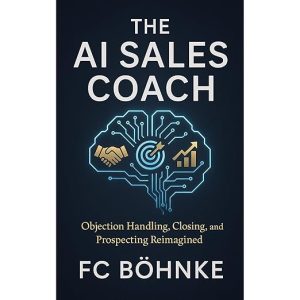
FC Bohnke's AI Sales Coach positions itself as something the sales training genre has needed for years: a guide that stops treating artificial intelligence as a curiosity and starts treating it as the operating environment. As an audiobook, the Virtual Voice narration is immediately apparent, and it creates a tension specific to this particular title, a book about human-AI partnership in professional communication, rendered in AI-generated audio. That irony is worth sitting with before deciding whether the content justifies the format.
Bohnke's credentials are specific and verifiable: fifteen years of consulting for companies including PayPal and Revolut, with a practice at frederikunfiltered.com built around AI-powered sales strategy. That background shapes the book's approach in useful ways. The advice is not theoretical AI enthusiasm; it is drawn from implementation experience across organizations with real pipeline pressure and real adoption friction. The difference shows in how the material handles failure cases and rollout realities rather than idealizing AI adoption as a linear upgrade path.
The book's structure moves through the full sales cycle: prospecting, qualification, objection handling, closing, and what Bohnke calls the complete AI sales stack. Each section is built around specific techniques rather than principles, which is the correct approach for a professional audience that needs actionable adjustments, not motivation. The claim of 'thirty to fifty percent better results' appears early and may test some listeners' patience, that figure is framed as achievable but not universally guaranteed, and Bohnke is careful to anchor it to specific conditions rather than presenting it as a baseline outcome.
Proactive Objection Design Replaces Reactive Response
The objection-handling section is the book's strongest. Bohnke's argument that AI can predict and pre-empt objections using behavioral data is well supported by the implementation logic he walks through. The move from reactive objection response to proactive objection design is a real shift in sales methodology, and the audio format works reasonably well here because the concept is verbal and can be absorbed without charts or workflows. Listeners who spend time in discovery calls will recognize the patterns he describes and find the AI-augmented frameworks a plausible evolution of techniques they already use.
The closing section is less revelatory but still practically grounded. Behavioral analysis applied to timing, reading prospect engagement signals to identify optimal commitment moments, is an approach that enterprise sales teams have been deploying for several years, and Bohnke synthesizes the current toolkit competently. Where the book adds value is in making that toolkit accessible to individual contributors and small business owners who lack the CRM infrastructure of larger organizations. The democratization argument is genuine: the tools Bohnke describes are not exclusively available to Fortune 500 sales departments.
The human-AI partnership framing in the final sections is the most important conceptual contribution. Bohnke's explicit argument that AI insights must be filtered through human judgment, not replace it, guards against the automation-as-solution fallacy that has undermined other AI adoption guides. He is honest about the failure modes: overdependence on predictive scoring, loss of authentic relationship texture, and the risk of personality-matching algorithms creating persuasion without genuine understanding. For sales professionals worried about what AI does to the craft of selling, those sections offer an honest accounting.
Virtual Voice Narration Flattens the Urgency
The Virtual Voice narration is the book's primary limitation as an audio experience. At two hours and fifty-one minutes, the content is dense but manageable, the AI narration keeps pace with the material and renders technical terminology clearly. What it cannot do is convey the professional urgency that shapes how sales content lands. Bohnke's prose, in skilled human hands, would carry the cadence of someone who has sat in those discovery calls and felt the resistance he describes. The synthetic delivery flattens that texture. Listeners who primarily absorb nonfiction through audio should consider whether the print or Kindle edition might serve them better for content that benefits from annotation and reference.
The book's scope is impressively broad for its runtime. A reader hoping for deep implementation guides for specific AI tools will find the coverage necessarily high-level. Bohnke names tool categories and use cases rather than walking through configuration of specific platforms, a sensible choice given how rapidly the AI tool landscape changes, but a limitation for listeners who want step-by-step setup guidance.
The prospecting section offers one of the more honest treatments of AI-powered lead qualification currently available in business audio. Bohnke's claim that predictive analytics can identify high-quality prospects with ninety percent or better accuracy is ambitious, and he is careful to contextualize it within systems that have been trained on substantial behavioral data. The practical framework he describes, using behavioral signals to identify prospects ready to engage before outreach rather than chasing cold leads through volume, represents a real shift in how outbound sales works when AI tools are properly integrated. For sales teams still operating on the assumption that more activity equals more pipeline, the qualification material is the section most likely to change how they think about where to direct effort.
Sales Professionals With Experience, Not Beginners
Sales professionals with two or more years of experience who want a structured framework for integrating AI tools into an existing process will find this more useful than a beginner's guide. The language assumes familiarity with pipeline management, qualification frameworks, and objection categories, newcomers to sales will need supplementary material to contextualize the AI overlays Bohnke describes. Entrepreneurs managing their own sales processes will also find the independence-oriented framing useful: the book is built for individuals as much as for teams.
Listeners who prefer human narration and tend to pause and re-listen to dense professional content should approach this audiobook version cautiously. The Virtual Voice rendering is functional but not the format in which Bohnke's material sings.
Good to Know
Is the AI Sales Coach audiobook suitable for someone just starting out in sales?
It assumes prior familiarity with pipeline management and objection frameworks. Beginners will benefit more from foundational sales training first. The book is best positioned for professionals ready to augment an existing practice with AI tools.
Does the audiobook cover specific AI tools by name or is it more conceptual?
Bohnke covers tool categories and use cases rather than step-by-step configuration of specific platforms. This keeps the content durable as the AI tool market evolves, but listeners who want implementation walkthroughs will need to supplement with vendor documentation.
How does the Virtual Voice narration affect the listening experience for this audiobook?
The AI narration is technically clear and accurate but lacks the professional authority that practitioner-driven content benefits from. Listeners who annotate or re-listen to key sections may prefer the print edition.
Does the audiobook address concerns about AI replacing human relationship-building in sales?
Yes, directly. Bohnke devotes significant space to the human-AI partnership framework and explicitly argues that AI insights must be filtered through human judgment. He outlines specific failure modes of over-automation, including loss of authentic trust-building.