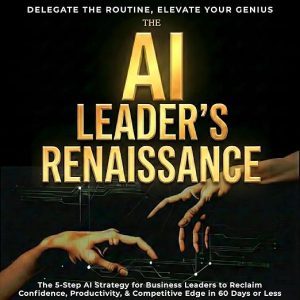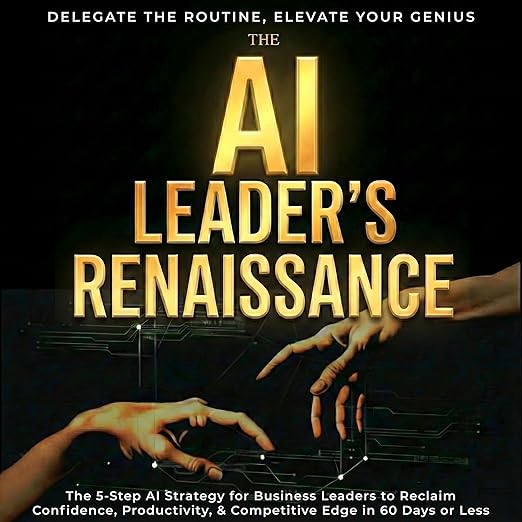
The AI Leader's Renaissance asks a question that most AI books sidestep entirely: not which tools should you learn, but what kind of work should you stop doing? Austin Chen's audiobook, narrated by Ted Kettler across nearly 8 hours, positions itself against the grain of AI adoption discourse that frames the challenge as a skills race. The argument here is structural rather than tactical: as automation makes speed, volume, and technical execution increasingly cheap, the human capabilities that become rare and valuable are judgment, direction, and the ability to decide what actually matters. This audiobook was designed for people already in leadership roles, responsible for outcomes rather than output, and that specificity of audience is one of its genuine assets.
Chen's central framework, the Automate vs. Amplify distinction, organizes the book's practical content. The premise is that AI adoption mistakes divide into two categories: using AI to do faster what you should stop doing altogether, or failing to use AI to enhance the capabilities that define your actual value. The Commoditization Trap, which Chen describes as the risk of turning AI adoption into faster-but-lower-leverage work, is one of the more useful diagnostic frames in recent AI-for-leaders writing. The trap is real: it is entirely possible to become an efficient producer of outputs that AI is simultaneously making less valuable, and the book's insistence that the question is not how to keep up but how to step out of execution into direction is the kind of reframing that some readers will find genuinely clarifying.
One reviewer described the experience of reading this book as addressing "that quiet sting of wondering if your hard-won expertise has an expiration date." That framing captures the emotional register Chen is working in. The book does not dismiss professional anxiety about AI's effect on knowledge work; instead, it tries to redirect that anxiety into a question about where human value actually lives in an AI-assisted environment. The answer Chen proposes is consistent across the book: not in execution speed or technical breadth, but in judgment, in knowing which decisions matter and which can be delegated.
Ted Kettler Paces a Five-Step Framework Well
The 5-step system Chen introduces, Release, Expand, Partner, Protect, Elevate, gives the audiobook a structural throughline that makes the abstract argument about AI leadership concrete. Each step addresses a specific relationship between human judgment and AI capability, from releasing routine tasks to elevating the decisions that compound human value over time. Ted Kettler's narration paces through this framework content with enough modulation to distinguish between definitional moments, practical applications, and strategic asides. The audiobook format suits Chen's approach better than a densely visual business book would, because the framework relies on argument and sequence rather than charts or matrices that need to be seen.
A second reviewer described the book as reframing AI at work "not as a tool race, but as a leadership shift," and praised its focus on judgment and decision-making rather than productivity hacks. That reframe is the book's consistent value proposition, and Chen returns to it from multiple angles without becoming repetitive. The promise of reclaiming 10 or more hours per week by offloading routine work is quantified enough to feel concrete while remaining illustrative rather than prescriptive, which is the right balance for a leadership book.
Two Five-Star Reviews and a Series to Come
The book is explicitly positioned for people already in leadership roles, described in the synopsis as those responsible for outcomes, not just output. Readers early in their careers or in individual contributor roles will find some of the framework applicable but may lack the organizational leverage to implement the delegation strategies Chen describes. The book does not require coding knowledge or deep technical fluency, which broadens its accessible range, but it does assume familiarity with the general landscape of AI's effects on knowledge work. Listeners expecting a tools guide or a platform-specific tutorial will find the content intentionally positioned against that expectation.
The two available reviews both rate this five stars, and the reviewers are specific about what worked for them in terms that align with the book's stated purpose. The low review count means the broad reception remains unclear, but the existing feedback suggests the book is landing with its intended audience. The series framing, AI for Business, Strategy, and Leadership, indicates Chen and his publisher are positioning this as the first entry in a longer body of work on AI leadership, which may be worth tracking if this audiobook's framework resonates.
Managers Who Want to Direct AI Adoption
Managers, directors, and executives who are responsible for team outcomes and are trying to figure out how to direct AI adoption rather than react to it. Knowledge workers who feel the pressure of AI's effect on their professional value and want a framework for thinking about where human judgment remains irreplaceable. Listeners who found other AI adoption books too focused on specific tools and not enough on strategic direction will find Chen's perspective a useful counterweight. Those who need technical depth on AI systems, specific platform tutorials, or coding guidance should look elsewhere. Anyone in early-career roles may find the leadership and delegation focus less immediately applicable to their current responsibilities, though the underlying argument about judgment versus execution has relevance across career stages. As AI capabilities continue to expand, Chen's core insight that the rarest and most durable form of professional leverage is the ability to decide what actually matters seems likely to age well.