Quick Take
- Narration: Sean Pratt brings a clear, journalistic authority to Vigna and Casey’s Wall Street reporting, the voice suits the investigative nonfiction register of the material throughout its long runtime.
- Themes: Bitcoin as financial disruption, blockchain technology and its societal implications, the global unbanked population and what digital currency promises them
- Mood: Measured and genuinely curious, journalism at its best rather than advocacy at its loudest
- Verdict: Published in 2015, this book is historically important as a document of crypto’s emergence but requires supplementary reading to account for the decade of extraordinary change that has followed.
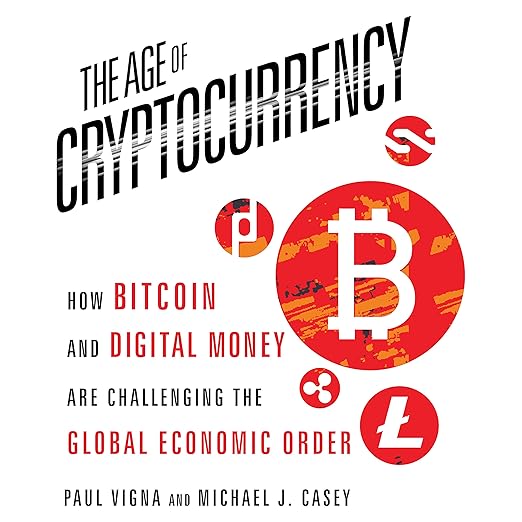
There is a particular challenge in reviewing a book about cryptocurrency that was published in 2015. The Age of Cryptocurrency, written by Wall Street Journal reporters Paul Vigna and Michael J. Casey, appeared when Bitcoin was still exotic enough that explaining what a blockchain was to a mainstream audience required significant effort and rhetorical care. A decade later, that explanation has been attempted ten thousand times in ten thousand formats, and the question for a contemporary listener is not whether the book explains things clearly, it does, with considerable skill, but whether the history it tells is still the history that matters most for understanding where we are now.
The answer is complicated in an interesting way. Vigna and Casey were not writing futurism. They were doing journalism, specific, reported, grounded in the people and institutions that were building and contesting cryptocurrency in the early 2010s. The book traces Bitcoin’s origins through Satoshi Nakamoto’s anonymous white paper, moves through the early adopter communities, examines the Silk Road episode and its regulatory consequences, and arrives at a considered argument about why decentralized digital currency represents something structurally significant about the future of money. Not because it is perfect or inevitable, but because the system it challenges has well-documented failures of its own that the financial crisis of 2008 made impossible to ignore.
The Journalistic Approach and What It Earns
The book’s greatest strength is exactly what you would expect from two reporters with Wall Street Journal credentials: skepticism. Vigna and Casey are not Bitcoin evangelists. They are not Austrian economics libertarians who have decided that fiat currency is inherently fraudulent and cryptocurrency is the only honest system. They are journalists who found a complicated story and reported it with the thoroughness it deserved. One reviewer observed that the authors are “not fanboys or breathless libertarian utopians, like so many of Bitcoin’s John the Baptists; rather, they are thoughtful and approach cryptocurrency from all angles and take a sober and rational stock of what it is, and what it is not.” That sobriety is the book’s most durable quality and the reason it holds up as a historical document even as much of its specific technical and regulatory landscape has shifted beyond recognition.
The Blockchain Chapter and Its Explanatory Achievement
Chapter five, dedicated to how the blockchain actually works, receives specific praise from reviewers who describe finally understanding the technology after encountering it in several other contexts. This is a genuine achievement, blockchain explanations have a long history of being either too technical for general readers or too simplified to convey what is actually happening in any meaningful way. Vigna and Casey find a middle path by grounding the technical description in the economic problem it solves, double-spending, the need for trust in a trustless system, rather than beginning with the cryptographic mathematics. The narrative around key figures in the early cryptocurrency drama, including miners, exchange operators, and the figures involved in the various early collapses and controversies, gives the abstract technical material a human frame that keeps it accessible across the full fourteen-hour runtime.
Sean Pratt and the Long-Form Nonfiction Requirement
At fourteen hours and seventeen minutes, The Age of Cryptocurrency requires a narrator with sustained authority and clarity. Sean Pratt is a reliable choice for this kind of material, his voice carries the even, confident quality of someone who handles long-form reported nonfiction regularly, and the financial and technical vocabulary does not present obstacles. The book’s structure, which moves between narrative journalism, technical explanation, and historical analysis, requires tonal flexibility, and Pratt manages the transitions without flattening the different registers into a single undifferentiated delivery. For a book that spends considerable time in both the mathematical abstractions of distributed ledger systems and the human drama of courtrooms and regulatory hearings, that range matters.
How to Listen to a Decade-Old Cryptocurrency Book
The most honest way to engage with this audiobook in 2026 is as the foundational layer of a much larger story that it could not have anticipated. Everything that has happened since, the rise of Ethereum and altcoins, the NFT wave and collapse, DeFi, multiple market cycles, Bitcoin ETF approval, the FTX scandal, regulatory frameworks in dozens of jurisdictions, built on the infrastructure this book describes and the cultural argument it traces. None of that renders The Age of Cryptocurrency obsolete. It renders it historical, which is a different thing entirely. Listeners who treat it as a starting point and then follow the story forward will get considerably more from it than those who treat it as a current guide.
Who should listen: Listeners interested in the history of Bitcoin and blockchain as a reported story rather than a technical manual or an investment thesis; readers who want to understand why cryptocurrency became culturally significant before the hype cycle made sober assessment difficult; anyone building foundational knowledge about digital finance who wants primary historical sources. A supplementary reading list from 2020 onward is genuinely needed. Who should skip: Anyone looking for current investment guidance, trading strategy, or a contemporary assessment of the crypto landscape, this book is a historical document, and treating it as current would be a significant misapplication of what it offers.
Frequently Asked Questions
How out of date is a 2015 book about cryptocurrency in 2026?
Significantly, in terms of specific prices, regulatory landscape, and the status of particular projects and exchanges. But the foundational explanations of blockchain mechanics, the history of Bitcoin’s origins, and the structural arguments about what decentralized currency represents remain relevant as historical context. Think of it as the foundational layer, not the current state.
Does the book cover anything beyond Bitcoin, Ethereum, altcoins, DeFi?
The primary focus is Bitcoin and the blockchain technology underlying it. At the time of publication, Ethereum was in very early development and altcoins were a minor footnote rather than an entire ecosystem. For coverage of what has happened since 2015, contemporary sources are essential.
Is this book appropriate for someone with no background in economics or finance?
Yes. Vigna and Casey write for a general audience, the book begins with first-principles questions about what money actually is before working toward the technical and economic arguments for cryptocurrency. No prior background in economics or finance is assumed or required.
Does Sean Pratt’s narration handle the technical blockchain and cryptography explanations clearly?
Yes. The technical sections are paced carefully and Pratt does not rush through the more complex explanations. Reviewers who credit the book with finally making blockchain comprehensible are implicitly crediting the narration as well as the writing, the two work together effectively in the key explanatory chapters.