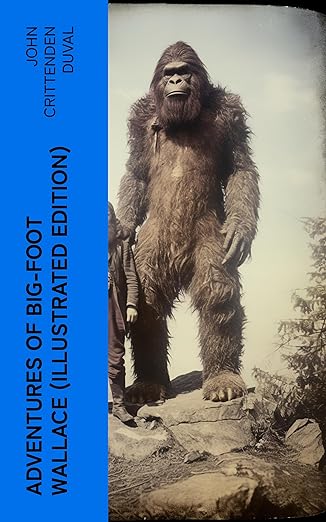
Who exactly is speaking in this audiobook is the first question worth asking, and the listing answers it in the strangest way available: with the writer's own apology. The description is the book's original preface, in which the author warns that the work will not stand the test of criticism as a literary production, concedes a rather limited education, and claims a single merit, namely that none of it was concocted in the brain of somebody who never went beyond the sound of a dinner bell. Seven hours and thirty-nine minutes, read by Jack Sondericker.
Duval Added Some Stories to Make a Better Yarn
John C. Duval sets out to record the scapes and scrapes of Big-Foot Wallace, the Texas Ranger and Hunter, working from notes Wallace furnished personally and telling it, as far as memory served, in Wallace's own language. That is the entire method, stated openly on the first screen. What arrives is a frontier life told at second hand by a man who had the subject in the room with him, which is a form of biography that stopped being possible roughly a century and a half ago and cannot be reconstructed by any amount of research since.
Sara Davis wrote the only substantial one of the three visible responses, and it supplies what the description will not. Wallace was on the famous Miers Expedition that explored West Texas, served among the original Texas Rangers, and stands as a genuine Texas icon; the humor is dry and understated in a way that fits West Texas exactly; and, most usefully of all, Duval added some stories to make it a better yarn. That last clause is the most important sentence anywhere on this page, and it sits buried in an entry from 2007. Everything a buyer needs in order to calibrate expectations is in one clause of one review, and nothing in the seller's own copy comes close to saying it.
Talk Read Aloud Recovers What the Page Smooths
An audiobook is arguably the correct home for this material. The preface insists the story was told in Wallace's own language, which makes the book a transcription of talk rather than a composition, and talk read aloud recovers something the printed page tends to smooth away. The dry understatement Sara Davis describes lives entirely in timing, in the pause before the punchline of a story about a scrape that nearly ended badly. Whether this particular reading finds that timing is not something the record will tell anybody in advance, but the material was built for a voice.
Jack Sondericker is the only name attached to the performance, and the job is harder than the runtime suggests: a nineteenth-century Texan quoting a nineteenth-century Texan, with a writer's frame around a talker's voice for the whole length of it. Get that wrong and the book collapses into a single undifferentiated drone. The credit arrives with no production notes of any kind, which is normal for a reissue of a text this old and unhelpful all the same when the reading is the entire value being added.
Three hundred and thirty pages sit in this record's page count field, which is a curious thing to find next to a runtime. The language field and the publisher field both open with an invisible character nobody typed deliberately and no listener will ever encounter. Even the duration is written in a shorthand the rest of the catalog does not use, with the hours abbreviated where other listings spell them out in full. This entry was assembled from a print catalog and then pointed at an audio product, and the seams are showing through.
The Newest Opinion Rates a Delivery Service
Sixteen years separate Sara Davis's response from this recording. It carries a date in February 2007; the audio is dated December 2023. Timmy L. Thomas's four stars, filed in 2016, consist in their entirety of the words thank you. S.R.'s five stars, filed months before the audio existed at all, report that a book arrived ahead of time, that it is in excellent condition, and that it has not been read yet. That is a rating of a delivery service, and it is currently the newest opinion on the page.
Two Invisible Votes Behind a 3.2 Badge
Two of the five votes on this title are invisible, and the arithmetic says what they must be. Five people rated it and the badge reads 3.2, which fixes the total at sixteen stars out of a possible twenty-five. The three grades anybody can see run five, four and five, which accounts for fourteen. Two stars are left for two voters, so both of them gave it the minimum. Nobody wrote a syllable explaining why, and the two harshest verdicts on this book are precisely the two nobody can read.
Texas history is the real subject, and it arrives with all the nineteenth-century freight that implies. Frontier memoirs of this period carry the assumptions of the men who wrote them, and this one promises Rangers, expeditions and a hunter's life delivered in the language of the time, because the preface says so in as many words. No publisher's note appears anywhere on the listing, no framing, no context. Anyone expecting the period to be handled with modern commentary attached will need to supply that themselves.
Stories Added to Improve the Yarn
History listeners with an appetite for primary material are the right audience, and they will know exactly what to do with a source whose own review column admits to embellishment. Anyone reading about the Texas Rangers has a firsthand account here of a man who rode with them, taken down by somebody who knew him. Anyone who enjoys a tall tale told with a straight face will find the dry understatement is the whole method rather than a garnish on top of it. The runtime is a fair length for a life that spent itself outdoors, and the episodic build means a listener can leave and return without losing the thread.
Avoid it if you want verified history, because the one detailed response on the page states outright that stories were added to improve the yarn, and avoid it if a record this scrambled leaves you wondering what else got copied across wrong. Duval never claimed to be producing literature, and the preface says so before any critic can get there first. Sondericker inherits a book that apologizes for itself in its opening lines and then spends the next seven hours making that apology look unnecessary.
Who reads The Adventures of Big-Foot Wallace audiobook?
Jack Sondericker holds the sole reading credit, across seven hours and thirty-nine minutes. No director, producer or supporting voice appears on the record. Given that the preface promises the story in Wallace's own language, filtered through a writer recalling it, the reader is carrying two nineteenth-century Texans at once.
Is this a true account of Big-Foot Wallace's life?
Partly. The preface calls it a plain, unvarnished story taken from notes Wallace supplied, but the one detailed response on the page says Duval added some stories to make a better yarn, and that much of it did happen. Treat it as a memoir shaped for telling rather than a verified chronicle.
Why does this audiobook listing show a page count?
Because the record was built from print data. A field reading three hundred and thirty pages sits beside the runtime, the language and publisher entries both begin with an invisible formatting character, and the duration uses an abbreviation the rest of the catalog avoids. None of it affects the recording, but it explains the review column.
What explains a 3.2 badge when the visible reviews are positive?
Five votes total sixteen stars out of twenty-five. The three you can read are a five, a four and another five, which is fourteen of those sixteen, leaving two stars to be split between two silent voters. Both of them gave the minimum, and neither wrote a word of explanation.