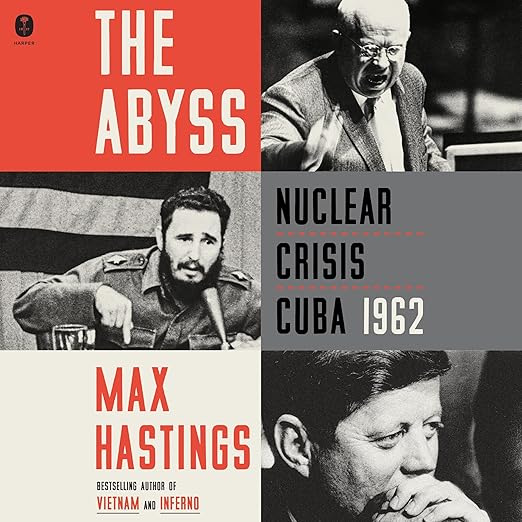
Quick Take
- Narration: Hastings narrates his own work with the authority of someone who has been writing military and political history for decades, dry, British, and entirely appropriate for the material.
- Themes: Nuclear brinkmanship, Cold War leadership psychology, the contingency of history
- Mood: Tense and analytically rich, with a final chapter that explicitly connects 1962 to the present
- Verdict: A human-focused account of the Cuban Missile Crisis that prioritizes understanding over dramatization, narrated by a historian who trusts his readers to sit with complexity.
The Cuban Missile Crisis has been written about extensively, and any new entry in the field has to justify its existence against what is already available. Max Hastings justifies The Abyss by approaching the thirteen days of October 1962 with the same people-focused methodology that has characterized his best military history: not just what happened, but who these people were, what they believed, what they feared, and how those individual psychologies shaped decisions that affected the entire world.
I came to this one already familiar with Michael Dobbs’s One Minute to Midnight, which covers the same thirteen days with an emphasis on military mechanisms and operational details. Hastings is doing something different. Where Dobbs tracks specific missiles and military units, Hastings tracks Kennedy, Khrushchev, Castro, and their advisors as human beings under pressure they had no precedent for managing. The comparison is instructive because both approaches illuminate what the other leaves dark.
Our Take on The Abyss
Hastings’s research spans Russian, Cuban, and American archives and sources, and the result is a genuinely three-sided account. The Soviet perspective, often flattened in American tellings of the crisis, is rendered with real complexity here. Khrushchev emerges as neither the buffoon of Western caricature nor a simple villain, but as a man who had miscalculated badly, knew it, and was trying to find a way out that preserved some Soviet dignity. Castro, who wanted the missiles fired regardless of consequences, is the genuinely alarming presence in the book, the actor whose preferences nearly overrode the negotiated settlement between Kennedy and Khrushchev.
One reviewer notes that Hastings belongs to what they call the Everybody Sucks school of historical writing, meaning he distributes criticism and responsibility across all parties rather than positioning one side as straightforwardly heroic. This is accurate, and it is also the correct approach for a crisis in which every major player made significant errors that could have had catastrophic consequences. Kennedy’s management of the crisis is presented as more improvised and contingent than the heroic narrative allows. Khrushchev’s placement of missiles in Cuba is explained through Soviet strategic logic rather than simply attributed to recklessness.
Why Listen to The Abyss
Hastings narrates his own work, and his voice carries the particular authority of a British historian of his generation, dry, measured, unwilling to perform excitement about material that should generate its own. At nineteen hours, this is a substantial commitment, and Hastings’s narration sustains it by never overselling what the documents actually say. When he speculates, he says so. When the historical record is ambiguous, he presents the ambiguity rather than resolving it artificially.
A reviewer specifically praises the final chapter’s analysis of parallels between 1962 and the present. This is where the book earns its contemporary relevance: not by forcing connections but by asking what the crisis reveals about nuclear deterrence, leadership psychology under pressure, and the conditions under which rational actors make catastrophically irrational decisions. Those questions do not have expiration dates.
What to Watch For in The Abyss
Readers coming to this without substantial background in Cold War history will want some patience with the political and institutional context Hastings establishes in the early chapters. The book is not entry-level, and it assumes some familiarity with the broad outlines of US-Soviet relations in the late 1950s and early 1960s. It rewards that investment but does require it.
The book leans toward political and social analysis rather than military operations. If you want a detailed account of the specific naval encounters, the U-2 shootdown, and the operational mechanics of the crisis, Dobbs’s One Minute to Midnight covers that ground more thoroughly. Hastings is more interested in what the leaders were thinking than in what the military units were doing, which is a legitimate emphasis but a specific one.
Who Should Listen to The Abyss
History readers with an interest in the Cold War, nuclear strategy, or political biography will find this a rich and carefully reasoned account. Listeners who responded to Hastings’s previous military history work, particularly his books on World War II, will recognize and appreciate his methodology here. Anyone who finds the current geopolitical moment generating anxiety about nuclear risk will find the book’s final chapter directly relevant.
Listeners who want a narrative-first thriller account of the crisis will find Hastings’s analytical approach too slow. His interest is in understanding, and understanding requires dwelling on complexity rather than pushing through it. At nineteen hours, this asks something of its listeners, and it pays back that investment with depth rather than pace.
Frequently Asked Questions
How does The Abyss compare to Michael Dobbs’s One Minute to Midnight on the same subject?
One Minute to Midnight emphasizes military and operational detail: specific ships, missiles, units, and the near-accidents that almost triggered war. The Abyss focuses on the political and personal: what Kennedy, Khrushchev, and Castro were thinking, believing, and fearing. A reviewer who had read Dobbs first found Hastings’s account more social and political, less military. Both are worth reading for a complete picture of the thirteen days.
Is Hastings critical of Kennedy’s handling of the crisis or does he treat it as the triumph it is often depicted as?
Hastings presents Kennedy’s management as more improvised and contingent than the established heroic narrative allows. He distributes responsibility for errors across all parties, including the American side. This has been described by one reviewer as the Everybody Sucks school of historical writing, which Hastings would likely accept as a reasonable description of honest historical judgment.
How much time does The Abyss spend on the Cuban perspective?
More than most accounts. Hastings uses Cuban sources and archival material to present Castro as a genuine actor with his own strategic logic rather than a passive recipient of superpower decisions. Castro’s preference for firing the missiles regardless of consequences, and the ways in which this nearly overrode the Kennedy-Khrushchev negotiation, is one of the more alarming sections of the book.
Does Hastings address the contemporary relevance of the crisis or is it purely historical?
The final chapter explicitly analyzes parallels between 1962 and the present. A reviewer specifically praises this section as illuminating. Hastings does not force the comparison but examines what the crisis reveals about nuclear deterrence, leadership psychology under pressure, and the conditions that allow rational actors to approach catastrophic decisions. Reviewers have found this section particularly valuable given current geopolitics.