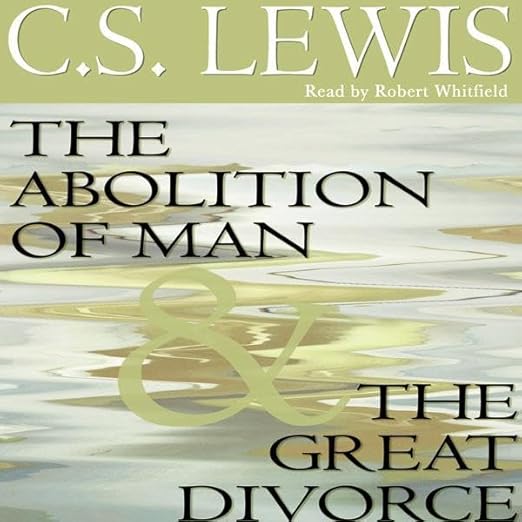
The Short Version
- Narrator: Simon Vance's measured, authoritative cadence is a natural fit for Lewis's philosophical prose; he gives the lectures of 'The Abolition of Man' appropriate gravity while lending 'The Great Divorce' a storytelling warmth that keeps the allegory vivid.
- Subjects: moral education vs. relativism, the nature of good and evil, free will and the afterlife
- Tone: Contemplative and intellectually charged, with moments of surprising whimsy
- Bottom line: Two essential Lewis works that reward listeners with genuine philosophical heft and memorable imagery in under five hours.
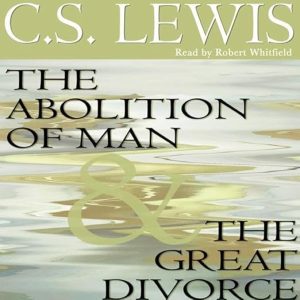
C.S. Lewis pairs two of his most enduring works in this audiobook collection, and the pairing is not accidental. Both The Abolition of Man and The Great Divorce circle the same essential question: what does it mean for a society, or a soul, to choose rightly? Lewis wrote both in the 1940s, and reading them together clarifies the architecture of his thinking in ways that encountering either one alone cannot. The audiobook runs just over four hours, which makes it an unusually efficient introduction to two of the twentieth century's most compelling arguments about moral life.
Simon Vance narrates both works, and his casting here is close to ideal. Vance has a gift for making complex philosophical sentences land without sounding like a lecturer reading notes aloud. He modulates carefully between the more formal, essay-like register of The Abolition of Man and the warmer, narrative quality that The Great Divorce demands. Reviewers have consistently praised this version as a particularly good way to encounter these texts, noting the clarity and the recording quality as assets for listeners who are, say, behind the wheel or otherwise away from a page.
How The Abolition of Man & The Great Divorce Holds Up
This is two books that could not be more different in form and yet more complementary in argument. The Abolition of Man is Lewis in full academic mode: three lectures originally delivered at Oxford, arguing that a society which strips moral education from its children has not liberated them but hollowed them out. The argument turns on what Lewis calls the Tao, his shorthand for the universal moral intuitions shared across cultures and traditions. Strip away objective value, he contends, and you produce not free-thinking individuals but what he memorably calls Men Without Chests: creatures capable of intellect and appetite but lacking the emotional and moral formation that makes those capacities serve something good. It is a short book, but its density rewards slow listening. You may want to pause and let certain passages sit.
The Great Divorce, by contrast, is a fable. A narrator boards a ghost-grey bus in a drizzly English city and rides it through a vision of Heaven and Hell. The structure is Dante-esque in its mechanics but thoroughly Lewis in its moral psychology. What makes the book so striking is Lewis's insistence that the damned are not punished from outside but have chosen, in every meaningful sense, to remain in their condition. Each ghost he meets on the plains of Heaven has a reason for refusing joy that is entirely recognizable, drawn from ordinary human vanity, resentment, possessiveness, and pride. Vance's narration handles the gallery of character voices with enough differentiation to keep the figures distinct without turning the piece into a radio drama.
Why The Abolition of Man & The Great Divorce Works as an Audiobook
The case for the audiobook format here is real. The Abolition of Man was originally spoken aloud before it was written down, and Vance restores something of that oral quality. You hear the rhythm of the argument in a way that can be obscured by the density of the page. The Great Divorce benefits even more from narration: it is fundamentally a story, and having Vance move you through the landscape of Lewis's afterworld gives it the texture of something being told rather than read. Reviewer J.G. Bennett makes this point directly, noting that the audio version transforms what could be study time into productive commute time. That observation applies especially to The Abolition of Man, where the compressed, aphoristic style can feel like dense reading but flows more naturally as spoken argument.
Neither work requires prior knowledge of Christian theology to engage with fully. Lewis takes pains in The Abolition of Man to ground his argument in the shared moral traditions of multiple cultures, drawing examples from Plato, Confucius, and the Norse sagas alongside the Bible. The Great Divorce operates as allegory accessible to believers and nonbelievers alike, even if its conclusions are clearly Christian in their final orientation. Reviewer Maria Gonzalez captures this broad accessibility when she calls it a great study of the spiritual battle in this world, using language that reaches beyond any single denomination.
Weak Spots in The Abolition of Man & The Great Divorce
A few things to calibrate expectations. The Abolition of Man is genuinely challenging, even at roughly ninety minutes of audio. Lewis assumes a reader comfortable with philosophical argument, and he moves quickly through his examples. Do not expect the conversational accessibility of Mere Christianity; this is Lewis the Oxford don, writing for an audience with some philosophical background. If you find yourself losing the thread, that is normal, and the solution is straightforward: replay the section. Vance's pacing is actually calibrated for comprehension rather than speed, which helps.
The Great Divorce should be understood as a work of imagination, not a doctrinal statement about the actual structure of the afterlife. Lewis himself insists on this in the preface, and it is worth holding onto. The book's power lies not in its cosmological claims but in its psychological portraits, which are almost embarrassingly accurate. You will recognize people you know in those ghosts, and you may recognize yourself. That recognition is the point, and it is one that Vance's performance enables rather than diffuses. At just over four hours total, this audiobook earns repeated listening in a way that few collections of this length can claim.
The Right Listener for The Abolition of Man & The Great Divorce
Listeners who will get the most from this audiobook are those who already have some affinity for Lewis's work and want to hear these less-traveled texts brought to life in audio. It is also well-suited to listeners interested in moral philosophy who want an argument presented with genuine wit and clarity rather than academic dryness. Those coming from a religious tradition, particularly Protestant or Catholic Christianity, will find the theological scaffolding familiar, but it is not required. Listeners who prefer narrative over essay form may find The Abolition of Man demanding; they should know it is only the first third of the runtime. Anyone who has read Mere Christianity or The Screwtape Letters and wondered where Lewis goes when he is writing for a more rigorous intellectual audience will find their answer here.
Questions Listeners Ask
Do you need to be a Christian or have religious background to get value from this audiobook?
No. 'The Abolition of Man' grounds its argument in cross-cultural moral traditions, drawing on Plato, Confucius, and others alongside Christian sources. 'The Great Divorce' is an allegory whose psychological portraits are accessible regardless of belief. Lewis himself notes in his preface that the book is not a doctrinal statement about the afterlife.
Is this audiobook appropriate for someone new to C.S. Lewis?
'The Great Divorce' works well as a Lewis entry point since it is accessible, narrative, and relatively short. 'The Abolition of Man' is denser and assumes some comfort with philosophical argument; new readers may find it helpful to have encountered Lewis's more conversational works, like 'Mere Christianity,' first. The collection rewards repeat listening as your familiarity with Lewis's thought deepens.