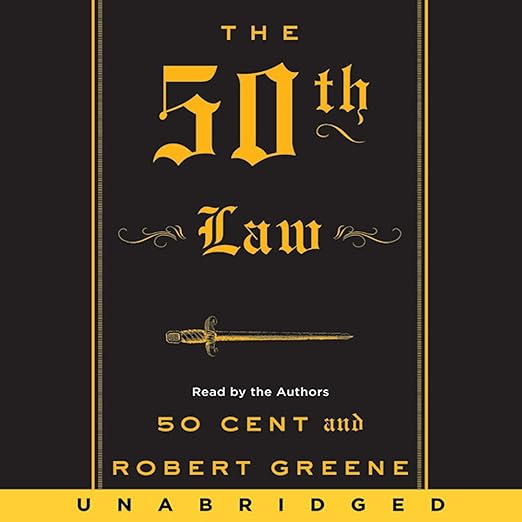
Fear is the whole thesis, and this audiobook states it in two words: fear nothing. The 50th Law pairs 50 Cent, who is also Curtis Jackson, with Robert Greene, author of The 48 Laws of Power, to build what the description calls a bible for success in life and work. Eight hours and sixteen minutes, published by Amistad on September 08, 2009, with 50 Cent credited as narrator. One name occupies the narrator field for a book the description says two people wrote, and the review column has firm opinions about which of the two brought them in.
Curtis Jackson supplies the raw material: life on the streets, the boardroom that followed, the rise after Get Rich or Die Tryin', and the proposition that fearlessness is a discipline a person can learn rather than a temperament they were issued at birth. The description also promises examples of other people who overcame adversity through the same principle, which is the co-author's half of the formula. State a law, then prove it through short historically referenced stories, as one reviewer describes the method, and let the celebrity biography carry the emotional weight that borrowed history cannot. The tag on this listing reads entertainment and celebrities, while the genre lines file it under biographies and memoirs and under politics and social sciences, which is three different books in three different fields.
Robert Greene does not appear in the author field of this record at all. The description names him in its opening sentence, and four of the five reviews treat the book as principally his work: one has been following his previous titles for years, another declares fandom for the 48 Laws and The Art of Seduction, a third opens by admitting a general dislike of this author's output as sometimes pretentious. Read the column without looking at the credit and you would never guess whose name governs the listing. A listener searching by author finds one of the two and has to already know about the other.
A Book Built to Skim, Except the Recording
Sonshi opens with a full disclosure, which is more than most reviewers manage anywhere: the founder of a Sun Tzu website that interviewed Greene after he wrote 33 Strategies of War and again after this book. The entry then argues that most business books are mediocre and nowhere near realistic enough, and it breaks off before naming what separates this one from the pile. A declared interest does not void a review. It does mean the longest and most considered piece of writing on this page came from somebody with a professional relationship to one of the authors, and a buyer should weigh it knowing that.
Eight hours and sixteen minutes is the commitment on offer here. In December 2009, J. Walsh recommended the book warmly and then added a practical note: it is readable in a couple of hours, the entry says, because of the big, and the sentence stops there, cut off in the middle of its own last word. Whatever the rest of that phrase was going to say, both statements now sit on the same page. One describes a printed object that somebody can finish across a single afternoon, the other is a recording that occupies most of a working day. That is less a contradiction than a warning, because a book engineered to be skimmed on paper cannot be skimmed at all in this format, and the repetitions a reader's eye would jump over arrive here at full length.
A Strikingly Small Pool for This Much Fame
When the celebrity framing is stripped away, what remains is a familiar machine, and the reviews describe it consistently: a message per section, supported by compact historical episodes that illustrate it. A reader in Canada who arrived actively disliking the author reports using every single strategy in the book against a business competitor and finding that events unfolded exactly as described. That is the most concrete testimonial available on this listing, and it comes from the most skeptical starting position in the column, which is the combination worth paying attention to.
Six ratings stand behind the 4.7 badge, on a book by one of the most recognizable musicians alive that has been on sale since 2009. Five of them left text. The two oldest were filed in October and December of that first year; the newest arrive from Canada in 2023 and from the United Arab Emirates in 2024, where a four-star reviewer compresses the entire argument into a single line about needing to understand the rules when you are serious about the game. Four territories, a very long spread of dates, and a strikingly small pool of votes for a title with this much name recognition attached.
Students of the co-author should be clear about what this record is not. It is not The 48 Laws of Power, and the description makes no such claim: this one runs on a single principle instead of a numbered catalog, and its central case study is one living career rather than a sweep of centuries. Anyone hunting for a substitute for the earlier book will be disappointed. Anyone who found the earlier book cold and diagrammatic may prefer this one, because a person stands at the middle of it and that person is doing the talking.
His Biography Serves as Evidence Here
Cynics have a fair point and it deserves airing. A success manual co-written by a celebrity and a specialist in success manuals belongs to a genre with a deservedly poor reputation, and the reviewer who called this author sometimes pretentious speaks for a sizeable constituency. What that same reviewer goes on to report is the interesting part: the book proved actionable in an actual dispute with an actual competitor. That settles nothing in general and it is the only test this kind of writing can be put to at all.
Entrepreneurs are the audience the description names, and the column backs the aim, with two of the five writing about applying the material at work rather than admiring it. Listeners who came looking for a music memoir should recalibrate now, because the copy promises a bible for success rather than a life story, and Curtis Jackson's biography functions as evidence rather than as subject. This is an old record and it carries no production information whatsoever, nothing about how the two writers divided the labor. Take the runtime seriously, because eight hours of principle and illustration is a wholly different proposition from an afternoon spent with the printed edition.