Quick Take
- Narration: Todd Conklin narrates his own work, which gives the audiobook an informal, conversational quality that suits the material’s intent perfectly.
- Themes: Systems thinking over individual blame, organizational learning, the gap between work-as-imagined and work-as-done
- Mood: Conversational and practical, occasionally provocative, never academic in a suffocating way
- Verdict: Essential listening for anyone in safety leadership or organizational management who wants a framework for rethinking how failure actually happens.
I was somewhere between a conference on organizational behavior and a stack of unread management theory when a colleague in the industrial safety space pressed this audiobook on me with the kind of insistence that usually means someone has found something genuinely useful rather than merely fashionable. Todd Conklin narrating his own work is, as it turns out, one of those audiobook decisions that pays off immediately. You can hear that he has given these ideas to live audiences hundreds of times, that he has debugged the explanations, found where the resistance tends to appear, and calibrated the examples accordingly.
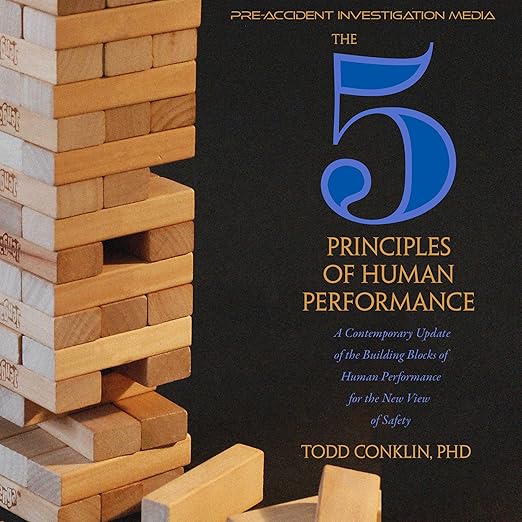
The premise of The 5 Principles of Human Performance is deceptively simple. Human error is not the cause of failure in organizations. It is a symptom. Systems create the conditions that make failure probable, and those conditions are always more interesting and more actionable than the individual who happened to be the last person in a chain of decisions that went wrong. Conklin builds this argument through five foundational principles, delivered conversationally rather than academically, and the result is a framework that safety professionals and managers alike can actually use.
Our Take on The 5 Principles of Human Performance
The most important thing Conklin does in this audiobook is reframe the question. Organizations that ask who made the error are asking a question that generates punishment but not learning. Organizations that ask what conditions made this error likely are in a position to actually reduce future failures. One reviewer, a police officer, noted that law enforcement all too often looks to punish the individual who made an error when we should be looking at the system and its role in creating the conditions that influenced errors. That observation holds across industries, and Conklin’s framework gives it formal grounding.
The audiobook draws on work from INPO, the Department of Energy, Sidney Dekker’s safety differently movement, and W. Edwards Deming’s quality philosophy, among others. Conklin situates his principles within this broader intellectual tradition without being pedantic about it. For listeners already familiar with systems thinking, the framework will feel like a consolidation of ideas they have encountered separately. For listeners new to this territory, it will feel like the beginning of a significant reorientation in how they think about organizational failure.
Why Listen to The 5 Principles of Human Performance
At just under four hours, this is a lean and purposeful listen. Conklin does not pad the material and does not repeat himself. One reviewer noted wishing for more practical case studies from specific companies rather than so much explanation of theory, which is a fair observation. The audiobook tilts toward conceptual foundation-laying rather than illustrated application, and whether that is a limitation depends on where the listener is starting from. For those who need the theory before the cases, this is exactly right. For those who learn primarily through example, supplementary reading alongside the audio would help.
Conklin’s narration style is distinctly informal. He talks to the listener the way he talks to conference rooms, and the effect is engaging rather than casual. There is no sense of someone reading a text they wrote months ago and have now slightly cooled on. The ideas feel live. That quality is difficult to manufacture and impossible to fake, and it is the primary reason this audiobook format works as well as it does for content that could have felt dry in a professional narrator’s hands.
What to Watch For in The 5 Principles of Human Performance
The genre tag of money and finance is a mismatch for this title. It sits more accurately in the organizational behavior and safety management space, and listeners who approach it expecting financial content will be confused. The actual audience is safety professionals, operations managers, leaders in high-reliability industries like aviation, nuclear energy, and healthcare, and anyone interested in how complex organizations fail and how they can be made more resilient.
The audiobook is also fairly self-contained as a theoretical foundation. Listeners looking for implementation toolkits or change management strategies will find that Conklin points toward possibilities without detailing methodologies. This is a frame-shifting listen, not an operations manual.
Who Should Listen to The 5 Principles of Human Performance
Safety leaders, operations managers, and organizational consultants will find this immediately applicable. It is also worthwhile for anyone in a management role who has participated in post-incident reviews and found the blame-the-individual framing inadequate but could not articulate why. Skip it if you are looking for a comprehensive implementation guide rather than a foundational reframe, or if you need extensive case studies to absorb conceptual material.
Frequently Asked Questions
Is this audiobook only relevant to industrial safety professionals?
No. While the examples often come from industrial and high-reliability settings, the core principles about how organizations create conditions for failure apply across sectors including healthcare, law enforcement, finance, and tech.
Does Todd Conklin’s self-narration make the content feel too informal for professional development use?
The opposite, actually. The informal tone is one of the audiobook’s strengths. It makes challenging organizational theory accessible without diluting the conceptual rigor.
How does this book relate to Sidney Dekker’s Safety Differently framework?
Conklin explicitly engages with Dekker’s work and draws on it as part of the intellectual lineage of human performance principles. Listeners familiar with Dekker will find familiar concepts articulated through Conklin’s own lens.
Is four hours enough to cover the full depth of the five principles?
For the conceptual foundation, yes. Conklin is efficient and focused. Listeners who want deeper application will need to pursue additional resources, and Conklin himself points toward where those conversations continue.