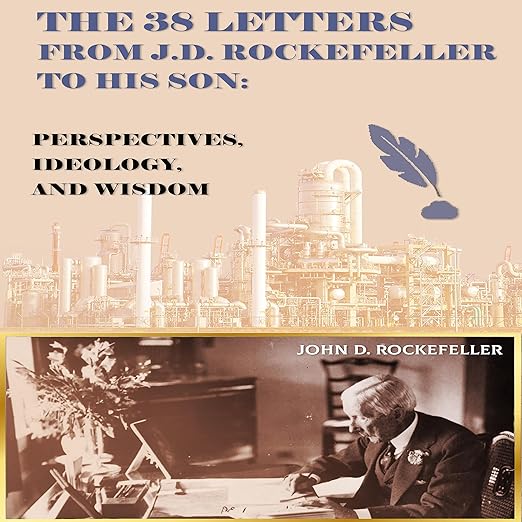
Key Details
- Narrator: Rick Font delivers the letters with quiet authority and appropriate restraint, making the personal correspondence format feel genuinely intimate rather than performative.
- Subjects: Wealth philosophy, character formation, legacy and fatherhood
- Tone: Reflective and measured
- Bottom line: A compact, durably useful audiobook for those drawn to first-person business philosophy delivered through the rare lens of personal correspondence.
Rockefeller's letters have sat in my listening queue for longer than I care to admit, and it was a quiet weeknight, clearing a backlog of short-form audiobooks, that I finally pressed play. At five hours and twenty-eight minutes, The 38 Letters from J.D. Rockefeller to His Son fits cleanly into a single unhurried session, and Rick Font's measured, authoritative delivery made it feel less like a listening assignment and more like sitting beside a fire while someone reads aloud from a leather-bound journal. That's the best I can say for an audiobook built around personal correspondence: it has to feel private, and Font gets that exactly right. The warmth he brings to the epistolary format is what makes this work as a listening experience rather than simply a reading exercise.
The premise is straightforward. Thirty-eight letters, written across years, from one of the wealthiest Americans who ever lived to his son. The letters cover Rockefeller's perspectives on business, character, money, work ethic, and the quiet disciplines he believed separated prosperity from mediocrity. As one listener noted, the compilation provides "real world advice that applies even today." That's the honest selling point here: not literary elegance or dramatic narrative, but the durable utility of one man's distilled experience passed down in ink. The format itself is the argument: these are not essays written for posterity, they are letters written for a son, and that distinction gives the advice a different texture from the self-improvement literature that would later systematize many of the same ideas.
A Worldview Repeated Until It Finally Takes Root
What's worth understanding about this audiobook is that its value lives in the cumulative weight of the letters rather than in any single revelation. Rockefeller isn't offering surprises. He believes in deliberate focus, in the slow compounding of good habits, in treating money as a tool rather than a destination. His ideology is legible within the first two or three letters, and the remaining thirty-five deepen and extend it rather than pivot. Listeners who come in looking for conventional biography or dramatic narrative will find neither. What they'll find instead is a consistent worldview, repeated with variation, like a mentor who keeps returning to the same themes because he knows repetition is how things finally take root.
A reviewer described it as offering "a rare and insightful look into Rockefeller's mind." That framing is accurate. The letters illuminate not just his practical advice but the underlying assumptions behind it: that character is built through discipline, that reputation travels farther than talent, that the accumulation of small right decisions eventually produces a life others call extraordinary. Whether or not you agree with every premise, the coherence of the worldview is itself instructive. You're not just reading what a rich man believed; you're examining why he believed it, and how that belief system played out across a remarkable life. That examination is what separates the letters from a motivational quote collection.
Rick Font's Understated Reading Restores the Letters' Intimacy
The audio format suits this material unusually well. Reading letters silently on a page can feel like browsing correspondence you weren't meant to see. Hearing them read aloud by a composed, understated narrator restores something of their original intimacy, the sense that these words were meant to land on one specific person, and that you're being trusted with them secondhand. Rick Font doesn't dramatize; he doesn't need to. He simply reads with clarity and conviction, letting the authority in Rockefeller's own sentences carry the weight. The five-and-a-half-hour runtime makes this one of the more accessible business and biography titles available in the format, and the short chapters within that runtime make it easy to pick up and set down without losing momentum.
Listeners who've already absorbed the classics of the self-made-man canon, from Andrew Carnegie's autobiography to Napoleon Hill, will find The 38 Letters occupies a distinct space. Where Hill systematizes success into principles and Carnegie narrates a life with novelistic sweep, Rockefeller writes as a father. The emotional undercurrent here is one of genuine concern for his son's character, not just his bank balance. That parental warmth gives the letters an affective texture the genre doesn't always provide, and it's one of the qualities that makes listeners return to this collection more than once.
A Curated Compilation, Not a Verified Archive
Listeners should enter aware that this is a curated compilation, not a verified historical archive. The letters are presented as Rockefeller's authentic correspondence, and for the audience seeking motivational content with a historical flavor, they function extremely well. But those with a scholarly interest in primary sources would want to investigate their provenance independently before citing or teaching from this material. The attribution and compilation context matters if you plan to treat it as documentary evidence rather than as wisdom literature.
The other caveat worth noting is tonal consistency. Rockefeller's voice across all thirty-eight letters is remarkably stable, even slightly formal, and listeners who prefer variety or surprise in their listening diet may feel the experience grows repetitive around the midpoint. This isn't a weakness so much as an accurate description of the content: if you're listening for reinforcement and reflection rather than discovery, that consistency feels appropriate. If you need narrative momentum, this audiobook won't supply it. The value here is in immersion rather than escalation.
For Entrepreneurs Who Want Ambition Framed as Relationship
This audiobook works best for listeners drawn to the intersection of personal correspondence and business philosophy, people who find value in seeing ambition framed through relationship rather than through quarterly targets. Entrepreneurs, early-career professionals thinking about long-term wealth building, and anyone interested in the psychology behind one of American capitalism's most consequential figures will find the time well spent. Those who prefer their biography with footnotes and archival rigor, or who need a narrative with dramatic shape, should look elsewhere. At under six hours, the commitment is modest; the ideas it leaves behind have a way of staying active long after the final letter closes.
Good to Know
Is The 38 Letters from J.D. Rockefeller to His Son audiobook appropriate for listeners with no prior knowledge of Rockefeller?
Yes. The letters stand on their own as reflections on business, character, and wealth, and Rick Font's narration keeps things accessible. No background knowledge of Rockefeller's biography is required to follow or benefit from the content.
At just over five hours, is this audiobook long enough to feel substantial?
For the genre it represents, yes. The letters are dense with perspective rather than narrative, and five hours gives the compilation enough room to build its cumulative case without overstaying. Listeners looking for a full biographical treatment would need to supplement it with longer titles.