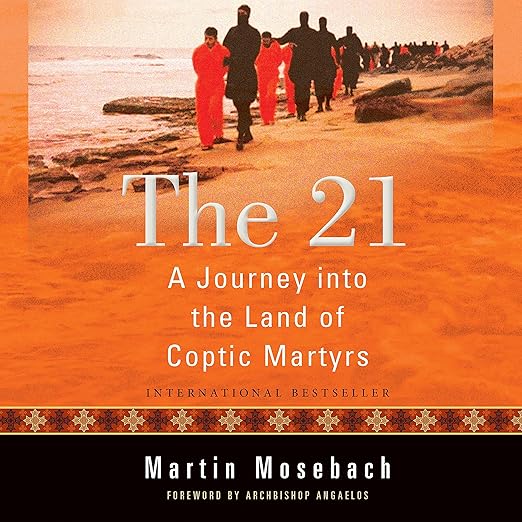
Quick Take
- Narration: Creative Orthodox delivers a measured, reverent performance that honors the gravity of the subject without veering into sentimentality, exactly the tone this material demands.
- Themes: Martyrdom and faith, clash of civilizations, Coptic Christianity in the modern world
- Mood: Quiet and profound, devastatingly human
- Verdict: A German literary writer travels to a village few Westerners have heard of and returns with one of the most moving accounts of contemporary faith available in audio.
I came to this one on a gray Tuesday afternoon, sitting at my kitchen table with the particular kind of restlessness that sets in between projects. I had read a short reference to the February 2015 ISIS beheading video in another book, a passing mention, a footnote of horror, and found myself unable to move past it. I needed to know who those men were. Martin Mosebach, it turns out, had asked the same question before me, and answered it far more rigorously than I ever could have.
The 21 runs just under six hours, and I finished it in a single sitting. I want to be honest about what that means: this is not an easy listen, and it is not a comfortable one. It is the kind of book that makes you sit quietly for a while after the final chapter ends.
The Stranger in the Concrete Houses
Mosebach arrives in El-Aour, a small village in Upper Egypt, as an acknowledged outsider, a skeptical Western Catholic, a literary writer rather than a journalist or theologian. This position is not a weakness in the book; it is its organizing tension. He enters homes where swallows dart through open windows, where portraits of Jesus and Mary share wall space with improvised shrines to the newly murdered. Families replay the propaganda video on an iPad. There is no talk of revenge. There is only the pride of a martyr in the family, a saint in heaven.
What Mosebach captures, and what the narration renders with genuine care, is the total foreignness of this response to a secular Western reader. These families live inside a cosmology in which suffering and biblical precedent are not separate categories. The murder of a son is terrible, and it is also a continuation of a story that began long before 2015. Mosebach never pretends to have fully entered this world. His honesty about his own incomprehension is one of the things that makes the book trustworthy.
Twenty-One Chapters, Twenty-One Men
The structure is elegant and deliberate: twenty-one symbolic chapters, each preceded by an image, mapping onto the twenty-one dead. This architecture prevents the book from becoming an abstraction. Each chapter carries weight in part because you understand what it represents, a specific life, a specific family, a specific absence. The effect accumulates quietly and then, somewhere in the final third, becomes almost unbearable.
Mosebach also delivers a substantial account of the Coptic Church itself, its liturgy, its ancient roots, its position as a religious minority in Muslim Egypt. One reviewer notes that some of his church history is “confused,” which is worth flagging for listeners with deep knowledge of the subject. But his focus on the distinctiveness of Coptic liturgy and its continuity with early Christianity is genuinely illuminating for Western listeners whose exposure to Eastern Christianity has been limited. The book is as much a travelogue of a living tradition as it is an account of a massacre.
What a Westerner Carries Away
One of the reviewers here, a self-described 21st-century American Catholic who says he never does reviews, writes that the book provided perspective on how the Gospel is for all people in all times. That response captures something real. Mosebach is not writing hagiography. He is writing about encountering a form of conviction so complete that it reorganizes his understanding of what faith actually means when tested to its limit.
The narration by Creative Orthodox is sober and precise. There is no performance excess, no dramatization of grief that would feel exploitative given the material. This is the right call. The prose is literary, and it benefits from a voice that trusts the sentences.
Who Should Listen, Who Should Skip
Listen if you want to understand who the men in the ISIS video actually were, where they came from, and what formed them. Listen if you have any interest in the Coptic Church, in the intersection of faith and political violence, or in what it means for a Western secular intellectual to encounter a genuinely different moral universe. Listen if you are willing to sit with discomfort and complexity for six hours.
Skip if you are looking for a straightforward news account or policy analysis of ISIS. This is literary nonfiction and travelogue, not investigative journalism. Some listeners with strong backgrounds in Coptic church history may find occasional historical imprecision frustrating. And if you need emotional distance from accounts of real religious persecution, this is not the book for that moment.
Frequently Asked Questions
Is The 21 suitable for listeners with no prior knowledge of the Coptic Church?
Yes. Mosebach writes as an outsider himself, and the book functions as an introduction to Coptic Christianity, its history, and its place in Egyptian society. Prior knowledge enriches it but is not required.
How graphic is the content given the subject matter involves the 2015 ISIS beheading?
Mosebach does not describe the killings in graphic physical detail. The book is emotionally intense but literary in its approach. The violence is present as context and consequence, not as spectacle.
Does the book present a religious argument, or is it more journalistic?
It occupies an unusual middle space. Mosebach is a skeptical Westerner who approaches the subject with genuine intellectual humility rather than either devotional confirmation or secular dismissal. Reviewers note it speaks to readers across a range of religious commitments.
Is there a companion PDF mentioned for this audiobook?
The Audible listing does not reference a companion PDF for this title. The twenty-one chapter structure and any images from the print edition are referenced in the narration’s framing but not provided as supplementary files.