Maxwell's Own Credentials Back Sixteen Modular Laws
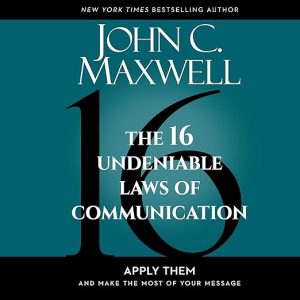
What actually separates a speaker who empties a room from one who holds it, according to someone who has spent fifty years finding out? I queued up this audiobook expecting a fairly standard public speaking primer and got something closer to a field manual instead, assembled by John C. Maxwell across five decades on platforms ranging from small town pulpits to arena stages. Maxwell narrates his own material here, and that choice says something about the book's premise before a single law is stated: communication is not a set of tricks recited by a hired voice, it is a skill demonstrated in real time by the person claiming to teach it.
The setup will be familiar to anyone who has ever dreaded a wedding toast. Maxwell opens with the old claim that public speaking outranks death itself on most fear surveys, then quotes Jerry Seinfeld's joke about preferring the casket to the eulogy. From there he moves systematically through sixteen named laws, each built around a specific discipline rather than a vague principle, covering everything from preparing content to reading a room's energy to adding value once you have people's attention. Maxwell has the credentials to back the structure. He is one of only eight people alive who hold both a Toastmaster's Golden Gavel and induction into the National Speakers Association Hall of Fame, and the book reads like the accumulated notes of someone who has actually delivered a eulogy, a sermon, and a boardroom pitch, not just researched how other people do it.
The synopsis lists eight explicit outcomes the book promises, from speaking with conviction to telling better stories to inspiring people toward action, and that list format itself signals something about how Maxwell built this book. Rather than a single sustained argument delivered chapter by chapter, it reads as sixteen modular units, each one a complete, standalone lesson a listener could return to in isolation before a specific speaking engagement. That structure trades the pleasure of a continuous narrative arc for something more useful in practice: a listener nervous about an upcoming board presentation can go straight to the law addressing preparation and audience focus without sitting through material aimed at a wedding toast or a sermon.
Sixteen Laws Narrower Than His Leadership Books
The strongest argument for choosing the audio edition over the print book is Maxwell himself. His timing on the Seinfeld line lands the way a joke lands when a speaker actually knows how to hold a pause, not the way it reads flatly off a page. That same instinct carries through the more instructional stretches: he never rushes past a law he considers foundational, and he slows noticeably when a concept requires the listener to sit with an uncomfortable truth about their own habits as a communicator. Warmth without sentimentality is the right description for the performance. Maxwell sounds like a mentor giving you the real version of his advice, not a motivational speaker performing enthusiasm for a crowd he cannot see.
Structurally, the sixteen laws break down into practical, checklist style guidance: speak from conviction, prepare both content and self, find your personal communication strengths, focus outward on the audience rather than inward on nerves, tell better stories, read the room, add value, inspire action. None of this is delivered as abstract theory. Maxwell keeps returning to specific rooms he has spoken in, specific mistakes he has made, and specific corrections that took him years to learn, which keeps a book built from sixteen discrete units from ever feeling like a syllabus.
Maxwell has published more than ninety books across a writing career spanning decades, most of them broadly about leadership, and this title's narrower focus is worth noting for listeners who already know his wider catalog. Where a book like The 21 Irrefutable Laws of Leadership covers organizational influence broadly, this one isolates communication specifically as its own discipline, which makes it a more useful, more targeted listen for anyone whose actual problem is not leadership in the abstract but the concrete fear of standing in front of people and being heard.
No Visible Chapter Breaks to Lean On
Sixteen laws delivered back to back in continuous audio can blur together if you try to absorb the whole book in one sitting, the way a conference keynote blurs if you attend six of them in a single afternoon. This is a title that rewards a chapter per day pace, ideally with a notebook nearby, over a single long commute. A few of the earlier laws will land as familiar territory for anyone who already speaks professionally: the material aimed at a first time PTA presenter and the material aimed at a working salesperson do not always carry equal weight for both audiences, and Maxwell does not fully separate the two tracks.
The listener reviews attached to this title are worth taking seriously as a signal, not just as marketing. One reviewer mentions reading it several times and now passing it along to someone else who needed it, another describes applying the lessons while still moving through the book. That pattern, repeat listening plus active application, suggests this audiobook functions less like a single narrative you finish once and more like a reference you return to before a specific speaking commitment. Treat it accordingly rather than as a one and done listen.
Because Maxwell narrates sixteen distinct laws himself without a visible chapter break for print readers to lean on, audio listeners benefit from actively tracking which law they are currently in, since the transitions between laws are conversational rather than sharply announced. A listener who tunes out briefly during a commute may resurface a few minutes into a new law without quite realizing the previous one ended, which argues for the same chapter per day pacing recommended above rather than passive background listening.
From School Boards to Sunday Sermons
This is a strong fit for exactly the audience Maxwell names outright: people who need to inspire employees, address a school board, deliver a sermon, report to a board of directors, or speak from any stage, small or large. It also works well for anyone whose fear of public speaking has kept them from raising a hand in the first place, since Maxwell treats that fear as the expected starting point rather than a personal failing.
Skip this one if you are looking for an academic communication theory text grounded in research citations rather than practitioner experience, or if you have already worked through several of Maxwell's other leadership books and are hoping for entirely new material rather than a communication specific reorganization of ideas he has returned to before.
Good to Know
Does John Maxwell narrate this audiobook himself, or is it read by a professional voice actor?
Maxwell narrates it himself, and that self-narration is a genuine asset here. His comedic timing and deliberate pacing on the harder lessons come through in a way a hired narrator reading the same script likely could not replicate.
Is this audiobook better suited to one long listen or spread out over multiple sessions?
Spread it out. Sixteen distinct laws delivered back to back tend to blur together, and this audiobook rewards a chapter per day pace with a notebook nearby over a single long commute.
Do I need public speaking experience already to get value from this audiobook?
No. Maxwell explicitly addresses everyone from first time PTA presenters to working professionals, though seasoned speakers may find a few of the earlier laws cover familiar ground.
How does this audiobook differ from Maxwell's other leadership titles?
It narrows the focus specifically to communication as its own discipline, organized around sixteen named laws, rather than the broader leadership frameworks his other books cover.