Quick Take
- Narration: Jonathan Yen handles the dense academic material with controlled precision, readable rather than dry, though the complexity of the arguments demands active listening rather than background play.
- Themes: Accelerated human evolution, agriculture as biological catalyst, the interplay of culture and genetics
- Mood: Dense and argumentative, rewarding for engaged listeners willing to sit with contested scientific claims
- Verdict: A genuinely thought-provoking challenge to evolutionary orthodoxy that requires listeners to bring their own critical apparatus, the arguments are bold enough to deserve serious engagement rather than easy acceptance.
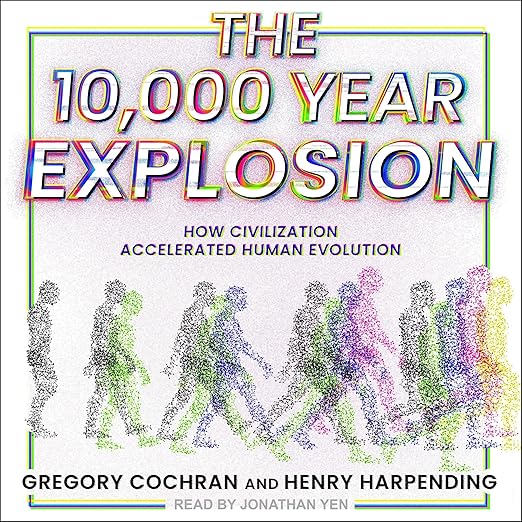
I approached this one with a certain wariness. Books that argue human evolution did not stop at the end of the Pleistocene occupy a complicated position in the popular science landscape, some are serious scientific contributions, others are provocations dressed as scholarship. The 10,000 Year Explosion, by geneticist Gregory Cochran and anthropologist Henry Harpending, sits in a genuine middle territory that requires the listener to do some of their own thinking.
I listened to it across two long walks, stopping occasionally to look things up, which is perhaps the appropriate relationship to have with a book that is explicitly arguing against received wisdom.
Our Take on The 10,000 Year Explosion
The central claim is this: scientists have long assumed that meaningful biological evolution in humans effectively stopped 40,000 to 50,000 years ago, when a behavioral and cognitive leap enabled the spread of modern human culture. Cochran and Harpending reject this view. They argue that the rise of agriculture roughly 10,000 years ago created new environmental pressures, new diseases, new diets, new social structures, that accelerated human genetic change rather than ending it. Traits like lactose tolerance, malaria resistance, and blue eye color all evolved within this recent window. These are uncontroversial examples that establish the basic premise.
From there the authors extend their argument into more contested territory: the genetic consequences of agriculture’s specific pressures on particular populations, the expansion of Indo-European peoples, and, most controversially, their account of why Ashkenazi Jews developed higher average scores on tests of verbal and mathematical reasoning, which they attribute to a thousand-year period of occupational selection under specific social conditions in medieval Europe. It is here that the book has attracted its most serious scrutiny and its strongest objections.
Why Listen to The 10,000 Year Explosion
Jonathan Yen narrates with a clean, precise delivery that keeps the academic material from becoming impenetrable. This is not an easy book to read aloud, the arguments chain across multiple disciplines including genetics, archaeology, historical linguistics, and epidemiology, and Yen manages the transitions without losing the thread. For a dense, argumentative text, he is a reliable guide.
The book’s strongest sections are its earlier ones: the overview of what human evolution actually looked like after the Pleistocene, the discussion of Neanderthal genetic contribution to non-African populations, and the sustained argument about agriculture as a biological pressure. These chapters represent a serious case for taking post-agricultural evolution seriously, and they are genuinely illuminating even for readers who are skeptical of the book’s larger claims. One reviewer described the book as “fascinating” and “plausible but not totally proven”, which is probably the most accurate brief characterization available.
What to Watch For in The 10,000 Year Explosion
The book has attracted significant controversy, and that controversy is worth understanding before you listen. The Ashkenazi intelligence hypothesis in particular has been challenged by other researchers on methodological grounds, and the authors’ willingness to use genetic arguments to explain what are often treated as purely cultural or historical phenomena has drawn criticism from scientists who see the evidentiary standards as insufficient for the conclusions drawn.
A 2014 reviewer noted that the book is explicitly arguing against a position championed by the late Stephen Jay Gould, that cultural flexibility rendered biological evolution in humans effectively neutral, and that framing situates the book in a genuine scientific debate rather than a settled one. One reviewer in this collection acknowledged it “sounds like eugenics,” which reflects the genuine concern that the book’s arguments, even where individually defensible, aggregate in directions that have been historically misused. Cochran and Harpending address some of these concerns but not all readers will find their treatment satisfactory. Approaching this as a provocation worth engaging with critically, rather than a conclusion to be accepted or rejected wholesale, is the most productive posture.
Who Should Listen to The 10,000 Year Explosion
This audiobook rewards listeners with some grounding in evolutionary biology, genetics, and the history of science, not because the authors are impenetrable, but because the contested claims land differently when you have enough context to evaluate them. Listeners who come to it cold and uncritical risk either accepting arguments that have not achieved scientific consensus or dismissing them without engaging the evidence the authors marshal.
For listeners who enjoy the kind of science book that argues against a dominant paradigm and makes you work to assess its case, this delivers that experience fully. The core argument, that human biology has changed meaningfully in the past 10,000 years, driven by the pressures of agricultural civilization, is defensible and important. How far the authors’ specific applications of that argument should be trusted is a more open question that listeners should carry through the eight hours with them.
Frequently Asked Questions
Is the science in this book current, or has it been significantly updated or challenged since publication?
The original book was published in 2009; this audio edition is from 2022. The field of ancient DNA analysis has advanced substantially since then, and some of the book’s specific claims have been refined or complicated by subsequent research. The broad thesis about post-agricultural evolution is widely accepted; specific applications, particularly the Ashkenazi intelligence hypothesis, remain contested.
How controversial is the Ashkenazi intelligence chapter, and should it affect my decision to listen?
The chapter is the most debated portion of the book. Cochran and Harpending argue that selection pressure from specific medieval occupational niches drove higher average verbal and mathematical intelligence in Ashkenazi Jewish populations. Other researchers dispute the evidentiary basis and methodological assumptions. It is a chapter to engage critically rather than accept as settled science.
Is Jonathan Yen’s narration able to handle the interdisciplinary scope of the arguments?
Yes. Yen is a precise, controlled narrator who moves between genetics, archaeology, and historical linguistics without losing the argumentative thread. The density of the material makes this better for active listening than background play.
What prior knowledge helps when listening to this book?
Some familiarity with evolutionary biology basics, the out-of-Africa hypothesis, and the history of the Neanderthal debate will help you assess the authors’ claims. Knowledge of the Stephen Jay Gould vs. adaptationist debates in evolutionary theory is useful context for understanding what position the book is arguing against.