In Brief
- Narration: Elyse Myers narrates her own material with custom pacing and light sound design, letting her established comedic timing carry directly into audio.
- Themes: neurodivergence and impostor syndrome, found family and self-acceptance, comedy built from specific vivid memories
- Mood: Warm, digressive, funny with real vulnerability underneath
- Verdict: A strong pick for existing fans and essay-collection listeners, though its non-linear structure may frustrate anyone wanting a conventional memoir arc.
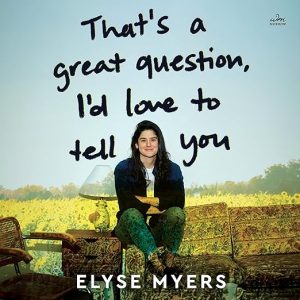
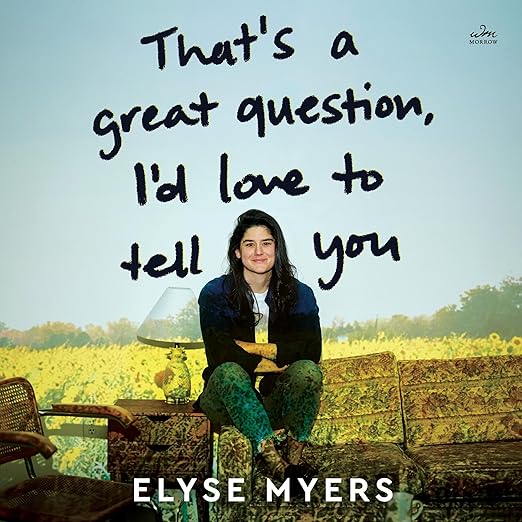
A Magic 8 Ball keychain named Lucy changing the entire trajectory of someone's life sounds like the setup for a joke, and in Elyse Myers' hands, on this audiobook, it mostly is, until it quietly isn't. That's a Great Question, I'd Love to Tell You is the debut essay collection from the creator millions of followers know as The Internet's Best Friend, and at five and a half hours, self-narrated, it plays less like a traditional memoir and more like an extended, wildly digressive conversation with someone who has decided to tell you absolutely everything.
A Structure That Mimics a Neurodivergent Mind
Myers structures the book around specific, oddly-titled moments rather than a chronological life story, an awkward spin-the-bottle-adjacent memory from middle school, a butcher-counter meet cute with her future husband in Australia, a ten-step guide to folding hospital corners that is somehow also a meditation on control. That non-linear approach could read as scattered in the wrong hands. In audio specifically, narrated by Myers herself, it instead mimics the actual experience of a neurodivergent mind moving between memories, which she is explicit about being an advocate for, so the structure is not just a stylistic choice, it enacts the very thing the book is partly about.
The through-line holding the essays together is less plot than persona: three stated goals, to make people feel known, loved, and like they belong, run under nearly every story here, whether Myers is describing a panic attack, a string of bad dates, or the four-state relocation, California to Australia to Texas to Nebraska, that shaped her adult life. That consistency of purpose is what keeps a genuinely scattered structure from feeling directionless by the end of five and a half hours.
Mundane Titles Concealing Real Vulnerability
The title is worth sitting with on its own. That's a Great Question, I'd Love to Tell You reads as a specific, real phrase, the kind of deflection-into-overshare a natural storyteller uses when someone asks something slightly too personal at a party, and it doubles as an accurate description of the book's own method: every essay here answers a question nobody quite asked with far more honesty than the moment technically required. That instinct, oversharing as a form of generosity rather than a lack of boundaries, is the book's actual comedic and emotional engine.
The bit titles alone are worth a mention as a craft choice: naming an essay How to Fold Hospital Corners in 10 EASY STEPS before revealing it is really about control and anxiety is a specific comic rhythm, a mundane, oddly specific instruction-manual title concealing real vulnerability until you are already inside the essay. Myers uses that misdirection repeatedly across the collection, and it works because the mundane titles never feel like a bait-and-switch, just an honest reflection of how she actually processes things.
Myers Paces Her Own Recording, With Sound Effects
This is a textbook case for audio being the superior format over print. Myers paced the recording herself and layered in subtle sound effects that add texture without turning the book into a full production, and one reviewer specifically says it felt like sitting with a friend, exactly the effect self-narration by a comedian with a huge existing audio and video following should produce. If you already know her voice from her platforms, this audiobook is simply that voice extended to essay length, timing intact.
The comedic timing alone justifies the audio format. Myers built her following on video delivery where pacing, pause, and inflection are the entire joke mechanism, and a hired narrator, however skilled, would need to reconstruct that rhythm from the page rather than simply performing it the way she already knows how to. Reviewers confirm this translates: multiple describe laughing out loud, a genuinely different bar to clear than well written for a comedic memoir.
Illustrations That Never Reach the Audio
The one consistent critique, and it comes from a reviewer who is explicit about being neurodivergent herself, is that the same structure that makes the book feel authentic can also read as distracting rather than illuminating, depending on how a given listener's brain processes non-linear storytelling. That reviewer says she would have preferred a more standard layout even while still rating the book four stars. Worth taking seriously as a genuine format mismatch risk rather than dismissing it, since it comes from inside the exact community the book is partly written for.
Fans expecting pure comedy should recalibrate slightly. Alongside silly, slightly embarrassing material one reviewer highlights, Myers writes directly about panic attacks, impostor syndrome, and body image, and the tonal shifts between a Magic 8 Ball bit and a genuinely vulnerable passage happen quickly. That range is a strength for readers who want more than a comedy set, but it means this is not pure lighthearted entertainment cover to cover.
At five hours and thirty-two minutes, this sits on the shorter end for a memoir-length audiobook, closer to a long conversation than an exhaustive life story. Listeners expecting the kind of decade-spanning arc a traditional celebrity memoir delivers should adjust expectations: this is a collection of specific, vivid moments rather than a comprehensive account of how Myers built a following in the millions.
The four-state relocation named directly in the synopsis, California to Australia to Texas to Nebraska, is doing more structural work than a simple biographical detail. Each move gets its own emotional register in the book, and stacking them back to back makes visible just how much instability shaped Myers' adult life before any of her twelve million followers ever found her online. That kind of concrete, specific detail is exactly what keeps an essay collection built on humor from floating free of any real stakes.
One format caveat worth flagging plainly: the print and ebook editions include hand-drawn illustrations throughout, a detail the synopsis mentions directly, and none of that visual material carries over to audio. For a book this personal and specific, illustrations likely add another intimate layer, so listeners who want the complete experience Myers built, not just the words, may want to have a print or ebook copy on hand alongside the audiobook rather than choosing audio as a total substitute.
Existing Fans Get Her Timing Intact
Existing fans of Myers' videos are the obvious audience, and they will get real added value from hearing these stories in her own voice with her own comedic timing intact. It is also a strong pick for listeners who enjoy essay-collection memoirs built on specific vivid scenes rather than tidy chronology, and for anyone interested in neurodivergence and impostor syndrome discussed with humor rather than clinical distance.
Skip it if you strongly prefer a linear, chronological memoir structure, the reviewer who wanted a more standard layout is a useful data point here, or if you are looking for a deep, comprehensive account of Myers' career rather than a scattered, intimate collection of specific personal moments.
A Few Questions About That's a Great Question, I'd Love to Tell You
Does Elyse Myers narrate her own audiobook?
Yes. She recorded it herself, paced the delivery, and added subtle sound effects, which reviewers say gives the audiobook the same intimate, direct feel as her videos.
Is this audiobook told in chronological order?
No. It's structured around specific titled moments rather than a linear life story, a choice reviewers connect to Myers' advocacy around neurodivergence, though at least one reviewer found the non-linear format distracting rather than illuminating.