Quick Take
- Narration: David de Vries reads with measured clarity that suits a cultural reference guide, authoritative without being dry, though the format is better suited to reading than listening.
- Themes: Thai social values and hierarchy, Buddhism and the monarchy’s cultural role, navigating cross-cultural communication
- Mood: Informative and respectful, with a genuine effort to go beyond surface-level tourism advice
- Verdict: A genuinely useful cultural orientation that works best as a pre-trip primer rather than a commute listen, and that earns its recommendation for anyone preparing for meaningful engagement in Thailand.
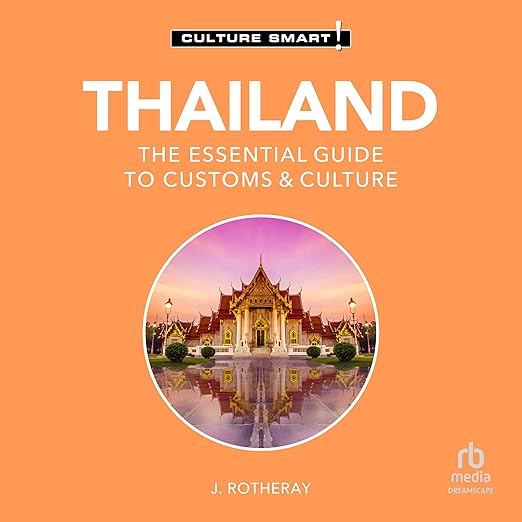
I have a somewhat predictable ritual before any significant international trip: I read the relevant Culture Smart! guide. Not because I think a four-hour audio book will make me fluent in a culture’s complexities, but because having a frame is better than having none. The Thailand installment came up ahead of a longer research trip I was planning, and I came to it with reasonable expectations about what it could and could not do.
The Culture Smart! series published by Dreamscape Media has a consistent format across its titles: history and geography, values and attitudes, religion and customs, social etiquette, communication norms. J. Rotheray, the author, follows this structure reliably, and what makes the Thailand volume stand out within the series is the quality of the central insight about Thai culture that organizes the whole book: that Thailand has never been conquered by a foreign power, and that this fact shapes Thai identity in ways that visitors consistently underestimate.
Our Take on Thailand: Culture Smart!
The Land of Smiles branding, which Thailand’s tourism board created in the 1980s, gets unpacked here in a way I found more revealing than most introductory treatments. Reviewer from Amazon Customer notes that a smile can mean many things in Thailand, and that having a sense of what is going on behind the veneer is your gateway to understanding and experiencing Thailand at its most authentic and enjoyable. Rotheray treats this not as a warning about deception but as an invitation to more attentive observation. The Thai smile is not false; it operates within a social logic that is simply different from Western directness.
The three pillars of Thai identity that Rotheray returns to throughout, Buddhism, the monarchy, and the military, give the book a consistent analytical frame. Understanding how these three institutions intersect and how they shape daily behavior, from workplace hierarchies to the concept of kreng jai (avoiding actions that impose on others), gives the cultural information genuine depth rather than the feel of a list of things not to do.
Why Listen to Thailand: Culture Smart!
David de Vries is a reliable narrator for reference nonfiction. He reads with the kind of measured authority that signals to the listener that the information is being delivered seriously without being pedantic about it. The Thai words and phrases that the author includes, which reviewer T.U. Scott specifically praises, are handled with reasonable pronunciation, which matters when you are trying to absorb them aurally rather than from a page.
At four hours and nine minutes, this is a very manageable listen. Reviewer Rachel Davis describes it as particularly useful for understanding cultural nuances, governance, and history, and notes it served her well for a first visit. That practical testimonial is more informative than a general endorsement: someone who actually went to Thailand and found the content applied.
What to Watch For in Thailand: Culture Smart!
The tension in any Cultural Smart! guide is between breadth and depth. Four hours covers thirty million annual visitors’ worth of cultural diversity at a level of generalization that can occasionally feel reductive. Thailand is a country with significant regional variation between Bangkok, the north, the northeast, and the southern provinces, and that variation does not always surface clearly in a guide oriented toward general visitor preparation.
The audiobook format also has limits for this kind of reference material. Unlike a print guide you can flip through by topic, the audio version requires listening from beginning to end or carefully using chapter navigation. If you want to revisit the section on workplace etiquette before a business meeting in Bangkok, that is harder to access on audio than on page. Reviewer Susan Davison gives it four stars and describes it as good for tourists with some interesting facts, which is an accurate if modest assessment. This is a starting point, not a complete education.
Who Should Listen to Thailand: Culture Smart!
First-time visitors to Thailand who want to go beyond standard tourist preparation will find this a useful investment of four hours before their trip. Business travelers who will be working with Thai colleagues will find the sections on hierarchy, face-saving, and communication norms particularly practical. Extended-stay visitors, expats, and people in Thai-adjacent professional contexts may want to supplement with deeper reading. The audio format works well as a commute or travel listen in the weeks before departure, but less well as a quick reference tool during a trip. Reviewer T.U. Scott’s recommendation to read it before tour guide books is exactly right.
Frequently Asked Questions
Does Thailand: Culture Smart! cover both Bangkok and regional Thailand, or is it focused on the capital?
The guide covers Thailand broadly rather than focusing exclusively on Bangkok. However, the framing is oriented toward general visitor preparation, and regional distinctions between northern Thailand, the northeast (Isan), and the deep south are touched on but not explored in depth.
How does this compare to a standard travel guidebook for Thailand?
It is explicitly not a travel guidebook. There are no hotel recommendations, restaurant listings, or sightseeing information. The focus is entirely on cultural understanding: values, communication norms, religion, history, and social behavior. Reviewer T.U. Scott recommends reading it before a standard tour guide book rather than instead of one.
Is the information up to date given that it was originally published in 2025?
The audiobook release from Dreamscape Media dates to September 2025, making it a relatively current edition. The Culture Smart! series updates its guides periodically, and this edition addresses recent social and political developments in Thailand.
Does the book address any sensitive topics like Thai politics, the monarchy’s legal protections, or social divisions?
Yes, briefly. The book acknowledges the monarchy and the military’s role in Thai governance and touches on the legal protections around lese-majeste laws. Rotheray handles these topics with care and without sensationalism, providing enough context for visitors to understand why certain conversations require particular tact.