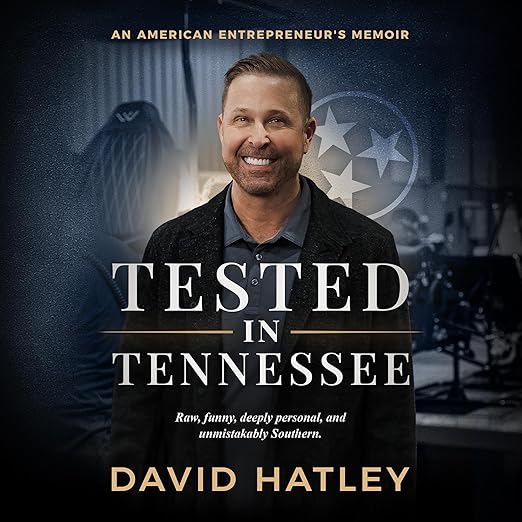
David Hatley's memoir opens with a six-year-old boy alone in a yard in Elizabethton, Tennessee, throwing a baseball against a brick wall because nobody is around to play catch with him, and that single image of self-reliant repetition becomes the structural key to everything Hatley builds afterward. He narrates this audiobook himself, and the craft choice pays off immediately: a hired narrator could read the facts of Tested in Tennessee, but only Hatley can deliver the specific cadence of someone who actually lived every one of them.
The Largest Hot Tub Manufacturer, No Investors
The book's title works on more than one level. Hatley was tested by a childhood shaped by his father's infidelity and his mother's alcoholism, tested again by his own early brushes with the law, and tested a third time by the unglamorous grind of building a hot tub manufacturing company with no investors, no trust fund, and no existing blueprint to follow. He is upfront that two marriages did not survive the process before a third one, as he puts it, changed everything, and that willingness to include the personal failures alongside the professional wins keeps the book from reading as a victory lap.
Reviewers consistently single out the same qualities: honesty, accountability, and a first-person account of self-belief that does not flinch from the uglier chapters. One reviewer who served in the United States Army specifically placed Hatley among the strongest leaders they had encountered, a notable comparison coming from someone with direct institutional leadership experience to measure against.
The specific nature of Hatley's business, hot tub manufacturing, is worth dwelling on rather than treating as an incidental detail. It is not a glamorous or obviously scalable industry on its face, and building the largest domestic manufacturer in that category without outside capital represents a genuinely unusual entrepreneurial path compared to the tech-startup or finance-world origin stories that dominate much of the business memoir shelf. That specificity is part of what makes the book feel grounded rather than aspirational in a generic sense.
Hatley Still Lives a Few Miles From the Hollow
Self-narration is doing real work here rather than functioning as a vanity choice. The book's emotional center, a kid throwing a baseball alone because nobody was coming to play catch, only carries its full weight when delivered by the person who was actually that kid, and Hatley's plainspoken, unpolished delivery reads as authenticity rather than a lack of production value.
The synopsis positions Tested in Tennessee alongside Shoe Dog, Hillbilly Elegy, and Sam Walton: Made in America, a reasonably earned comparison rather than pure marketing reach. Like those books, this one blends a specific regional upbringing with an origin story of self-made entrepreneurship, and listeners who responded to Phil Knight's scrappy founder voice or J.D. Vance's Appalachian family reckoning will recognize familiar emotional terrain here, transplanted to Carter County, Tennessee, and the hot tub industry specifically.
One detail the synopsis includes almost in passing carries real thematic weight: despite his success, Hatley still lives just a few miles from the hollow where he grew up. That choice reframes the entire book's arc away from a rags-to-riches escape narrative and toward something more like a reconciliation with origin, wealth and stability achieved without geographic or emotional distance from where the difficulty started, a less common shape for this genre than it might first appear.
Impressive, but at a Smaller Commercial Scale
At five hours and nine minutes, this is a tighter listen than most of the business memoirs it invites comparison to, which means the story moves briskly rather than lingering extensively on any single chapter of Hatley's life. Listeners wanting a slow, richly detailed unpacking of specific business decisions may find the pace closer to a well-told story than a granular case study.
It is worth being precise about scale when weighing those comparisons: Shoe Dog and Sam Walton: Made in America both trace the building of globally recognized brands, while Hatley's story, however impressive within its own industry, operates at a smaller commercial scale. That does not diminish the personal narrative, which stands on its own merits, but listeners expecting a business story of Nike or Walmart's magnitude should calibrate expectations toward a regional manufacturing success story with an unusually honest personal throughline instead.
Only Four Ratings, All of Them Five Stars
Only four ratings are attached to this title so far, all five stars, a genuinely strong signal but still a small enough sample that it is worth naming plainly rather than treating as exhaustive proof of the book's reach or reception.
It is also worth being clear about what this book is not: it is not a tactical how-to guide for starting a manufacturing business, step by step. The reviewers who mention leadership and grit are responding to the memoir's emotional and character-driven throughline rather than a repeatable playbook, so listeners hoping for concrete operational advice on sourcing, staffing, or scaling a manufacturing company should adjust their expectations toward inspiration and personal narrative rather than a business-school syllabus.
Elizabethton Reads as a Real, Particular Place
This is a strong fit for fans of self-made entrepreneurship memoirs, especially anyone who responded to the Southern, working-class specificity of Hillbilly Elegy or the founder-grit energy of Shoe Dog. Listeners interested in addiction's ripple effects on a family, and in how someone builds stability despite that inheritance rather than because of it, will also find real substance here.
Listeners looking for a technical business manual, or who prefer polished, professionally acted narration over a founder's own unvarnished voice, may want to sample a few minutes first. For the memoir's intended audience, though, self-narration and specific regional detail work together rather than against each other, and that combination is a large part of why this book earns its comparisons.
Listeners who enjoy audio memoirs specifically for their sense of place, the way a Southern voice and a specific hollow in Carter County can feel as vivid as any big-city setting, will find that regional specificity is one of the book's quieter strengths. Hatley does not generalize his hometown into interchangeable small-town Americana; Elizabethton and its surrounding community read as a real, particular place throughout, which grounds even the book's most difficult family chapters in something concrete rather than abstract.
Before You Listen
Does David Hatley narrate this audiobook himself?
Yes, and it matters. His own delivery carries the specific weight of a man describing his own childhood and business struggles rather than a hired narrator performing them secondhand.
Is this audiobook more of a business how-to guide or a personal memoir?
It is a memoir first. Listeners hoping for a step-by-step manufacturing or business playbook should adjust expectations toward inspiration and personal narrative instead.
How long is the Tested in Tennessee audiobook?
Five hours and nine minutes, a tighter listen than most comparable business memoirs like Shoe Dog or The Snowball.