Quick Take
- Voice: Gadsby reads her own memoir, a fitting choice for a book explicitly about reclaiming the terms of her own story.
- Big ideas: queer identity in Tasmania, late ADHD and autism diagnosis, truth-telling over self-deprecation
- Atmosphere: reflective, at times harrowing, occasionally very funny
- Worth it?: a substantial, self-narrated account of the years before Nanette, best suited to listeners who want the reasoning, not just the highlight reel.
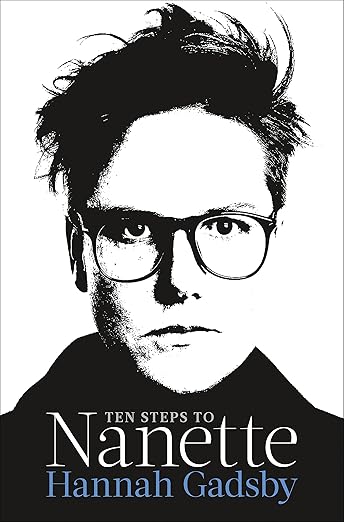
I remember exactly where I was when Hannah Gadsby's comedy special Nanette convinced me that stand-up could work as something closer to testimony than to a string of punchlines. This audiobook is Gadsby narrating the decade that built toward that hour on stage, and toward the harder decision that came after it, which was to stop performing herself for laughs. Ten Steps to Nanette isn't a making-of featurette bolted onto a famous hour of comedy. It's a full memoir, and Gadsby reads it herself, which matters more here than it does for most audio memoirs, because the entire argument of Nanette was about who gets to control the shape of a story and how it gets told.
According to the listing, Gadsby structures the book as a walk through the moments that built her: growing up queer in Tasmania, where homosexuality remained illegal until 1997, then years inside a comedy industry that rewarded the very self-deprecation Nanette eventually renounced. The synopsis is upfront that this isn't a comedy album transcribed into prose. It traces a relationship with stand-up that kept shifting shape across her career, and it lands, eventually, on the diagnoses that came late, ADHD and autism, arriving well into adulthood and reframing everything that came before them.
What I can't do here is compare notes with other listeners, because the listing carries no written reviews at all, just eight ratings that add up to 36 of a possible 40. That's a strong number, but it's a number without a single voice attached to it, so take my read of the text as one critic's read rather than a consensus of listeners who have actually finished it. What the synopsis promises is a memoir built on a stated principle, that truth-telling, however costly, beats the easier work of making yourself smaller for a room. Gadsby narrating her own account of arriving at that principle is the audiobook's clearest asset, because a hired narrator reciting those conclusions would be reciting somebody else's hard-won certainty rather than her own.
Multi-award-winning is the kind of descriptor that gets slapped on a lot of comedy memoirs, but here it points to something specific: a career built well before Nanette went viral, with years of open mics, false starts, and a slow climb that the book treats as the actual story rather than a preamble to the famous part. That framing matters for how the memoir is structured. It isn't organized around a single triumphant hour on stage. It's organized around everything that had to be survived first.
Letting a Line Land Without Softening It
The case for this one is really a case for hearing the author instead of reading her. Ten Steps to Nanette covers ground Gadsby has already turned into one of the most discussed stand-up specials of the last decade, and the audiobook gives her the chance to narrate it in her own cadence rather than have someone else's delivery stand in for hers. If you found Nanette's shifts between comic timing and flat, unadorned honesty affecting on stage, that same instinct for when to let a line land without softening it is presumably still hers to control here, on her own terms, in her own voice.
The book also covers a lot of ground beyond the special itself: a childhood and young adulthood shaped by a place where her own identity was, legally, a problem to be solved rather than a fact to be lived with, and a career built inside an industry that asked her to keep performing the joke at her own expense. Listeners who came to Gadsby through Nanette and wondered how she got there, specifically, get an answer instead of an inference. The 384 pages the print edition runs to suggest this is a substantial account rather than a quick coda to the special, and the audio runs nearly 14 hours to match that scope, room enough for Tasmania, comedy, and the ADHD and autism diagnosis to each get real weight.
A 384-Page Count Sitting Beside 14 Hours
Go in expecting reflection rather than a laugh-a-minute set. The synopsis calls the book harrowing about as often as it calls it hilarious, and the material it covers, homosexuality that was illegal within living memory, a late ADHD and autism diagnosis, the specific misogyny of the comedy circuit, earns that word honestly. If you want ninety minutes of jokes, this is the wrong shape of audiobook. If you want the reasoning behind why Gadsby stopped being willing to supply jokes at her own expense, it's the right one, and it takes its time getting there.
The absence of written reviews is worth repeating rather than glossing over, because it means the book arrives without the usual chorus of listener reactions to check your own response against. I'd also flag something small but real: the listing still carries a 384-page count field that reads like it was pulled from a print edition, sitting right next to an audio runtime of just under 14 hours. It's not a contradiction, just a reminder that this book exists in more than one format, and the page count on file describes the page, not the recording. None of that changes what's actually in the audiobook, but it's worth knowing before you buy rather than after.
One more thing worth setting expectations around: this is Gadsby working in prose rather than in a ninety-minute set built for a live room, and prose gives her more room to sit inside a memory before turning it into a joke, if she turns it into a joke at all. Listeners expecting the same rhythm as Nanette, tight, escalating, built for an audience's reaction in real time, may find the memoir's pacing looser and more discursive by design.
Read by the One Person Who Lived It
This suits listeners who watched Nanette and wanted the backstory in Gadsby's own words, and it suits anyone drawn to memoirs about late-diagnosed neurodivergence, since her account of receiving an ADHD and autism diagnosis well into adulthood is a real, specific throughline rather than a footnote tacked on at the end. Queer listeners curious about Tasmania's particular legal history, and about what it meant to grow up there before 1997, will find that context treated as central rather than incidental to everything else.
Skip it if you're after stand-up material rather than memoir, or if harrowing, the book's own word for itself, is a sign you'd rather not sit with right now. This isn't a rewatch of the special in audio form. It's the account of everything that had to happen first, read by the one person who lived it and eventually decided to say so out loud, on her own terms, at whatever length that truth required.