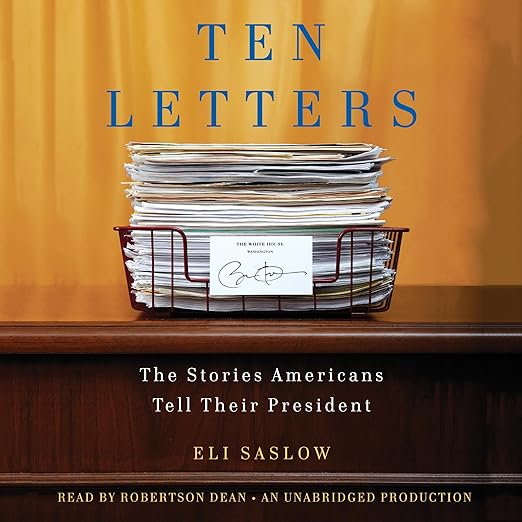
Ten representative letters, picked each day from the thousands arriving, reached President Obama, and Eli Saslow built a book out of going to find who wrote them. This audiobook runs nine hours and thirty-six minutes, Robertson Dean reads it, and Random House Audio released it on October 11, 2011. Fifty-two ratings hold it at 4.1. Five of those came with words attached, and the grades among them travel the entire distance from five stars down to one, which is unusual in a column of five.
From Dear Jackass to Dear Mr. President
Saslow's method is why this holds up. Instead of writing about presidential mail as a phenomenon, he takes ten letters that drew a personal reply and goes to find the people who sent them, which converts a White House procedure into ten pieces of American reporting. The senders are described as people of every age, walk of life and political persuasion, and the copy is blunt about the range: as many envelopes addressed Dear Jackass as Dear Mr. President. That mixture is the book's whole claim to being something other than an administration souvenir.
Documents and reportage alternate the entire way through, which poses a specific problem for a recording. On a page a letter looks different from the prose around it, indented and set in another face, visibly somebody else's handwriting rendered into type. Audio has none of those signals. A listener has only a shift in register to know that somebody's own words have started and the reporter's account has paused. Nine and a half hours of that alternation is a genuine demand, and how it gets handled decides whether the book works aloud at all.
Eliezer, writing twelve days after release, names the element I found most interesting: Saslow examines the process by which regular Americans' letters are selected to reach the president's desk. That procedural spine keeps ten hardship stories from turning into a parade of misfortune. Somebody sorts the mail. Somebody decides which ten go upstairs. The same entry observes that the writers were probably not expecting Obama to read what they sent, still less to answer it, and the book finds its charge inside that gap between expectation and reply.
Twenty Thousand Letters Sorted Into Purple Folders
LiteBlue Gator, writing in December 2012, supplies the most concrete number in the column: twenty thousand letters and emails reaching the White House daily, sorted into purple folders. That entry also hands the book credit for a history of the tradition stretching back far enough to include an eleven-year-old girl who talked Abraham Lincoln into growing a beard. Whether or not that particular story survives scrutiny, it signals the range on offer, which runs considerably wider than the ten cases in the title.
Nine and a half hours divides sensibly across the structure. Ten lives plus the machinery around them leaves something under an hour for each, which is roughly where a magazine profile stops being a sketch and starts being a life. Saslow was working at the Washington Post when this began, and the reporting habits show in the pacing: every case gets an opening, a complication and a consequence rather than a quotation and a quick move to the next name on the list.
Ordinary is the word carrying the most weight in the description, and the book earns it in a way political writing usually cannot. These correspondents are not activists, plaintiffs or people with a media strategy. They are people who sat down and wrote because the country had done something to them, and the copy insists that what emerges from the pile is endurance and optimism rather than despair. That framing runs warmer than the raw material suggests, and the description commits to it directly instead of hedging.
Filed in the Wrong Aisle, Next to Novels
Angela Stephens left one star in August 2014 and two sentences: it did not focus on the letters, and it showed how egotistical the president is. The second half is a political verdict any listener can weigh alone. The first half is a legitimate structural complaint, and the description confirms it outright, since the letters function as a lens rather than the subject itself. Anyone expecting ten letters read aloud with commentary has the wrong book, and the title does nothing to prevent the misunderstanding.
Filed under two genres at once, biographies-memoirs and literature-fiction, this record puts a work of newspaper reporting in a fiction category. The tag reads Diaries and Correspondence, which fits far better and is the label to trust. The series entries are blank and no badge marks the record, so anyone browsing by category will meet this book in the wrong aisle, next to novels it has nothing in common with beyond a first-person register.
The Correspondents Are the Reason to Listen
Rick Spell, writing in July 2012, puts the audience problem better than I could: people allow their political persuasion to govern their reading, so a book like this will not be read by all, and it should be. That observation has not aged out. The same response points at the sadness inside stories most Americans never experience but that are commonplace for poorer citizens, and at the anger of the correspondent the entry nicknames the Man Cave Man, who ends up receiving a reply.
Readers of long-form American reporting will recognize the form immediately and should be comfortable. The audience that gains most, though, is anyone whose desk these letters land on: caseworkers, constituent services staff, anybody who processes other people's worst weeks for a living. This book is largely about what happens when an institution decides to read its own mail, and that question outlasts the particular administration attached to it.
Tolerance for the subject decides the rest. A listener who cannot hear Obama's name for nine hours without arguing back will find a great deal to argue with here. Everyone else gets ten pieces of careful reporting about people who wrote a letter and, improbably, received an answer. The correspondents are the reason to listen. The correspondence is only the door they came through.
Key Details
- Narration: Robertson Dean carries the entire recording, on a trade edition dated to the book's own publication month.
- Themes: Presidential mail as a window onto ordinary lives, hardship and endurance, the machinery behind a personal reply.
- Mood: Steady, humane and unhurried.
- Verdict: Strong reported nonfiction that treats the letters as a lens rather than a subject, which is the one expectation worth adjusting before you start.
Is Ten Letters an insider account of the Obama White House?
No, and the description rules it out directly, calling it not an insider Washington book by any means but a book for the times. The White House appears mainly as the place where the mail arrives and gets sorted, while the reporting itself lives out among the people who wrote in.
How long is the Ten Letters audiobook, and who published it?
Nine hours and thirty-six minutes, released by Random House Audio on October 11, 2011, with Robertson Dean credited as the reader. The single tag reads Diaries and Correspondence, which describes the contents more accurately than either genre listing does. No supporting cast is credited, so one voice carries both the reporting and the quoted mail.
Does the audiobook cover the replies as well as the letters?
The ten letters were chosen precisely because Obama answered them personally, so the replies are the selection criterion rather than the material. What the book pursues afterward is the sender: who they are, what happened to them, and what conditions made writing to a president seem worth the stamp.
How divided is the rating?
The 4.1 rests on fifty-two ratings, only five of which carry text. Those five span five stars down to one, and the most recent of them, filed on the first day of 2026, amounts to a single line of praise. The newest entry on the page is also the least informative.