Quick Take
- Narration: George Backman handles the dense factional texture of Reed’s account with steady clarity, though at fourteen hours the narration asks for committed attention across the full run.
- Themes: Revolutionary upheaval, the gap between idealism and historical reality, participatory journalism as witnessing
- Mood: Urgent and immersive, with the specific electricity of a document written in the immediate wake of transformative events
- Verdict: One of the foundational texts of eyewitness political journalism, essential for anyone serious about understanding the Russian Revolution, though listeners should come prepared for its limitations.
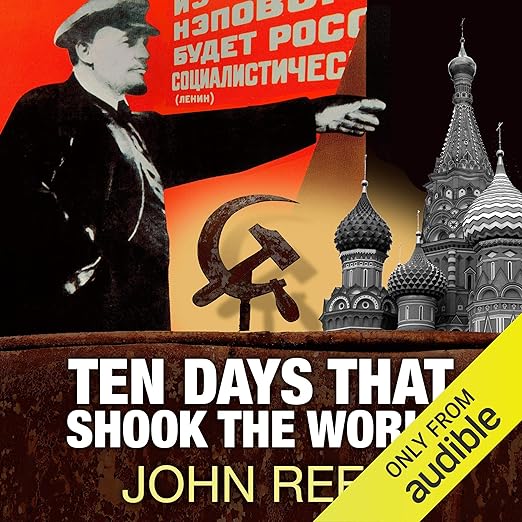
I remember the specific shelf in my university library where I first encountered John Reed’s Ten Days That Shook the World, sandwiched between dry institutional histories of early Soviet governance and a tattered copy of Victor Serge’s memoirs. It was the only book on the shelf that read like dispatches from somewhere genuinely dangerous, where you could feel the chaos and noise and smell of crowds pressing against the text. That quality is not diminished in audio. George Backman’s narration, at fourteen hours and eighteen minutes, gives this landmark text the time it needs to breathe.
John Reed was a thirty-year-old American journalist when he arrived in Petrograd in October 1917. He had already built a reputation as a radical correspondent, having covered the Mexican Revolution and labor struggles in the United States. He arrived in Russia with sympathies already formed and found a revolution in progress that exceeded, in its scale and velocity, anything he had witnessed before. What he produced was published in 1919 and has never been out of print since. That longevity is not accidental.
Our Take on Ten Days That Shook the World
The text is organized around the November events, from the final days of the Provisional Government through the Bolshevik seizure of power and its immediate aftermath. Reed structures it chronologically, which creates a reading experience that mirrors the disorientation of the period: you are never quite sure what authority is operating, which factions are in the ascendant, or where the competing crowds will carry their energy next. He includes verbatim transcriptions of speeches from Trotsky, Lenin, and Kerensky alongside the overheard comments of soldiers and factory workers, creating a textured account that oscillates between the heights of political theater and street-level confusion.
The revolutionary enthusiasm is not hidden. Reed was a committed socialist and arrived in Russia hoping to witness what he believed was a genuine transformation of human society. That investment shapes what he noticed, what he quoted, and what he chose not to include. One reviewer describes the book as ‘unabashedly pro-Bolshevik,’ and that is accurate. It is also, as the same reviewer notes, useful for that reason, because it allows you to measure Reed’s idealism against the historical record that followed.
Why Listen to Ten Days That Shook the World
The audiobook format reveals qualities of the text that reading sometimes obscures. The speeches transcribed by Reed, Lenin at the Congress of Soviets, the competing voices from the floor, the proclamations read aloud to waiting crowds, were public events delivered in voice. Hearing them rendered in Backman’s narration returns something of their original character. The dramatic passages in particular, Reed describing himself pressing through crowds outside the Winter Palace, or watching armored cars move through the night streets of Petrograd, gain a propulsive quality in audio.
Backman’s narration is measured and serious, appropriate for material that demands it. He does not reach for dramatic effect in the crowd scenes but lets Reed’s prose carry the energy. For a fourteen-hour text with substantial documentary material including committee resolutions, political decrees, and factional arguments, that restraint is the right call. Reed’s writing can sustain its own energy without narrators pushing it.
The historical significance needs to be stated plainly. This is not a book about the Russian Revolution in the way a later historical analysis would be. It is a primary source, a document produced by someone who was present. As one reviewer notes, the introduction acknowledges that Reed took literary license in certain sections. But the contemporaneity of the document, its status as an account written before anyone knew what the Bolshevik Revolution would become, gives it an irreplaceable quality that no later history can replicate.
What to Watch For in Ten Days That Shook the World
The background knowledge requirement is the sharpest practical limitation. Reed wrote for readers who already knew who the Mensheviks were, what the Soviets represented as an institution, and why the relationship between the Provisional Government and the various socialist factions had reached a breaking point. In 1919, that knowledge was current. Today, listeners without prior grounding in the period will find themselves frequently disoriented by the proliferating factional names and political positions. One reviewer, reading within a group, described consulting notes and supplements without fully bridging the gap.
The ideological commitment also means the book has genuine blind spots. The counterrevolutionary perspective is largely absent. The experiences of populations who did not celebrate the Bolshevik seizure of power, the bourgeoisie, the national minorities, the more conservative peasantry, are present only as obstacles or background. Reed’s account of the revolution is the account of the revolution as its most enthusiastic participants experienced it.
Who Should Listen to Ten Days That Shook the World
Listeners with some foundation in Russian history and the early twentieth century political landscape of Europe will get the most from this. It pairs well with more analytically distanced accounts of the same period, Orlando Figes’s A People’s Tragedy being the obvious complement. For those who are approaching the Russian Revolution for the first time, a shorter contextual introduction listened to beforehand will significantly improve the experience. As a document of revolutionary journalism, as an example of what it means to be present at a historical hinge point and to write from inside it, Ten Days That Shook the World remains essential.
Frequently Asked Questions
Is Ten Days That Shook the World still historically reliable despite its obvious political sympathies?
Reliable as a primary source document, with caveats. Reed’s sympathies shape his selection and framing, and he took literary license in some sections, as noted in the introduction. It should be read alongside rather than instead of historical analyses that can provide critical distance. What it reliably captures is the texture of experience for those who participated in or witnessed the Bolshevik seizure of power.
Is fourteen hours too long for the content, or does the runtime feel justified?
The length reflects the density of the original text, which includes documentary material beyond Reed’s narrative prose. The pace is not padded; this is the full text. Listeners who find the historical density of factions and resolutions engaging will find the runtime justified. Those who prefer tighter narrative history may find the documentary sections test their patience.
What background should I have before listening to this audiobook?
A basic understanding of the Russian Revolution, including the key factions (Bolsheviks, Mensheviks, Socialist Revolutionaries), the role of the Soviets as worker and soldier councils, and the collapse of the Provisional Government under Kerensky, will make the text substantially more coherent. Without that foundation, the proliferating names and political alignments can become confusing.
How does George Backman’s narration handle the passages where Reed transcribes speeches verbatim?
Backman reads the speeches with measured formality rather than theatrical performance, which is the right call. The speeches were political addresses and their weight comes from what is being said rather than dramatic interpretation. His steady delivery makes the documentary material legible without making it feel like a newspaper being read aloud.