Quick Take
- Narration: Robin Miles brings a lush, authoritative voice to Hurston’s prose, honoring both the anthropological precision and the vivid literary personality that makes this travelogue singular.
- Themes: Voodoo as living culture and spiritual system, Haiti and Jamaica under colonialism, the anthropologist as participant observer
- Mood: Dense, strange, and luminous; the product of a brilliant mind encountering a world that unsettled and fascinated her in equal measure
- Verdict: An essential Hurston document that this audiobook finally makes fully accessible, best approached as literary anthropology rather than conventional travel writing.
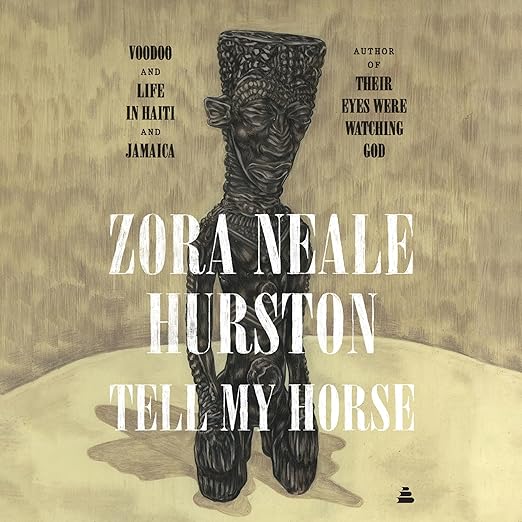
Tell My Horse has always been the Zora Neale Hurston title that readers come to after Their Eyes Were Watching God and then aren’t quite sure how to hold. It sits in a genuinely uncomfortable middle space between ethnographic fieldwork, travel writing, political commentary, and spiritual document, and it does not resolve that ambiguity into anything more comfortable than what it is. I finally listened to this audiobook after years of meaning to read the print edition, and Robin Miles’s narration turned out to be exactly the thing needed to make Hurston’s voice fully inhabit the material. This is prose that wants to be heard, that was written by someone whose primary mode of processing experience was oral and performative before it was literary.
Hurston came to Jamaica and Haiti in the 1930s on a Guggenheim fellowship, and she did something that most anthropologists of her era either could not or would not do: she participated rather than merely observed. She did not attend voodoo ceremonies from a safe distance with a notebook. She underwent initiations, built relationships with practitioners, learned the internal logic of the system from the inside rather than mapping it from outside, and attempted to understand it as a coherent religious tradition rather than as exotic material for outside documentation. The New York Times Book Review called it strikingly dramatic, yet simple and unrestrained, and that description holds across eighty years because Hurston’s voice has not aged in the ways that more careful and distanced anthropological writing from the same period often has.
The Anthropologist Who Refused the View from Outside
Hurston studied under Franz Boas at Columbia, and Tell My Horse reflects that training while also straining against its methodological assumptions in ways that were ahead of their time. Boas-era anthropology was committed to the ideal of the objective outside observer, to the researcher who maintains analytical distance from the material being studied. Hurston repeatedly refuses that position. She eats the food, participates in the ceremonies, forms affections and aversions about specific places and people, and shares her opinions about Haitian and Jamaican politics with a frankness that would have made a more conventionally positioned anthropologist visibly uncomfortable.
The result is a fieldwork document that reads with the intimacy of memoir and the analytical ambition of scholarship, and one reviewer describes it precisely as uncommonly readable anthropology, which is accurate and not a small achievement. The history of key events in Haiti, the political landscape she walked into, and the daily life she depicts in both countries are handled in a way that another reviewer calls both readable and informative without contradiction between those two qualities. Hurston manages to be both a witness and an analyst without the two modes canceling each other out, which is the central skill of the best ethnographic writing.
Voodoo as a Living System Rather Than a Spectacle
What distinguishes Hurston’s treatment of voodoo from most contemporary accounts, and many subsequent ones, is that she takes the religious system seriously as a system rather than as a collection of dramatic practices available for outside commentary. She is not writing about voodoo as superstition to be corrected, as spectacle to be described at a safe remove, or as evidence of cultural primitivism. She is writing about a sophisticated set of practices with internal logic, historical roots reaching back to West African religious traditions transformed by the Middle Passage and the specific experience of Haitian history, and genuine spiritual depth that she encountered with respect rather than condescension.
One reviewer who noted that Hurston observed a kind of secrecy around the inner dimensions of the initiations she underwent is pointing to something important about the book’s ethical structure. Hurston does not reveal everything she witnessed or experienced. She maintains confidences about certain inner dimensions of the ceremonies. That restraint is itself a form of respect and an acknowledgment of her relationship with the community rather than an outside expert’s right to document everything for an external audience. It also means the book leaves the reader with a sense of depth that has not been fully disclosed, which is appropriate to the subject and to the relationship Hurston was in with it.
Robin Miles and Hurston’s Particular Voice
Robin Miles is one of the best narrators currently working in audiobook, and her particular fluency with African American literary voices makes her an ideal match for Hurston’s prose. She reads with authority and warmth simultaneously, capturing the way Hurston’s writing moves between journalistic clarity and lyric description without calling attention to the transitions. The formal passages on Haitian political history land with appropriate weight and precision. The passages on ceremony and spiritual encounter carry a different kind of gravity, something closer to awe, and Miles distinguishes between those registers without making the distinction feel mechanical.
At just under ten hours, Tell My Horse is a substantial listen that never feels padded. Hurston was an economical writer even when her subject was enormous and her approach was immersive, and Miles honors that economy throughout. The pacing never drags, which is meaningful for material that includes extended descriptive passages on ceremonies that may be unfamiliar to most listeners and a substantial section on Haitian political dynamics that requires sustained attention and some tolerance for complexity that does not resolve into simple narrative.
Approaching Hurston Without the Fiction First
Listeners who come to Tell My Horse primarily as Hurston completionists, having loved Their Eyes Were Watching God and wanting to understand her full range, should understand that this is a radically different kind of book from her fiction. Its pleasures are ethnographic, intellectual, and occasionally lyric rather than narrative in any conventional sense. Listeners who want a conventional travel memoir with linear movement through landscape and personal growth will find this too anthropologically dense and too politically complicated for that reading. Listeners who want serious engagement with Caribbean religious culture and history from a perspective that was genuinely ahead of its moment will find it extraordinary. Hurston’s willingness to go inside rather than just observe is what makes Tell My Horse irreplaceable, and this audiobook finally gives it the performance it has always deserved.
Frequently Asked Questions
Do I need to have read Their Eyes Were Watching God before listening to Tell My Horse?
No, but familiarity with Hurston as a writer helps calibrate expectations. Tell My Horse operates in a completely different register from her fiction. Coming to it cold as your first Hurston may undervalue how singular her voice is when applied to non-fiction material.
Is Tell My Horse anthropology, travel writing, or memoir, and which should I expect?
All three simultaneously, and none of them exactly. Hurston was trained as an anthropologist under Franz Boas but participated rather than observed, and her prose has the personality of memoir and the analytical ambition of literary non-fiction. Expect a hybrid that does not fit neatly into any single category.
How does Hurston handle the spiritual and ceremonial content she encountered, and does she reveal everything she witnessed?
She is explicit about respecting certain inner dimensions of the initiations she underwent. She depicts ceremonies with seriousness and detail but acknowledges limits to what she discloses. That ethical restraint is part of what makes the account trustworthy rather than extractive.
Is the political content about Haiti and Jamaica as accessible as the voodoo material?
The political sections are more demanding and reflect Hurston’s specific historical moment and some of its assumptions. Several reviewers note they are well-written but require more active engagement than the spiritual and ceremonial material, and some of her political positions read as complicated by contemporary standards.