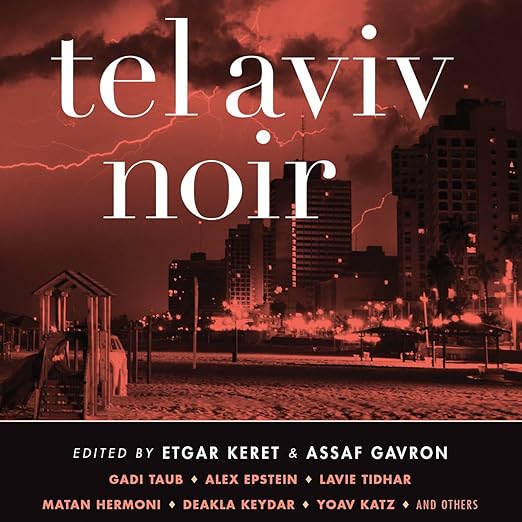
Quick Take
- Narration: Jonathan Davis handles a multi-author anthology with the tonal flexibility it requires, the stories vary considerably in register and Davis tracks those shifts without losing continuity.
- Themes: Urban alienation, geopolitical tension beneath civilian life, migration and belonging
- Mood: Dark and eclectic, like a late-night walk through a city that is more complicated than it looks
- Verdict: An uneven but worthwhile anthology that delivers on its city-specific premise, the best stories justify the weaker ones, and Davis’s narration keeps the collection from feeling fragmented.
I put on Tel Aviv Noir on a rainy afternoon when I wanted something with atmosphere and a sense of place. The Akashic Noir series has been one of the more interesting editorial projects in contemporary short fiction, the premise of commissioning original noir stories set in specific neighborhoods of a specific city is simple enough that it sounds gimmicky until you realize how effectively it forces writers to engage with place rather than using it as backdrop. The Tel Aviv volume, edited by Assaf Gavron with an introduction by Etgar Keret, was one of the earlier entries in the series and introduced Israeli writers to English-language readers who likely had encountered few of them before.
Keret’s introduction, which Jonathan Davis reads with the appropriate deadpan irony it demands, is itself one of the best pieces in the collection. His description of the city’s hidden complexity, the automatic weapons training most dancers at a club have undergone, the Eritrean refugees washing dishes in the fluorescent kitchen below, the deejay’s particular pharmaceutical interests, is delivered as a tour guide’s patter that reveals the darkness with a straight face. It sets the tone for what follows perfectly, and it is worth noting that Keret is not performing outrage. He loves this city. The darkness is part of the love.
Our Take on Tel Aviv Noir
The collection’s fourteen stories cover a range of registers wider than the noir label might suggest. One reviewer who applies the useful test of whether a city-specific collection passes the only-here standard found that roughly eighty percent of the stories succeeded on those terms. That is a high rate for an anthology. The stories are grounded in specific neighborhoods, Jaffa, Florentin, the Carmel Market, and in specifically Israeli preoccupations: the relationship between secular and Orthodox life, the presence of the Palestinian conflict as background radiation, the mix of languages and immigrant histories that make Tel Aviv a genuinely cosmopolitan city despite its small size.
The supernatural element that appears in several stories, a Yiddish-speaking ghost, a haunted tour of crime scenes, is handled with a matter-of-fact quality that feels appropriate for a city where multiple layers of history are literally underfoot. These are not horror stories. They are stories about how the past refuses to stay past in a place that has been contested for this long.
Why Listen to Tel Aviv Noir
Jonathan Davis is a reliable narrator for anthology work, which requires a different skill set than narrating a single-author book. He needs to find the distinct registers of different writers without making each story feel like a performance. Davis does this by staying close to the prose’s own rhythms rather than imposing a unified interpretive style. The translated stories, several authors were published in Hebrew and rendered into English for this collection, benefit particularly from this approach: translation already requires some interpretive mediation, and Davis does not add another layer on top of it.
One reviewer described the translations as beautiful, which is worth noting since translation quality is rarely flagged in audio review contexts. The original Hebrew material has apparently been brought over with sufficient care that the literary quality survives the shift in language.
What to Watch For in Tel Aviv Noir
As with any anthology, the quality varies. The collection has a 3.7 average rating with 76 reviews, which is lower than the individual enthusiasm of the positive reviewers would suggest. This means some stories land harder than others, and listeners who are disappointed by a weaker entry should resist the temptation to give up, the collection’s peaks are genuinely strong. One reviewer noted that some stories do not escape the genre conventions enough to feel specifically Tel Avivian, which is the anthology’s version of the all-too-common problem of setting serving as costume rather than character.
The book was published in 2014, which means some of the political context has shifted. The Israeli-Palestinian situation, the refugee community, the cultural tensions between neighborhoods, these are living realities that have continued to develop. The stories are not news journalism, so they retain their literary value, but listeners who are very current on Israeli politics may find themselves mentally updating certain frames.
Who Should Listen to Tel Aviv Noir
For listeners who enjoy literary short fiction and particularly anthologies organized around a specific place, this delivers. For readers interested in contemporary Israeli literature who want exposure to writers they may not have encountered in English before, names like Lavie Tidhar, Shimon Adaf, and Etgar Keret himself, this is a good introduction. Listeners who want linear narrative or a consistent noir formula should look elsewhere; the anthology format requires comfort with variety and occasional disappointment.
Frequently Asked Questions
Do I need to know Tel Aviv to appreciate the stories, or does the collection provide enough local context?
The stories provide their own context, and Keret’s introduction establishes the city’s texture efficiently. Prior familiarity with Tel Aviv will add resonance, but the collection works for readers who have never visited.
How does Jonathan Davis handle the tonal variation between fourteen different authors in a single collection?
Davis stays close to each story’s own rhythms rather than imposing a unified style, which is the right approach for anthology work. He manages the shifts between registers, from deadpan noir to supernatural to geopolitical thriller, without making the transitions feel jarring.
Are the stories translated from Hebrew, and does the translation quality hold up in audio?
Several stories were originally written in Hebrew; others were written in English by Israeli authors. At least one reviewer specifically praised the translation quality, and the audio delivery honors that quality without adding an additional interpretive layer.
How dark is Tel Aviv Noir compared to other Akashic Noir anthologies?
Darker in some ways, lighter in others. The Israeli political context gives certain stories a weight that domestic crime fiction cannot replicate. But the collection also has a black-humor strand and even some supernatural whimsy. It is varied enough that not every story operates at the same level of darkness.