Quick Take
- Narration: Carrington MacDuffie matches Craig’s first-person voice with precision, conveying both the clinical detachment and the emotional undercurrent of a career spent identifying the dead.
- Themes: Science as an act of justice, the politics of high-profile disaster investigation, the midlife reinvention of a career
- Mood: Absorbing and emotionally honest, with genuine procedural depth
- Verdict: Emily Craig’s forensic memoir is more emotionally complex than the genre usually allows, and MacDuffie’s narration makes it feel like sitting with someone who has genuinely lived these cases.
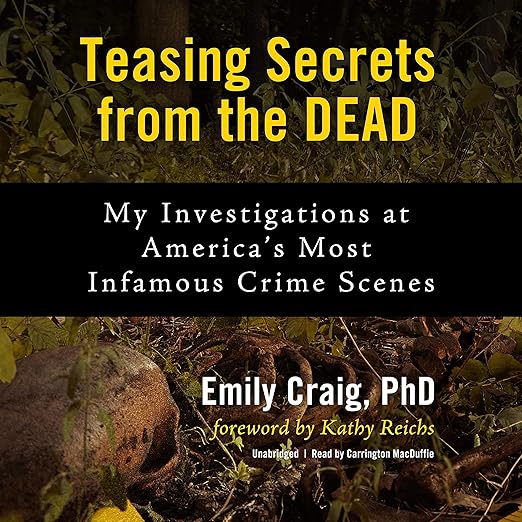
I started listening to Teasing Secrets from the Dead on a long drive, half expecting the kind of forensic procedural that delivers graphic details at the expense of human consequence. What I found instead was something more careful and, frankly, more disturbing: a book that keeps the human consequences of violence constantly in view, using the technical work of forensic anthropology as a vehicle for thinking about what it means to seek justice for the dead. By the time I reached the Oklahoma City bombing chapter, I had to stop the car for a few minutes.
Emily Craig came to forensic anthropology by an unusual route. She was a respected medical illustrator when she was called in by local police to help create a reconstruction of a murder victim’s face. That specific case, described early in the audiobook, opened something in her that her previous career had only touched indirectly: the intersection of art, science, and the recovery of identity. The midlife career change that followed, going back to school to earn a doctorate in forensic anthropology from the University of Tennessee, is both the organizing arc of the memoir and a genuinely compelling story about the relationship between curiosity and professional reinvention.
The Waco Chapter and What Craig Keeps In Frame
The book’s most historically significant section covers Craig’s work at the Waco disaster site as a doctoral student with the FBI. The Branch Davidian compound fire and its aftermath was a case already saturated with political interpretation by the time Craig arrived. Her account strips the politics back to the forensic reality: determining, from remains, the cause of death for specific individuals including David Koresh. The detail that Craig physically reconstructed Koresh’s bullet-pierced skull with her own hands while still a student is not deployed for shock value. She uses it to examine what it means to handle evidence that carries enormous legal and cultural weight without allowing that weight to distort what the bones actually say.
One reviewer, an EMT, noted that even their clinical background left them affected by some of the more graphic descriptions, but that nothing felt gratuitous. That balance, between unflinching accuracy and purposeful restraint, is the technical achievement that distinguishes this memoir from forensic true crime that deploys graphic detail as a commodity.
Kentucky, Murder Rates, and the Weight of Ordinary Cases
Between the landmark cases, Waco, Oklahoma City, and the World Trade Center, Craig intersperses accounts of her day-to-day work as forensic anthropologist for the Commonwealth of Kentucky. This is where the book earns its emotional depth. The famous cases are inherently dramatic; Craig’s account of the bodies found in Kentucky’s rural backcountry, people whose deaths attracted no national attention, is where the book’s moral argument is clearest. The work of identifying the dead matters equally regardless of whether the death generates media coverage. That insistence, demonstrated through specific anonymous cases rather than declared as a principle, gives the memoir a different quality than most true crime.
A reviewer who was using the book in a forensic science teaching context noted the section on Craig’s time at Dr. William Bass’s Body Farm, the famous outdoor human decomposition laboratory at the University of Tennessee. For listeners who have encountered the Body Farm through Jefferson Bass’s fictional accounts, Craig’s firsthand description of the actual research facility and its academic context is instructive. She trained there and writes about it with the matter-of-factness of someone who has spent time on the grounds rather than someone describing it from outside.
Carrington MacDuffie and the First-Person Forensic Voice
MacDuffie is a narrator with a long record in memoir and nonfiction, and she brings to Teasing Secrets from the Dead an accurate reading of Craig’s particular voice: clinical precision held in tension with genuine emotion about what that precision serves. Craig is not a detached scientist in the way that some forensic writing presents its subjects. She cares about the people whose remains she examines, and MacDuffie conveys that care without sentimentalizing it.
The technical passages, descriptions of skeletal analysis, decomposition stages, identification procedures, are handled with appropriate matter-of-factness. MacDuffie does not soften them, but she also does not perform them for effect. The chapters on the Oklahoma City bombing investigation, where a dismembered leg found at the scene did not match any known victim and became critical evidence in the prosecution of Timothy McVeigh, are delivered with the measured precision that the legal stakes of the work demand.
The Larger Argument About Forensic Science and Justice
One reviewer described reaching the end of the book and regretting it, a reliable sign that the narrative has done something beyond merely conveying information. Teasing Secrets from the Dead works as forensic procedural, as career memoir, and as a sustained argument that the scientific identification of human remains is an act with deep ethical stakes. Craig is explicit about this framing: she describes her work as giving dignity back to those who were lost and providing some level of comfort to their families. Those are not modest claims, and the book earns them through the specificity of the cases rather than through declaration.
This audiobook belongs on the shelf of anyone interested in forensic science, in true crime that takes human consequence seriously, or in memoir about the relationship between scientific work and personal meaning. MacDuffie makes ten hours and forty-five minutes feel appropriately weighted: not light, but not heavy for the wrong reasons.
Frequently Asked Questions
How graphic is the forensic detail in Teasing Secrets from the Dead, and is it appropriate for listeners with a low tolerance for descriptions of decomposition?
The forensic descriptions are detailed and medically accurate. Craig does not sanitize the work, but she also avoids gratuitous detail. An EMT reviewer noted being affected by some passages but finding nothing gratuitous. Listeners with strong sensitivity to descriptions of human remains should approach this one with awareness.
Does the book focus primarily on the famous cases like Waco and Oklahoma City, or is the Kentucky forensic work equally represented?
Both receive substantial attention. Craig deliberately balances the landmark national cases with her day-to-day forensic work in Kentucky. The ordinary cases are thematically central to her argument about the equal importance of identifying all victims regardless of media attention.
How does Carrington MacDuffie handle the shift between Craig’s clinical forensic voice and the more emotional passages about victims’ families?
MacDuffie navigates the tonal shifts without overcorrecting in either direction. The clinical passages are read with appropriate detachment; the passages about Craig’s connections to victims and their families are warmer but not sentimental. Several reviewers specifically noted the emotional honesty of the reading.
Is prior knowledge of forensic anthropology necessary to follow the technical aspects of the book?
No. Craig writes for a general audience and explains technical concepts as they appear. Her background as a medical illustrator gives her an instinct for clear visual description that makes the science accessible. The Body Farm, skeletal analysis, and identification procedures are all explained as they become relevant to the cases.