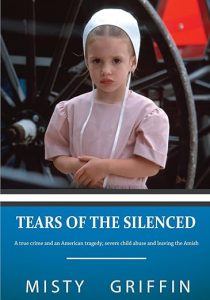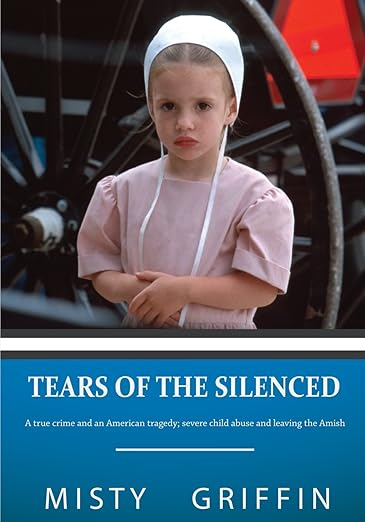
I finished Tears of the Silenced late on a Sunday night, sitting with it for a while before I could move on to anything else. That is not always a sign of a great book, sometimes it is simply a sign of subject matter that leaves a residue, but in this case it was both. Misty Griffin has written an account of her own childhood and young adulthood that is almost impossible to process quickly, and Cassandra Campbell narrates it with the kind of quiet steadiness that such material requires.
Griffin's story begins with isolation, not in the Amish sense but in a more fundamental way: raised by a stepfather who controlled access to the outside world entirely, she and her sister lived on a remote mountain ranch with little contact with anyone who might intervene. When her parents placed her and her sister in an Amish community as teenagers, the geography changed but the dynamics did not. The community's insularity, combined with its deeply patriarchal structure and its preference for handling misconduct internally, created conditions in which abuse continued and the bishop who assaulted her faced only a six-week shunning before resuming his position.
A Closer Look at Tears of the Silenced
What distinguishes this memoir from others in the abuse-survival genre is the specificity of the institutional context. Griffin is not simply recounting personal trauma; she is documenting how a closed religious community's structures function to protect perpetrators and silence victims. The Amish world she describes, particularly the Swartzentruber order, which is among the most conservative, operates almost entirely outside contact with civil law enforcement, which is why Griffin's eventual decision to walk to a rural Minnesota police station in early March took the kind of courage that is genuinely hard to comprehend from the outside.
Some reviewers have questioned the sheer accumulation of suffering in a single life, and that skepticism is understandable. The book presents extraordinary circumstances. But Griffin is consistent and detailed in her account, and the structural conditions she describes, the isolation, the absence of legal documentation, the community's enforcement of silence, make the events she recounts unfortunately plausible. The parallel between her early captivity on the ranch and her later captivity within Amish boundaries is one the book draws deliberately and effectively.
What Makes Tears of the Silenced Worth Hearing
Cassandra Campbell is well-suited to this material. Her voice has an evenness that serves memoir differently than it serves fiction, there is something about the lack of performative variation that makes a first-person account feel more credible, more like testimony than dramatization. At just under twelve hours, the listen is demanding but not interminable, and Campbell maintains enough presence to hold the listener without overwhelming the source material with her own affect.
The book will be most valuable to listeners who want to understand how communities of deep religious insularity can become environments of systemic harm. It is not an attack on Amish life broadly, Griffin distinguishes between orders and between individuals throughout, but it is a serious indictment of the structures that allow abuse to persist when external accountability is absent.
Things to Know Before Starting Tears of the Silenced
Griffin closes with an account of her subsequent life: nursing school, a master's degree program, work as a child abuse awareness activist. That trajectory is not a tidy resolution, recovery from the kind of sustained trauma she describes is not a narrative arc so much as an ongoing practice, but it is worth paying attention to, because the book is ultimately oriented toward what becomes possible once silence is broken. The contrast between the girl who had a second-grade education and no identification documents when she left the Amish community, and the woman writing this book, is the real subject underneath the surface events.
Listeners should be aware that the content includes detailed descriptions of physical and sexual violence, including against children. This is not a book for casual listening during commutes with others nearby.
Who Misty Griffin Is Writing For
Readers drawn to survival memoirs who want institutional context alongside personal testimony will find this essential. It pairs well with books like Educated by Tara Westover, which similarly examines how extreme religious insularity shapes and limits the lives of children within closed communities. Those seeking lighter memoir or who are sensitive to detailed descriptions of abuse should give this one a pass, not because it is poorly done, but because it asks a great deal of its audience.
Is Tears of the Silenced written as testimony or does it read more like narrative memoir?
It reads as narrative memoir, Griffin reconstructs scenes and dialogue in detail, but it carries the weight of testimony throughout. The authorial voice is personal and direct rather than literary.
How does Cassandra Campbell handle the more graphic sections of the memoir?
Campbell maintains a consistent, measured tone throughout, including during difficult passages. She does not dramatize or soften the content, her approach is one of steady presence.