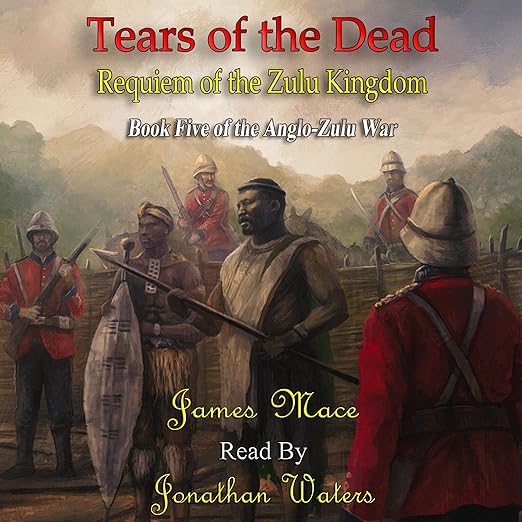
Quick Take
- Narration: Jonathan Waters handles the battle sequences with appropriate urgency and navigates the large cast of historical figures without losing clarity, a real challenge in a narrative this densely populated.
- Themes: Imperial overreach, the human cost of colonial warfare on both sides, political maneuvering and honor
- Mood: Propulsive and elegiac in alternating measure, with the weight of inevitability pressing through every chapter
- Verdict: A near-nineteen-hour series finale that satisfies fans of the preceding four volumes and stands as one of the most thorough fictional treatments of the Anglo-Zulu War available.
I came to this one having not read the earlier volumes in James Mace’s Anglo-Zulu War series, which I should acknowledge upfront as a limitation. Series book five in a historical fiction sequence is not an ideal entry point, and reviewers who had followed Mace from the beginning clearly experienced something I could not access fully, that accumulated knowledge of characters and their trajectories across four previous volumes. That said, Mace’s writing is sufficiently immersive that the narrative logic holds even for a newcomer, and the historical events it documents are significant enough that I was willing to work for my orientation.
Jonathan Waters narrates just under nineteen hours of material, a substantial commitment, and handles the extended demands with consistent competence. The battle sequences, which occupy a significant portion of the runtime, require a narrator who can maintain spatial clarity across multiple units and movements. Waters does this. The quieter sequences, where King Cetshwayo weighs his diplomatic options against the advancing British forces, require a different register, and Waters makes those transitions without jarring the listener.
The Lull Between Two Invasions
The novel opens in the pause between the first and second British invasions of Zululand, following the Battles of Khambula and Gingindlovu. This is, historically, a fascinating and underexamined period. The British emerged from those battles with tactical victories but had suffered enough to require withdrawal. Cetshwayo, who never wanted the war, interpreted this as an opportunity for negotiated settlement. Lord Chelmsford interpreted it as a logistical pause before a final advance. Both men were operating from information sets that made their chosen strategies rational. Mace captures this double-perspective effectively, and the narrative’s sympathy is carefully distributed across both sides.
The geopolitical subplot, Chelmsford’s awareness that he is about to be replaced by General Garnet Wolseley and his determination to force a decisive engagement before Wolseley can arrive to claim credit, is handled with particular skill. It reframes Chelmsford as a figure whose recklessness in the final campaign was partly a function of professional vanity and career desperation, which is historically accurate and adds complexity to what might otherwise be a straightforward villain role.
King Cetshwayo’s Impossible Position
The series’ most significant achievement, based on both reviewer responses and the internal evidence of this volume, is its sustained engagement with the Zulu perspective. Cetshwayo emerges as a political leader of genuine sophistication trapped between the momentum of his own military system and the intransigence of British colonial policy. He understands that the war was forced on the Zulu Kingdom through calculated British provocations, he understands that his military advantages in the first invasion have not translated into negotiating leverage, and he understands that what is coming will likely be catastrophic.
The novel does not sentimentalize this awareness into modern political consciousness. Cetshwayo thinks and acts from within his own world’s assumptions, and that historical fidelity is what distinguishes Mace’s series from less careful treatments of the same material.
The Mechanics of Series Conclusion
A reviewer noted that book five provides the most accurate and complete account of the Anglo-Zulu War in any fictional treatment and praised how it handles the aftermath for individual characters. The inclusion of what happened to major figures after the war’s formal conclusion is a structural choice that pays off significantly in a series this long. The Zulu Kingdom as a political entity did not survive the British invasion. What happened to its people, its generals, its king, in the following years is not incidental to the story but central to it, and the sense of conclusion that one reviewer described as a “brief closure” for main individuals is one of the more thoughtful structural decisions in the novel.
Waters’s performance through these concluding sections, the battle of Ulundi that ends the kingdom, the surrender and its aftermath, is notably steady. He does not reach for pathos that the prose itself already contains.
Who Should Listen, Who Should Skip
Start with volume one of the Anglo-Zulu War series if you have not already done so. The investment across five volumes is considerable, but reviewers who committed to the full sequence are unanimous about its rewards. For standalone engagement with the Anglo-Zulu War in historical fiction, this volume provides enough context to be followed, but the emotional resonance that reviewers describe requires the accumulated character knowledge of the preceding books. Listeners specifically interested in Cetshwayo, in the British military’s internal political dynamics of the period, or in the detailed reconstruction of the final campaign will find this volume particularly valuable.
Frequently Asked Questions
Can Tears of the Dead be read as a standalone, or is the full series required?
Mace provides enough context within this volume for a newcomer to follow the events, but the emotional investment reviewers describe, particularly the sense of conclusion for individual characters, requires the preceding four volumes. The series is best experienced from the beginning. The Anglo-Zulu War series opens with the events of 1879 that preceded the battles covered in this finale.
How historically accurate is Mace’s treatment of the events and figures?
Reviewers consistently praise the series for historical accuracy. Mace’s account of the political maneuvering between Chelmsford and Wolseley, Cetshwayo’s diplomatic efforts, and the mechanics of the second invasion aligns with the historical record. As with all historical fiction, some characterization and dialogue is invented, but the structural events are documented.
Does the novel show what happened to the Zulu Kingdom after the war’s conclusion?
Yes. The aftermath for both major historical figures and the series’ recurring characters is covered, which reviewers identify as one of the volume’s strengths. The fate of King Cetshwayo and the dismemberment of the Zulu Kingdom are part of the novel’s resolution rather than an epilogue.
Is Jonathan Waters consistent across the series, or does the narration change between volumes?
This review covers only the fifth volume. Listeners who have followed the series from the beginning should check narrator credits for earlier volumes to determine whether Waters narrates the full sequence or joined at a later point. Narrator consistency across a long series has significant impact on the listening experience.