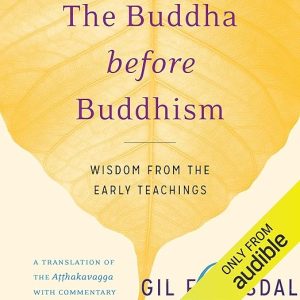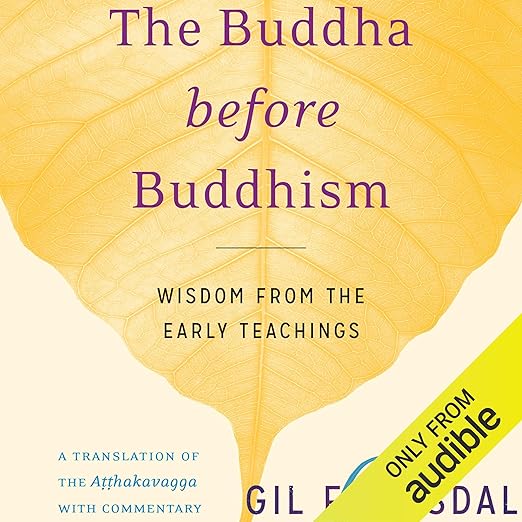
The craft decision that makes Teachings of the Buddha by Gil Fronsdal genuinely worth extended attention is also the one that sets it apart from most introductions to Buddhist thought. Fronsdal is translating the Atthakavagga, or Book of Eights, not the Dhammapada or the more systematized texts that became the doctrinal foundation of institutional Buddhism. The Atthakavagga is widely considered by scholars to be one of the oldest surviving Buddhist texts, predating the period when the Buddha's teachings were codified into the doctrinal structures that later traditions built their identities around. What that means in practice is a text remarkably free of religious apparatus, and this audiobook of 3 hours and 17 minutes with Edoardo Ballerini narrating Fronsdal's translation and commentary preserves that quality with genuine scholarly care.
The result is Buddhist teaching without Buddhism as an institutional religion, in the specific sense that the Atthakavagga does not require adherence to doctrine. It describes a direct approach to attaining peace through practice. This distinction, which Fronsdal's commentary develops throughout the audiobook, is what makes the text interesting not only to practitioners of any Buddhist tradition but to the broader audience of readers who identify as spiritual but not religious and who want a path toward genuine practice rather than another belief system requiring adoption. That audience is real and growing, and Fronsdal's translation speaks to it directly rather than treating the secular reader as a secondary concern.
Fronsdal's translation is described by multiple reviewers as deceptively simple. One notes that the text completely overturns the great majority of religions' claims to truth, Buddhism included. That is the argument the Atthakavagga makes, and it makes it quietly, without polemic, by simply not requiring what later doctrinal Buddhism came to require. Non-attachment is described as a means for realizing peace rather than as a theological position to be held. The commentary Fronsdal provides situates the text historically and explains the translation choices that shape the listener's experience of it, which is the kind of scholarly grounding that makes a translation trustworthy rather than merely accessible to general readers.
One reviewer with Buddhist scholarly background identifies the Atthakavagga as considered among the oldest texts of the canon and notes it lacks most of the doctrine inserted by later monks. That context matters for understanding why this audiobook occupies a different position in Buddhist literature than most popular teachings. It is not presenting Buddhism as currently practiced by any school. It is presenting something closer to whatever the earliest recorded version of the Buddha's teaching actually contained, before centuries of institutional accretion shaped it into recognizable religious tradition. That historical positioning is not an academic abstraction; it changes what the text asks of the reader, which is practice and observation rather than belief and affiliation.
Why Teachings of the Buddha Works as an Audiobook
Ballerini's narration is the strongest argument for the audio format here. The contemplative nature of the text invites a slow, deliberate engagement that the audiobook format supports more naturally than print reading allows for most people in most contexts. The spoken form sets the pace in a way that serves material designed to be absorbed rather than consumed. Ballerini does not rush the translation or the commentary, and his voice has a quality of attention that matches the material's register without tipping into performance or theatrical solemnity. He is presenting the text with the care of someone who has read it carefully, not interpreting it dramatically.
The 3 hours and 17 minutes runtime makes this a genuinely accessible audiobook for a text that might seem forbidding in a scholarly print context. Fronsdal's combination of rigorous translation with commentary that explains both the historical situation and the specific translation choices makes the Atthakavagga available to listeners with no prior knowledge of Pali or Buddhist textual history. Repeated listening is also worth noting: multiple reviews suggest the text rewards second and third encounters, as specific passages become more legible in relation to the whole across multiple hearings. The short runtime makes that kind of repeated engagement practical rather than aspirational.
Weak Spots in Teachings of the Buddha
The audiobook's scholarly framing may create a different expectation than listeners used to more devotional or practice-oriented Buddhist audio content. This is a translation with commentary. It is not a guided meditation, a dharma talk, or an inspirational overview of Buddhist thought for general audiences. It is a careful rendering of an ancient text with the intellectual apparatus that makes it comprehensible across a gap of more than two millennia. Listeners who want immediate practical application in the format of daily practices or actionable steps may find the orientation of the text and commentary more contemplative and less prescriptive than they expected from a book titled Teachings of the Buddha.
The text's central teaching, that peace is attainable through direct practice rather than through doctrine, is genuinely challenging to the assumption that spiritual progress requires a belief system. Some listeners will find this liberating. Others, who are looking for confirmation of existing religious commitments within a Buddhist framework, may find the Atthakavagga's agnosticism about doctrine uncomfortable rather than clarifying. Fronsdal's commentary does not smooth this over or apologize for it. The 4.6 rating across 176 reviews suggests the text has found a readership prepared to engage with this quality of the material. Those who have not read it will know quickly whether it is for them, because the first chapter establishes the approach very clearly.
The Right Listener for Teachings of the Buddha
Listeners who identify as spiritual but not religious, who want a genuinely ancient Buddhist text in a clean translation that does not require adopting institutional Buddhist doctrine, will find this audiobook directly suited to their interests. Practitioners of any Buddhist tradition who want to encounter one of the oldest surviving strata of the teaching, before doctrinal accretion shaped it, will find Fronsdal's scholarship valuable. Academics and students of religious history interested in early Buddhist texts will find the translation rigorous enough to be useful. Devotional readers seeking confirmation or inspiration within a specific Buddhist school will find the text's pre-doctrinal nature more challenging than rewarding. And anyone curious about what the earliest recorded Buddhist teaching actually contained, before institutional religion reshaped it across two and a half millennia, will find this audiobook an important place to begin that inquiry.