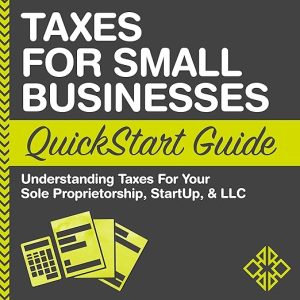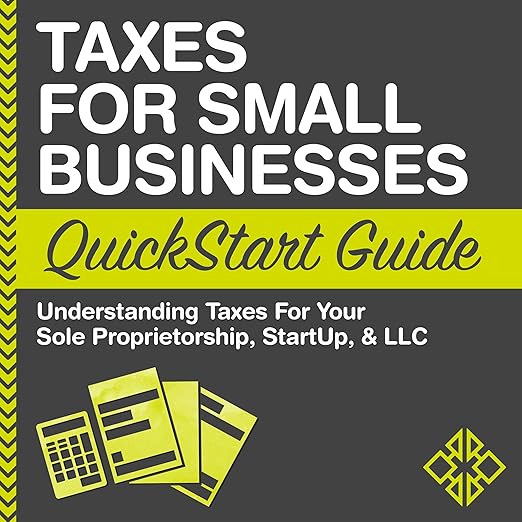
Three to four months' profit, that is roughly how long the typical small business owner works each year just to cover their tax bill, according to the figure this audiobook opens with. Taxes for Small Businesses QuickStart Guide treats that statistic as the whole argument for itself: taxes are not a year-end afterthought but a cost that belongs in the business plan from day one, alongside rent and payroll.
Produced by ClydeBank Business and narrated by Kevin Kollins, this one-hour-and-thirty-seven-minute audiobook holds 4.4 out of 5 from 789 ratings on Audible. It is Book 2 in the Starting a Business QuickStart Guides series, per reviewer Sheryl McEwen's own reference to the title.
Blindsided by Basics, Even With Prior Knowledge
The guide covers a specific, practical checklist: handling the IRS, accurate recordkeeping, payroll tax timing, the deductions business owners most often miss, and the mistakes that get small businesses into trouble. None of it is exhaustive tax law, and it is not trying to be. The book's own pitch, learning taxes without the fluff, is a fair description of the pacing: each topic gets covered efficiently and moves on, which suits a title built around a 97-minute runtime rather than a comprehensive reference.
Reviewer Sheryl McEwen, who describes herself as already familiar with 'the basics of taxes and corporation entities,' says she was still 'completely blindsided' by how much she did not know, a genuinely useful signal that the QuickStart framing does not mean the content is trivial for listeners with some existing knowledge. Jasmine CB., who handles finances for her own small business alongside a few years of bookkeeping experience, reports the same thing: real added value even for someone not starting from zero.
The three-to-four-month figure lines up closely with the real, well-documented concept of Tax Freedom Day, the economic calculation of how far into the calendar year the average American must work before their total tax burden for the year is covered. Hearing that same logic applied specifically to small business owners, who often face a more complicated mix of self-employment tax, quarterly estimated payments, and payroll obligations, gives the guide's opening statistic real weight rather than treating it as a scare-tactic hook.
Kollins Keeps Ninety-Seven Minutes Brisk and Clear
Kevin Kollins keeps the pace brisk and the delivery instructional, well suited to a guide built for a single sitting rather than a reference you return to chapter by chapter. Reviewer Alex, who explicitly reviewed 'the audio version' rather than the print edition, praises the specific examples and clarified deductions the book walks through, confirming that the audio format itself carries the practical content cleanly rather than losing anything in translation from a page-based guide.
The efficiency is also the book's real selling point against the alternative most small business owners actually use: unstructured internet searching and scattered videos, which the synopsis calls out directly as the problem this guide solves. Ninety-seven minutes of organized, sequenced tax fundamentals genuinely beats an afternoon of unfocused browsing, and Jasmine CB.'s report of finishing it in under two hours before moving on to a more detailed resource suggests the format works exactly as designed: a fast, focused foundation, not a final destination.
ClydeBank Business built its catalog specifically around this QuickStart Guide format: compact, single-topic primers meant to get a specific type of reader oriented quickly rather than functioning as an exhaustive reference shelf. That publishing philosophy matches exactly what this title delivers, and listeners who find this particular guide useful will likely find the same efficient, no-fluff approach across the wider QuickStart Guides catalog on other small-business topics.
One of the most common, costly mistakes new business owners make, failing to realize self-employment income requires quarterly estimated tax payments rather than a single annual filing, sits squarely inside what this guide promises to cover. Missing that requirement in year one typically means an unexpected penalty on top of an already unfamiliar tax bill, precisely the kind of foundational, easy-to-miss knowledge gap a 97-minute orientation guide is well positioned to close before it becomes an expensive lesson learned the hard way.
Alex's Honest Ceiling, and What State Taxes Miss
Reviewer Alex is direct about the ceiling here: this is not 'substantial enough to do your own' business taxes without further help. That is an honest and important caveat. At under two hours, the guide is explicitly an orientation, not a substitute for an accountant or a deeper tax-specific resource, and listeners should treat it as the first step in a longer process rather than a complete solution.
The short runtime also means depth on any single topic, payroll tax specifics, entity-type nuances between an LLC and a sole proprietorship, stays fairly high-level. Owners with more complex structures or multi-state operations will likely need to supplement this guide with more specialized material once the fundamentals here are in place.
Reviewer Sheryl McEwen's reference to this title as Book 2 in the Starting a Business QuickStart Guides series implies a first volume covering earlier-stage decisions, likely business formation and entity selection, that this tax-focused guide builds on rather than repeats. Listeners just beginning the process of choosing between a sole proprietorship, an LLC, or another structure may get more value starting with that earlier volume before moving to this one's tax-specific content.
One likely scope gap is worth flagging plainly, since none of the three attached reviews raise it directly: a 97-minute guide built around IRS fundamentals and payroll tax timing is almost certainly working at the federal level, and state-specific tax obligations, which vary considerably across all fifty states, are unlikely to get meaningful coverage in a runtime this tight. Business owners should treat this guide as federal-level orientation and expect to research their own state's requirements as a separate step.
Clearest Fit for Brand-New Entrepreneurs Starting Out
Brand-new entrepreneurs, sole proprietors, and anyone launching an LLC or startup who has not yet built a real tax strategy are the clearest fit, exactly the audience the title names. Listeners who want a fast, no-fluff orientation before their first real conversation with an accountant, rather than a full self-service tax course, will get precisely what this guide promises.
Skip this if you already have solid tax fundamentals in place and need advanced or entity-specific guidance instead, or if you are hoping a 97-minute audiobook can fully replace professional tax help. As both the book and reviewer Alex acknowledge honestly, this is a starting point, not the complete answer.
A Few Questions About Taxes for Small Businesses QuickStart Guide
Is this audiobook enough to do my own small business taxes?
Not on its own, and reviewer Alex says as much directly. Treat it as a foundation that prepares you for a real conversation with an accountant or a more detailed resource, not a complete do-it-yourself solution.
How long is the Taxes for Small Businesses audiobook?
One hour and 37 minutes. It is designed as a fast, no-fluff orientation rather than a comprehensive tax reference, and most listeners finish it in a single sitting.
Does this audiobook work for a sole proprietorship as well as an LLC?
Yes. The guide is written to cover sole proprietorships, startups, and LLCs alike, with general recordkeeping and deduction guidance that applies across those structures rather than being narrowly specific to one.
Is Kevin Kollins's narration clear for listeners new to tax terminology?
Yes, the delivery stays instructional and brisk without assuming prior tax knowledge, which matches reviewer feedback describing the content as accessible even for owners with some existing bookkeeping background.