Quick Take
- Narration: Kristen Clemmer reads this concisely and professionally, suited to a short practical guide rather than a long-form listen.
- Themes: Alternative investment strategies, tax lien mechanics, passive real estate income
- Mood: Practical and informational, like a competent workshop session
- Verdict: A genuinely useful introduction to an overlooked investing niche, though experienced investors may find the level of detail leaves them wanting more.
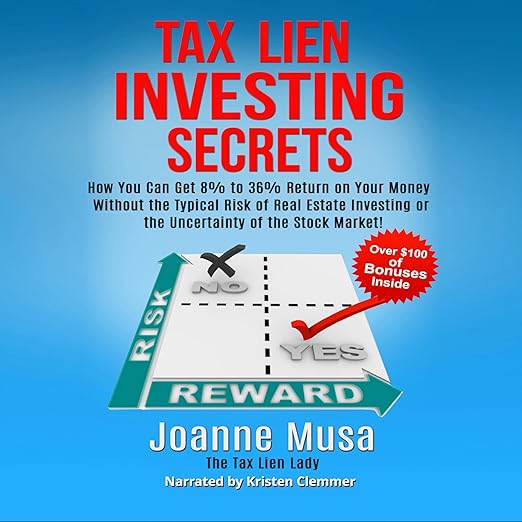
Tax lien investing occupies a strange position in the personal finance canon: almost everyone who covers real estate investing eventually mentions it, but very few books go past the basics. I listened to Tax Lien Investing Secrets by Joanne Musa while commuting one morning, it clocks in at two and a half hours, which is one of its significant practical virtues, and came away with a clearer picture of both what the strategy offers and where its limitations as a listen sit.
Musa is not an amateur commentator. She is a working realtor who has built a professional practice around tax lien education, including digital courses and a following of serious investors. That practitioner background shapes the book usefully. She is not theorizing about how tax liens work, she is explaining what she has actually done and seen, including what institutional investors do at auctions and why individual investors need to understand that dynamic to compete effectively.
Our Take on Tax Lien Investing Secrets
The book delivers what it promises: five steps to purchasing profitable tax liens or deeds, strategies for protecting your investment and maximizing returns, three ways to cash in, and a look at automating the process. It also covers several myths that circulate in the tax lien space, promises of huge returns with no work, for instance, with enough skepticism to be genuinely useful rather than merely promotional.
The section on institutional investors and how they bid at auctions is particularly valuable. This is exactly the kind of information that general-audience real estate books skip: how professional investors drive down yields at popular auctions, which states have auction structures that favor individual investors, and how to find opportunities that institutional capital hasn’t already saturated. Reviewer Tsch described Musa as offering dense information and real substance rather than a promotional scaffold for her other products, and that holds for most of the book.
Why Listen to Tax Lien Investing Secrets
Kristen Clemmer’s narration is appropriate for the material, clear, professional, no particular performance ambitions, which is exactly what a practical investment guide needs. The short runtime works as a feature: Musa does not pad. The book gets to its information quickly and trusts the listener to follow up on the details she points toward.
For listeners approaching tax lien investing without prior background, this audiobook functions as an honest orientation. Reviewer Ed Barton’s note that the strategies are evergreen even as some specifics date is accurate, the mechanics of tax lien sales, state variations, and auction dynamics don’t change rapidly even if specific links or state-by-state data need updating.
What to Watch For in Tax Lien Investing Secrets
The legitimate criticisms in the reviews are fair. One reviewer described it as vague in places and as a platform for marketing the author’s other products. There is some truth to this: Musa points toward her courses and more comprehensive resources at several points, and the depth available in two and a half hours means some topics receive coverage that gestures toward complexity without resolving it. Listeners who want granular state-by-state analysis, specific due diligence checklists, or detailed legal process breakdowns will find this a starting point rather than a complete resource.
The review noting broken links and dated specifics is worth taking seriously for any practical investing detail the book references. The framework is sound; the tactical specifics should be verified against current sources before acting on them.
Who Should Listen to Tax Lien Investing Secrets
Best for investors exploring alternative strategies who want a reliable, jargon-light introduction to the tax lien space before going deeper. Also useful for note investors or landlords looking to diversify without adding management responsibilities. Less useful for experienced tax lien investors who have already moved beyond the fundamentals and need implementation-level depth. Think of this audiobook as a structured orientation session rather than a comprehensive manual, and approach it accordingly, with further research queued up for afterward.
Frequently Asked Questions
Is Tax Lien Investing Secrets suitable for someone with no real estate investing background?
Yes. Musa writes for beginners and explains lingo and process clearly. The book is explicitly positioned as a guide for those new to the strategy, covering legal process, terminology, and auction mechanics without assuming prior knowledge.
Does the audiobook cover state-by-state differences in tax lien law?
It touches on state variations and notes that not all states offer tax lien certificates, some offer tax deeds instead. However, it does not provide exhaustive state-by-state analysis. Musa recommends verifying current specifics locally before investing.
How does this compare to other tax lien investing books on the market?
Reviewers who have read multiple books on the topic place this among the better practical introductions, particularly for its honest treatment of institutional investor competition at auctions. It is more comprehensive than Musa’s shorter companion volume on the same topic.
Is the two-and-a-half-hour runtime long enough to give a genuine foundation, or is it too brief to be useful?
For an introduction and orientation, it is sufficient. Listeners consistently describe leaving with actionable clarity about the fundamentals and the five-step process. Those wanting depth on any specific element will need additional resources, which Musa acknowledges.