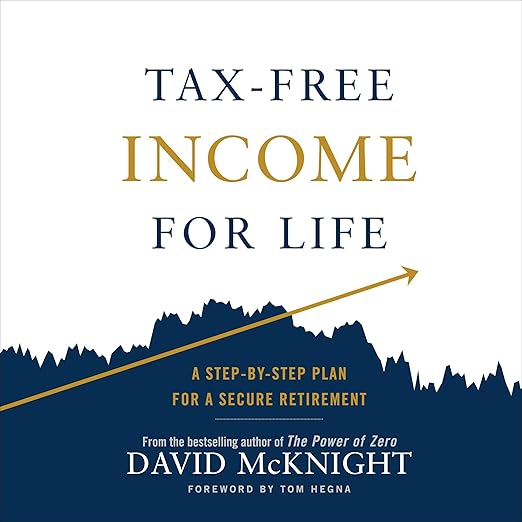
David McKnight built this audiobook as a direct sequel, picking up exactly where his bestselling The Power of Zero left off and pushing the argument from theory into a specific action plan. Tax-Free Income for Life runs a lean three hours and seven minutes, and every minute of it stays locked on one argument: a guaranteed, inflation-adjusted income stream paired with a proactive tax-bracket strategy can outrun what McKnight considers the two real threats to a retiree's savings, outliving the money and watching tax rates climb. Narrator Marc Cashman handles the material with the same measured, analytical delivery he has brought to other dense nonfiction in his catalog, treating retirement-tax strategy as a framework to be laid out clearly rather than sold with manufactured urgency.
McKnight Picks Guaranteed Income Over Market Bets
McKnight's core claim is not exactly new territory for anyone who has read a retirement-planning bestseller before: taxes are likely to rise, and money sitting in an unprotected account is a liability disguised as an asset. What distinguishes this entry from his earlier book is the shift from persuasion to blueprint. The synopsis describes a comprehensive, step-by-step roadmap rather than another restatement of the thesis, and the audiobook mostly delivers on that promise, moving briskly through the combination of guaranteed lifetime income products and a phased asset-shifting strategy McKnight positions as the practical fix for both longevity risk and future tax exposure. Listeners already sold on the premise will find the pacing efficient rather than repetitive, since McKnight rarely circles back to re-argue points already established.
One reviewer, Garth Hassel, frames the book's urgency as 'real, not hyped,' pointing to how the post-pandemic debt spike pulled McKnight's tax-rate warnings closer to the present than a typical five- or ten-year projection usually allows. That context matters for how the book reads now: written in the shadow of a specific fiscal moment, its warnings land with more immediacy than a generic retirement guide managing abstract future risk. A 4.5 average across 477 ratings suggests a genuinely engaged audience, mostly readers who already trusted McKnight's earlier argument and came back for the follow-through rather than newcomers sampling his ideas cold for the first time.
The broader debate McKnight enters here is a real and long-running one in retirement planning circles: whether to rely on market-based withdrawal strategies from a traditional portfolio, or to shift a portion of savings into guaranteed income vehicles that trade some upside for certainty. McKnight comes down firmly on the guaranteed-income side of that debate, and Tax-Free Income for Life reads as much like an argument for that broader philosophy as a specific tax-planning manual. Listeners who already lean toward market-based strategies and simple index-fund withdrawal rules should know this book is arguing against, not just alongside, that more hands-off approach to retirement income.
Cashman's Brisk Pace Makes This a Credibility Document
The case for the audio format here is mostly practical. At just over three hours, this is a single-sitting listen for a long commute or two, short enough that the roadmap holds together as one continuous argument instead of getting chopped into disconnected chapters absorbed weeks apart. Cashman's pacing matches that intent: he does not linger for effect or pause for drama the way a memoir narrator might, he moves through concepts, numbers, and action steps at a clip that respects a listener's time without rushing past the parts that require real comprehension, like how a proactive asset-shifting timeline actually gets executed year by year in practice.
The second review in this set, a two-word 'Great Information' from a reader named john, is thin as commentary but consistent with a pattern across all three: nobody here is praising McKnight's prose style; they are praising the usefulness of the content itself. Jim's review goes further, describing a financial advisor who 'preaches your gospel,' a small but telling detail suggesting this book functions less as a standalone read and more as a credibility document, something a listener brings into a conversation with their own advisor rather than a piece of literature consumed purely for its own sake.
Skipping the Basics, Assuming You Know the Problem
This is not a book for anyone starting from zero. McKnight assumes a listener who already understands the basic problem, tax-deferred accounts eventually get taxed, often at a worse rate than expected, and wants the next-level strategy rather than an introduction to retirement math. Readers who have not encountered The Power of Zero first may find some of the shorthand references to guaranteed income vehicles and tax-bracket management move faster than they would like. The audiobook does not pause to rebuild foundational concepts before advancing into its more specific asset-shifting recommendations for a general audience.
A structural reality applies to any short-form financial nonfiction too: three hours is enough to lay out a philosophy and a general roadmap, not enough to substitute for a fee-only advisor working through your specific numbers. McKnight seems aware of this limitation rather than overselling the book as a complete substitute for professional planning; the guidance reads as a framework to bring into that conversation, not a replacement for having it. Listeners hoping for detailed worksheets or state-by-state tax comparisons should look to supplementary material instead of this recording.
The single tag attached to this listing, Taxation, is accurate but narrow, and it undersells how much of the book is really about product selection and timing rather than tax law itself. McKnight spends real time on which guaranteed-income vehicles to consider and when to shift assets into them, material that sits as much in the retirement-income-planning category as in pure tax strategy, which is worth knowing if you came to this title purely looking for tax-code explanation rather than product-level guidance.
Five to Fifteen Years Out, Ready for Action
This audiobook makes the most sense for listeners within roughly five to fifteen years of retirement who already suspect their tax bill will be a bigger problem than their portfolio balance, and especially for anyone who read The Power of Zero and is ready to move from philosophy into specific action steps rather than hearing the thesis restated once more. Financial-planning enthusiasts who like arriving at an advisor meeting with informed questions will get real value from Cashman's brisk, businesslike read, since the whole thing can be finished in an evening or two of focused listening without losing the thread.
Skip it if you are decades from retirement with no tax-deferred savings built up yet, since the strategies here assume a meaningful existing balance to shift and shield over time. It is also not the right fit if you want a single all-in-one reference covering both basic tax literacy and advanced strategy, since McKnight writes here for a reader who already has the foundational vocabulary and simply wants the specific mechanics of execution laid out clearly.