Quick Take
- Voice: Ray Porter brings his signature controlled intensity to Targeted: Beirut, shifting cleanly between survivor testimony and tactical description without losing the gravity the material demands.
- Big ideas: Cold War proxy conflict, institutional failure and accountability, the human cost of terrorism
- Atmosphere: Measured and sober, building toward genuine outrage
- Worth it?: A rigorous account of the 1983 Marine barracks bombing that treats both the strategic failures and the 241 individual lives with equal seriousness.
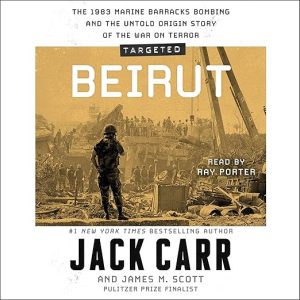
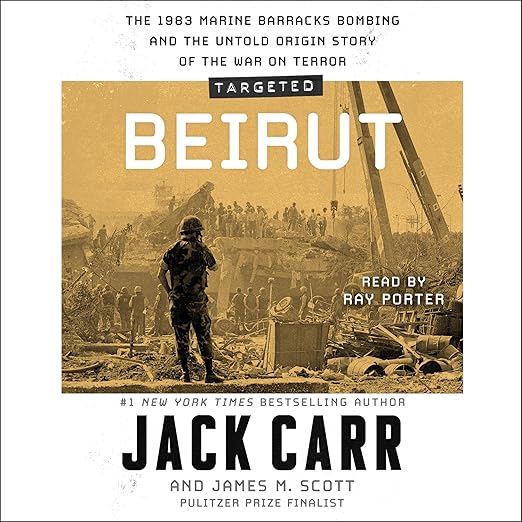
Jack Carr and James M. Scott open this audiobook with a figure that stops the breath: 241 servicemen killed in a single morning, a loss that eclipsed Iwo Jima's worst single day. Targeted: Beirut, narrated by Ray Porter and running 14 hours and 36 minutes, launches the first entry in a new nonfiction series examining the terrorist attacks that reshaped American foreign policy. The framing matters: this is not a thriller dressed in historical clothing. It is a work of documented history built from comprehensive survivor interviews, military records, personal letters, diaries, and photographs, co-authored by a thriller writer and a Pulitzer Prize finalist historian.
Carr and Scott's Partnership Mostly Works
The partnership between Jack Carr and James M. Scott is unusual and mostly works. Carr contributes military and tactical credibility, the institutional knowledge of how Marine units actually operate and how command decisions travel up and down a chain of authority. Scott contributes archival rigor: the survivor interviews, the declassified military records, the personal correspondence that transforms statistics into specific human beings. The result is a book that reads with the narrative drive Carr's fiction readers expect and carries evidentiary weight you would expect from someone who was a Pulitzer finalist for Target Tokyo, his account of the Doolittle Raid.
Where the collaboration occasionally shows strain is in the tension between those two instincts. The drive toward narrative momentum sometimes compresses political context that could use more room. The Lebanese civil war's factions, the interplay between Syrian, Iranian, and PLO interests in Beirut in 1983, the Reagan administration's evolving and contradictory rules of engagement for the multinational force - these are gestured at rather than fully examined. Listeners seeking a deep geopolitical analysis of Lebanon will find the military story considerably richer than the diplomatic one. That is a deliberate choice, not an oversight, but it is worth knowing before you start.
The book is at its most powerful when it stays with individual Marines rather than with command decisions. The letters and diaries recovered by Scott provide specificity that no secondary account can replicate: what the barracks smelled like, what the men were doing in the minutes before the truck hit, the mundane quality of that Sunday morning that made the violence even more shocking in retrospect. These are the passages where Porter's narration earns the most - letting the human evidence speak without commentary. One reviewer who was thirty years old when the bombing occurred described moving through the book in sixteen days and being struck by the research depth. The opportunity to relearn is apt: the 1983 Marine barracks bombing has been partially absorbed into the background noise of American military history, and Carr and Scott's project is explicitly to restore its weight.
Porter Modulates from Tactical to Testimony
Ray Porter has spent years narrating Carr's James Reece thriller novels, and Carr's prose voice - precise, stripped of sentiment without being cold, deeply respectful of military service - is territory Porter navigates from memory. What is impressive here is how Porter modulates register when the text shifts from tactical description to survivor testimony. The passages drawn from personal letters and diaries carry a different emotional frequency, and Porter honors that without slipping into melodrama. The 14-hour-and-36-minute runtime never drags. The authors' decision to reconstruct the bombing and its aftermath chronologically, weaving between intelligence failures in Washington and the day-to-day reality of Marines in an increasingly untenable position, gives the audiobook a forward momentum that meanders nowhere.
The production suits the material. This is not a book that needed atmospheric sound design or dramatic music beds; the facts carry sufficient weight. Porter's clean, unadorned delivery is the right call for a work whose power comes from documented reality rather than dramatization.
The True Precursor Before September 11
The book's most consequential argument is not about the bombing itself but about what the political and military establishment did with the findings afterward - specifically, the ways in which the attack was processed, partially addressed, and ultimately folded into institutional patterns that left comparable vulnerabilities intact for decades. Carr and Scott argue, carefully and with documentation, that the Marine barracks bombing is the true precursor event for understanding American counterterrorism failure. Treating September 11 as a rupture in history misses the degree to which the failure modes were already visible and named in 1983.
Pay close attention to the sections dealing with the investigation's conclusions and their fate inside the bureaucracy. That is where the book does its most important analytical work, and it is what earned the title its placement on the Marine Corps Commandant's Professional Reading List. That designation is not ceremonial; this is a book being used to teach institutional memory to the next generation of Marine officers.
Fourteen Hours Worth It for Reece Readers
Listeners who want military history that takes the human dimension seriously alongside the strategic one. Readers of Carr's James Reece novels will find a different rhythm here - no fiction shortcuts, no explosive set pieces engineered for maximum tension - but the same commitment to getting operational details right. If you follow American foreign policy and want to understand how 1983 Beirut established a template for later failures, this is a worthy investment of 14 hours. Skip it if you want a broad geopolitical history of Lebanon's civil war; this book is tightly focused on the Marines, the attack, and the direct aftermath. Also skip it if detailed accounts of mass casualty events are not something you can engage with right now; the authors do not flinch from what a truck bomb does to a building full of sleeping men.