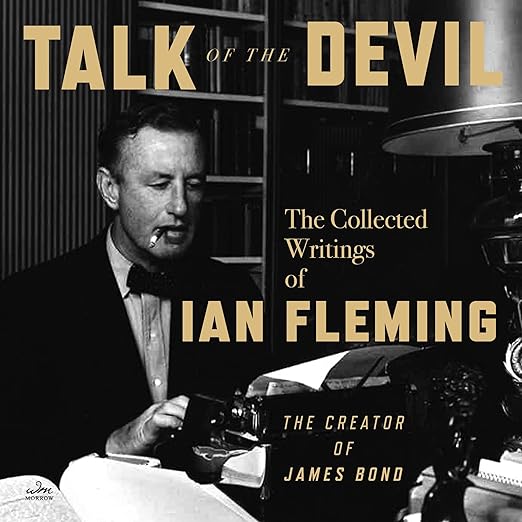
Fleming's Jamaica study is one of the scenes in Talk of the Devil that most made me stop and replay. He is writing about befriending an octopus in the waters near his Goldeneye estate, with the precise observational attention that made him such a distinctive journalist, and the scene feels both utterly characteristic and completely unlike anything in the Bond novels. That gap, between the public Ian Fleming and the private one, is what this audiobook fills, and it fills it across 12 hours and 35 minutes of journalism, essays, and personal writing that has rarely been collected before.
Julian Rhind-Tutt narrates throughout. For anyone who has encountered Rhind-Tutt's voice work before, the casting here makes immediate sense: he has the clipped mid-century British register that suits Fleming's prose, but he can modulate into warmth and even humor when the material calls for it. Fleming's personal writing, particularly the golf tournament passage and the Jamaica material, requires that range, and Rhind-Tutt delivers it.
The synopsis is accurate about what this collection contains: wartime experiences, reflections on crime and espionage, and Fleming's own account of writing his novels. But the scope is wider than that description suggests. One of the more excited reviewers called this "a GIFT from the Literary Gods," noting it gives "dimension to the man behind the myth." That enthusiasm is defensible. Fleming is a figure whose personal life and professional biography have been extensively mined for the Bond mythology, but the specific texture of his journalism and non-Bond writing has been harder to access. This audiobook collects material that even dedicated Fleming readers may not have encountered.
The wartime experiences material is particularly valuable for understanding how the real world of Naval Intelligence translated, and where it diverged, from the operational fantasies Fleming would later construct for 007. Fleming writes about actual wartime work with a specificity that illuminates both what he knew and what he had to invent when the real material ran dry. As one reviewer, a Fleming fan who called him their "FAVORITE author," noted, "this is Fleming, his turn of phrase, his eye for detail, for sound and scene."
Rhind-Tutt Restores Journalism's Original Radio Register
Rhind-Tutt's narration is the strongest argument for the audiobook format over the print collection. The journalism and essays in this collection were written for a general audience and originally delivered, in several cases, via radio or for general-interest magazines. Hearing them read aloud by a narrator with the right period register restores something of their original medium that silent reading on the page cannot. Fleming wrote for ears as much as for eyes, and this audiobook makes that quality audible.
The range of material is also better served in audio than it might appear. A 12-hour collection of journalism and essays from a single writer across multiple decades could easily become tonally monotonous. Rhind-Tutt manages the modulation between Fleming's serious wartime reflections, his wry golf commentary, and his affectionate writing about Jamaica and the natural world with sufficient variety to sustain the runtime.
Tedious in Spots but Covers a Great Life
One reviewer noted "tedious in spots but covers a great life," which is an honest assessment for a collection of this kind. Not every piece in a journalism collection lands with equal weight, and Talk of the Devil is no exception. Certain sections, particularly some of the more procedural espionage-adjacent writing, carry the dutiful quality of journalism produced to deadline rather than the full attention Fleming brought to his best work. These sections are minority territory within the full collection, but they exist and listeners should not be surprised by uneven terrain in a 12-hour anthology.
For listeners who come primarily to the Bond novels and have not read much Fleming journalism, the collection may also require some adjustment of expectation. The journalism is not Bond. It is sharper, more fragmented, more personal, and occasionally more interesting than the novels precisely because it is not constrained by the requirements of genre. Approaching it on those terms produces the most rewarding listen.
The collection's range, from wartime memoirs to the mortifying golf tournament scene that multiple reviewers have cited as one of the audiobook's more charming diversions, demonstrates a Fleming that the Bond readership does not always encounter. The golf writing in particular is a reminder that Fleming was a lifelong enthusiast whose relationship to the game had its own emotional texture, quite apart from the famous sequence in Goldfinger. Rhind-Tutt reads those passages with appropriate wryness, which is the correct temperature for Fleming at his most self-deprecating.
Fleming's writing about espionage and crime, outside the Bond framework, reveals how much of his fictional universe was built from close observation of actual operational realities. The journalism collected here shows a writer with a specific skill for the institutional detail of intelligence work, the bureaucratic texture, the personality types, the unwritten codes, that he would later translate into the Bond novels' atmosphere. Julian Rhind-Tutt gives those passages the right register: interested and observant rather than breathless.
Rewarded by the Jamaica and Wartime Detour
Fleming devotees who have read all fourteen Bond novels and the short story collections will find this audiobook extends their relationship with its subject in directions those works cannot. The journalism and personal writing reveal a Fleming who is more reflective, more vulnerable, and more genuinely curious than the public myth allows. Listeners interested in mid-century British literary journalism as a form will find Fleming's prose a worthy example of the genre. General listeners who come for the Bond connection and stay for the Jamaican nature writing or the wartime memoirs will likely be rewarded by the detour. Anyone who requires Bond-adjacent action or plot will be disappointed: this is Fleming the writer, not Fleming the constructor of adventure.